We make one of these two products, so read this the way you would read any comparison written by an interested party. What we can do is put the concessions first and source every claim about the other side to a page you can open yourself.
ManyChat has been doing this far longer than we have, and its pricing page — read on 26 August 2026 — describes a product with a reach ours does not attempt.
Start with the part where we lose
On their pricing page, not on ours
What we do instead
That list is not a preamble before the real argument. For a lot of businesses it is the argument, and if you are one of them you can stop reading and go set up ManyChat with a clear conscience.
The meter is the actual difference
Everything else on this page follows from one sentence on each pricing page.
ManyChat's, checked on 26 August 2026, says: an Active Contact is "a real person you interact with during a monthly billing period — whether that happens through messages or automations", and "one person = one Active Contact for the month." Their published tiers on that date run Free at $0 for 25 Active Contacts a month, then Essential at 250 contacts, Pro at 2,500, Business at 7,500 and Advanced at 25,000. Read the billing toggle before you read the price. With annual billing selected the four paid tiers show $14, $29, $69 and $139 a month; billed monthly they are higher, and their pricing page shows the annual figure by default. Each tier states a per-contact price above its allowance, and their page notes automations keep running through an overage rather than stopping.
Ours says something different. One credit is one AI-written reply. A reply sent from a template you wrote costs nothing, however many people it goes to. The free tier is 100 credits with no card, and packs are ₹499 for 500 credits, ₹1,699 for 2,000 and ₹4,499 for 6,000, or $6.99, $22.99 and $59.99.
One meter counts the people you reached. The other counts the sentences a model had to write.
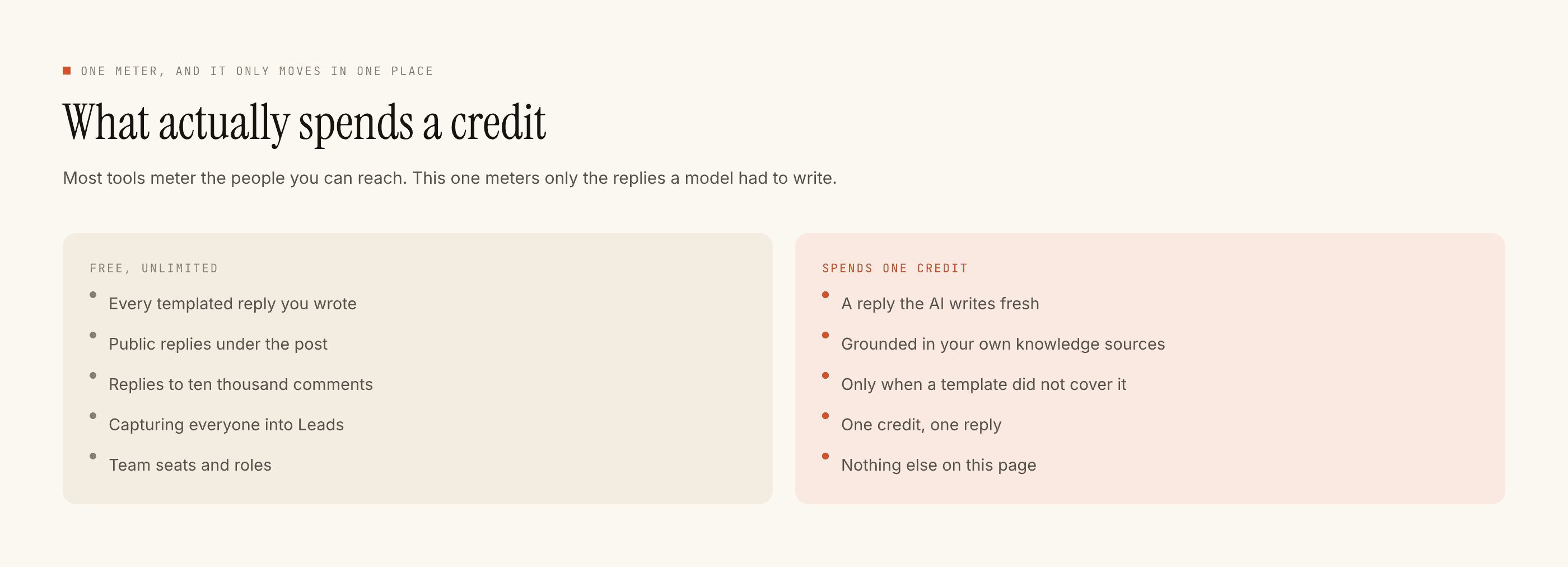
Where each shape hurts
Neither is a trick. They break in different places, and which one breaks for you is knowable in an afternoon.
A per-person meter is comfortable when your audience is stable and buys reliably, because you are paying for a roughly fixed number of humans. It gets uncomfortable the month a Reel travels, because a wave of one-question commenters is a wave of billable contacts whether or not any of them was ever going to buy.
A per-reply meter is comfortable when your inbox repeats itself, because repetition is exactly what a template absorbs for free. It gets uncomfortable when every single reply genuinely needs composing from scratch.
Neither of us can change the platform
Both products sit on the official Instagram API, so both live in the same box. You can reply to a DM within 24 hours of that person's last message and to a comment within 7 days. Nobody sells an exemption from that, and a tool implying otherwise is not describing the official API. We wrote out the whole shape of it in is Instagram DM automation safe.
What differs inside the box is what a tool refuses to do. Ours runs ten checks in a fixed order before anything sends — kill switch, connection, takeover, window, dedupe, cooldown, quiet hours, rate budget, credits, content safety — and the first failure stops the send with its reason recorded in Activity, so a reply that did not go out is something you can read rather than a mystery. Out of credits is a refusal like any other, and the fallback is your own template rather than silence.
Decide it in a fortnight, not in a spreadsheet
- 01
Leave ManyChat running
You are adding a second opinion on one surface, not migrating a system you still depend on.
- 02
Give us one surface only
Comments on Reels, or story replies. One trigger, so nobody gets two answers and so you can read every reply we produced.
- 03
Paste in your four most common answers
Templated sends cost nothing, so this covers the bulk of your volume at no running cost and gives the AI fallback something to fall back to.
- 04
Read twenty replies end to end
Would you have sent those? No dashboard answers that question, and it decides the whole thing.
- 05
Then price it
Count how many of those twenty needed a model at all. That count, not your follower number, is what we would have cost you.
If the answer is that you need channels we do not have, this was a short conversation and ManyChat wins it. If you only ever used the Instagram half, the arithmetic is in why the ManyChat bill grows and the longer head-to-head is PostEngage vs ManyChat.
Otherwise: the free tier is 100 credits and no card, Chatfuel is the other comparison worth reading first, and how we source every claim on pages like this one is set out in our methodology.