We make one of these two products, so read this the way you would read any comparison written by an interested party. What we can do is put the concessions first and source every claim about the other side to a page you can open yourself.
ReplyRush is an Instagram and Facebook DM automation tool. We read its homepage and its pricing page on 21 October 2026. Both describe a product built around comment-to-DM. Most of what it does overlaps with what we do, and a few things go further than ours.
Start with the part where we lose
On their pricing page, not on ours
What we do instead
Their pricing page also lists an email collector, SendBack for comments that missed the first DM, an excess DM queue, global triggers you reuse across posts, and automation set up on posts before they go live, and it has iOS and Android apps. If a follow gate is how your lead magnets work, or your Facebook Page gets as many comments as your Instagram, ReplyRush does something we do not, and you can stop reading here.
The meter is the actual difference
Both pricing pages sell a monthly plan. They meter different things.
ReplyRush's, checked on 21 October 2026, meters DMs. Free is $0 for 1,500 DMs a month. Lite is $10 a month for 7,500, Boost is $25 for 40,000 and Max is $100 for 400,000, each listed as a "Total DM Limit (per month)". Accounts step up with the plan: one Instagram and one Facebook account on Free and Lite, three of each on Boost, five of each on Max. Removing their branding from your DMs starts at Boost. The page shows monthly prices only, with no annual price and no trial listed. Their homepage gives slightly different numbers for some of this, describing up to three Instagram accounts and up to 150,000 DMs per account each month. We used the pricing page throughout.
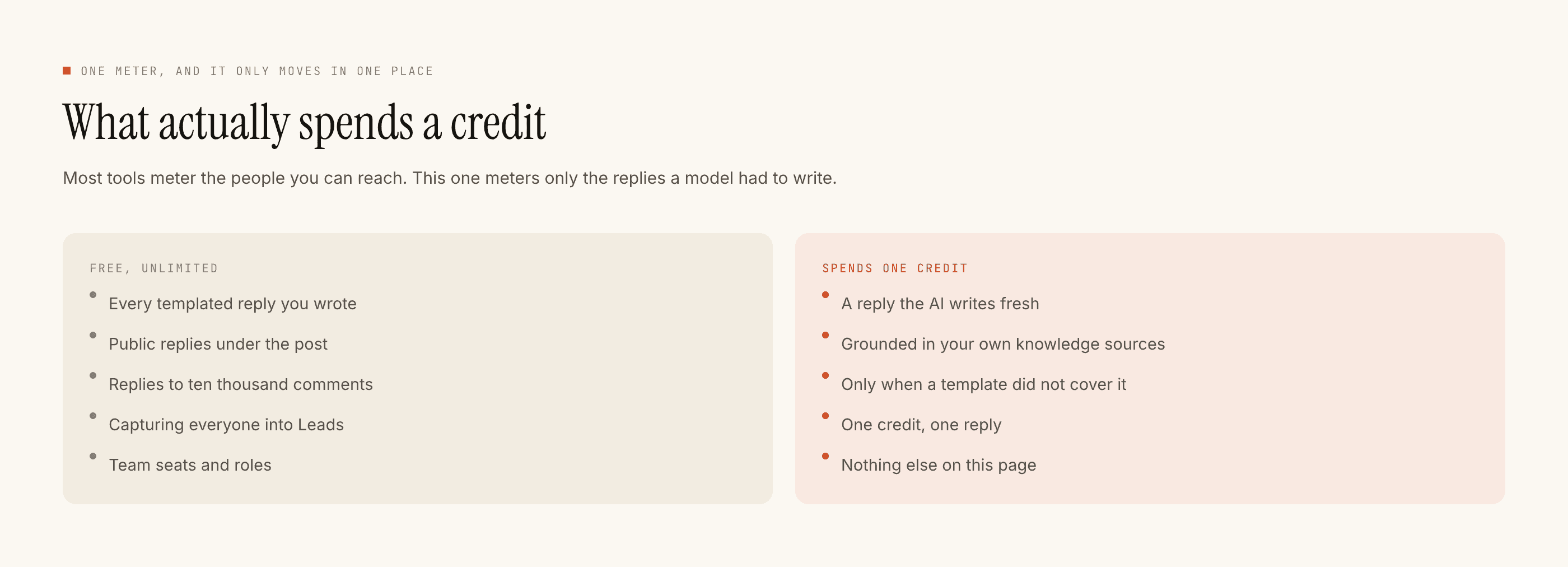
Ours meters AI replies. One credit is one AI-written reply. A comment reply costs nothing on any plan, templated or AI, however many people it reaches. DMs on Free are capped at 1,000 every 30 days, templated or AI, and Lite removes that cap for $4 a month. The free tier includes 100 credits with no card. Packs are $3.99 for 1,000 credits, $14.99 for 4,500 and $39.99 for 12,000, and they never expire. The full table is on our pricing page.
One meter counts the DMs you sent. The other counts the replies a model had to write.
Where each shape hurts
Neither is a trick. They break in different places.
A DM bucket is easy to plan when your volume is steady. You know roughly how many people comment "link" on a normal Reel, and you buy the plan that holds them. It gets uncomfortable the week a Reel travels. Everyone who comments still counts against the month, and the step from 7,500 to 40,000 DMs is the step from $10 to $25.
A per-reply meter is easy when your replies repeat, because a repeated reply is a template and a template is free. It gets uncomfortable when every DM needs composing from scratch. Lite includes no monthly AI credits, so a busy AI inbox on Lite runs on packs. Creator at $12 a month includes 3,000 AI replies.
Here is a worked example using both pricing pages. Say a Reel brings 5,000 comments asking for a link, and you answer each one with the same templated DM. On ReplyRush that fits inside Lite's 7,500, so it costs $10 for the month. On our side, 5,000 DMs is past Free's 1,000 cap, so you need Lite at $4. A templated DM spends no credit, so that is the whole bill. Now say the next Reel brings 20,000 comments. ReplyRush moves you to Boost at $25. We stay at $4, because the DMs are still templated.
Now change one assumption. If you want every one of those 20,000 DMs written fresh by AI, our side costs well over $25, because each one spends a credit. That is the trade: you can use templates as much as you like, and AI writing is metered.
Neither of us can change the platform
ReplyRush says it runs on Meta's official Instagram and Facebook APIs, and so do we. That means both tools follow the same rules. A DM can go out within 24 hours of that person's last message. A private reply to a comment is one message, sent within 7 days of the comment. No tool on the official API gets an exception, and we set out the details in is Instagram DM automation safe.
Where tools differ is in what they refuse to send. Ours runs sixteen checks in a fixed order before anything goes out: kill switch, connection, takeover, auto-reply switch, complaint pause, messaging window, dedupe, burst, bot loop, cooldown, quiet hours, account rate limit, Instagram rate budget, Free DM cap, credits and content safety. The first one that fails stops the send and records why in Activity. ReplyRush's FAQ says it follows rate limits and manages pacing to keep accounts within safe sending limits. Its pricing page does not describe a list of checks, so we have not compared the two.
Decide it in a fortnight
- 01
Keep ReplyRush on what it already handles
You are adding a second tool on one surface, not moving everything at once.
- 02
Give us one surface
Comments on new Reels, say. One trigger per tool, so nobody gets two DMs.
- 03
Paste in your most common answers
Templated replies cost no credit, so they cover the bulk of your volume and give the AI something to fall back on.
- 04
Read twenty replies end to end
Would you have sent them? That question decides more than any pricing table.
- 05
Then price it
Count how many of those twenty needed AI at all. That count, not your DM total, is what we would cost you.
If the answer is a follow gate or Facebook, ReplyRush wins this one. If you came here looking for something cheaper than ManyChat and want the full picture first, read what to check in a ManyChat alternative and PostEngage vs ManyChat. How we source every claim on pages like this one is in our methodology.