Comparison · 5 min read
PostEngage vs ManyChat in 2026: An Honest Head to Head
There is no neutral way to write this page. We make one of the two products. What we can do is put the concessions near the top instead of burying them, because a comparison that admits nothing is just an advert with a table in it.
ManyChat is a genuinely capable product. It is a Meta partner on the official API, it has been in this category far longer than we have, and it does several things we do not do at all.
Start with what we lose at
ManyChat does this, we do not
What we do instead
If WhatsApp carries revenue for you, this comparison is over. We do not do WhatsApp and it is not on the roadmap. Same if your automation has to hand off into a CRM and a store platform and an ad tool, or if you want a branching canvas you can point at in a meeting. Those are real needs and a bigger product serves them better.
Feature count is a legitimate way to choose software. We are not going to argue you out of it.
What we actually built for
One problem, narrowly: replies that sound like the person whose account it is, and a tool with the judgement to send nothing when it is not sure.
The voice profile is built from replies you wrote yourself. Not a tone dropdown, not three adjectives. Actual messages you sent, which is where phrasing habits live. If a draft is not grounded in those words, or the model is unsure, or it is slow, your own template goes out instead.
That last sentence is the design. The generated reply is the upgrade. Your template is the floor, and the floor is what ships when anything is off.
The interesting part of an automation is not what it sends. It is what it decides not to send.
The ten checks, in order, before anything sends
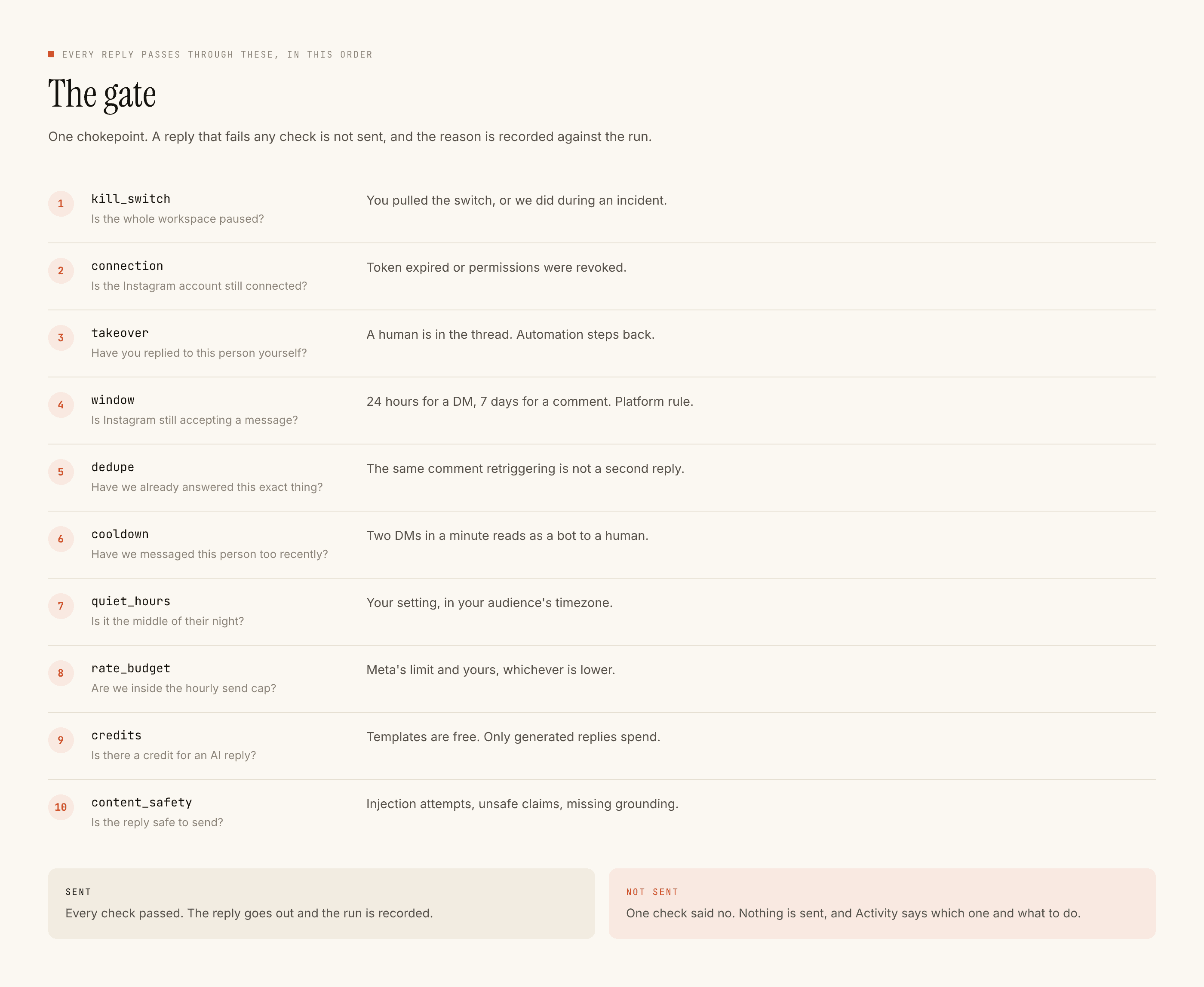
Every send runs the same sequence. First failure stops it and the reason is recorded, so a skipped reply is something you can go and read rather than a mystery.
| # | Check | Stops the send when |
|---|---|---|
| 1 | kill_switch | You have turned automation off |
| 2 | connection | The Instagram connection is not healthy |
| 3 | takeover | A human has replied in this thread |
| 4 | window | Outside 24h for DMs or 7 days for comments |
| 5 | dedupe | This person already got a reply for this trigger |
| 6 | cooldown | Too soon since the last reply to them |
| 7 | quiet_hours | Local time you said not to send |
| 8 | rate_budget | Too many sends this hour |
| 9 | credits | No credits, so the template goes instead |
| 10 | content_safety | The draft should not go out as written |
The order matters. Cheap and absolute checks come first, so a kill switch does not wait behind a model call. Takeover sits high because a human already handling a thread should end the automation immediately, not after the reply is drafted.
The pricing shapes are genuinely different
We are not going to state ManyChat's current price. Vendors change them and a stale figure is worse than none. The shape is the stable part and the shape is what bites.
This category has historically metered contacts: distinct people your automation has ever spoken to. That number only climbs. Someone who asked one question in March is still on December's invoice, and a Reel that travels permanently raises your floor.
We meter work performed. Templated replies are unlimited and free. Credits come out only when the model writes something new. Free tier is 100 credits with no card, and packs start at ₹499.
The viral post is where the difference shows
Both tools handle a normal Tuesday. The interesting test is the post that does twenty times your usual numbers.
On any per-contact meter, that post permanently raises the bill, because every one of those commenters is now a contact forever. On ours it is mostly free, because a viral post is overwhelmingly the same four questions repeated, and repeated questions hit templates.
The other half is behaviour. Nine hundred comments in three hours is when dedupe, cooldown and the hourly rate budget earn their place, and when you want the kill switch to be one click. Test that deliberately in whatever tool you pick: comment twice from a second account, comment at midnight, and reply by hand mid-thread to see whether the automation notices and stops.
Neither of us can change the platform rules
How to decide in a fortnight
Do not migrate to find out. Run both.
- 01
Leave your existing setup running
You are adding a second opinion, not replacing something you still depend on.
- 02
Point us at one account and one surface
Comments on Reels, or DMs from story replies. One surface, so you can read every reply produced.
- 03
Paste in your four most common answers
Templated sends are free, so this covers most volume at no running cost and gives the fallback something to fall back to.
- 04
Read twenty replies
Would you have sent those? No dashboard metric answers that, and it is the whole decision.
- 05
Then look at the arithmetic
Cheap replies you would not have sent are not a saving.
If the answer is that you need channels we do not have, stay on ManyChat with a clear conscience. If you only ever used the Instagram half, the wider survey of alternatives covers the rest of the field, and the cost arithmetic covers the meter.