Three quite different problems bring people to this search, and the fix is different for each one.
The first is a pricing shape that stopped being predictable — a bill that moves with how far a post travelled rather than with how much work you did. The second is paying for a suite when you only ever use the Instagram corner of it. The third is wanting replies that read like a person wrote them rather than like a decision tree ended.
Only the first two are solved by changing tools. The third is solved by writing better templates, in any tool, and it is worth trying that before a migration.
What you would be giving up
This is the part an alternatives page usually buries, so it goes near the top. ManyChat does several things we do not do, have not built, and are not building:
- WhatsApp, Messenger and Telegram. We are Instagram only.
- A visual flow-builder canvas. Ours is a form, not a diagram.
- Broadcasts. No sending to a list.
- Multi-step nurture sequences. Not a gap — the Instagram messaging window is 24 hours from that person's last message to you, so a message scheduled for day three has nowhere to go.
If any one of those is load-bearing in how you actually work, stop here. You would be trading a working system for a smaller one, and no amount of pricing argument makes that a good trade. The roadmap says plainly which of these are decisions rather than things we have not got to yet.
The six questions worth asking any replacement
Not just us. Ask these of every tool on your shortlist, including the one you are already paying for.
- Which API is it on? If the answer involves your Instagram password rather than a Meta authorisation, nothing else on the list matters.
- What is metered? Contacts, subscribers, conversations, or replies. This single answer determines whether a good week is an expensive week.
- What happens when a messaging window closes? A tool that lets you schedule into a closed window is a tool that will fail silently.
- What happens when a send is refused? A red dot is not a diagnosis. You want the name of the rule that stopped it and a sentence about what would change it.
- What happens when you reply by hand? Automation should stand down in that thread, structurally, not because you remembered to switch something off.
- What leaves with you? If the leads cannot be exported, they are not yours in any way that survives cancelling.
What we actually are
An Instagram comment and DM autoresponder on the official Graph API, and not much more than that by design.
An automation here is a form: a trigger post and its keywords, negative keywords, the public reply, the private reply, capture-to-Leads, and three advanced settings. There are two buttons — Test on myself and Go live — and a Try It panel where you type a message yourself and see whether the rule would fire, on which keyword, and exactly what would go out.
On metering: a templated reply you wrote is free and unlimited, forever. A credit is spent only when the AI writes something new for a specific message, one credit for one reply. Nothing is counted per contact, per follower or per conversation. The free tier is 100 credits with no card, and the credits page is the exact accounting.
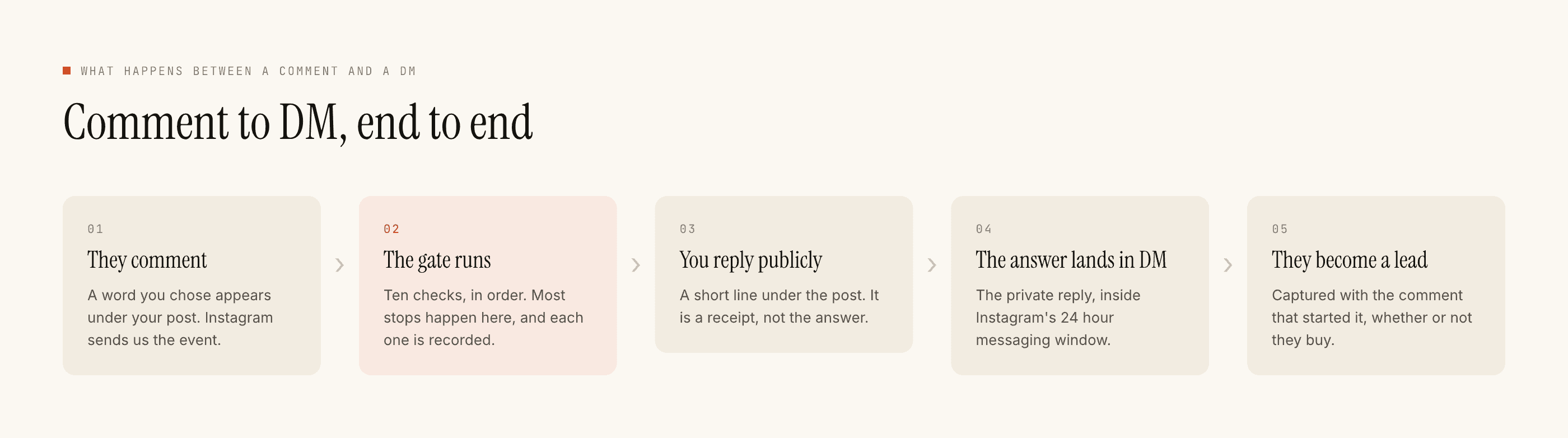
Ten checks run before every send, in a fixed order, and the one that refused a reply is recorded by name with the reason. Takeover is one of those ten, which is what makes "the automation stops when I answer" a structural fact rather than a setting you have to trust.
A smaller tool is only the better buy when the parts it dropped are parts you were not using.
If you decide to move
Do not rebuild everything. That is the failure mode of every migration in this category — a week spent recreating flows that fired four times last year.
Open your current tool and sort by volume. Take the top two. Rebuild those as rules, run Test on myself until the tone is right, put them live on new posts only, and leave the old system running on the old ones. After a week, read the blocked list. If it is boring, move the third rule. If it is not, you have found something worth knowing before you cut over.
Where to read the rest
The comparisons put us beside ManyChat and ten others, each with the date its claims were checked and a plain sentence about who the other product is genuinely better for. The alternatives guide is the longer version of the six questions above, written as a shortlist rather than as a landing page.
If you have already decided and want to build the first rule, start here. And if the thing that actually bothers you is bot-sounding replies rather than billing, what changes when the AI writes them is a more useful page than this one.