
The honest answer is that it depends on one thing: how the tool talks to Instagram. There are two ways, they carry completely different risk, and most comparison articles treat them as the same product category.
The two kinds, and why only one is safe
Official API automation goes through Meta's Instagram Messaging API. You connect your account once through Meta's own consent screen, Meta issues the tool a token scoped to specific permissions, and every reply is a request Meta receives, validates and logs. Meta knows the tool exists. It approved it.
Unauthorized automation does not have a token. It signs in as you, either with your password or by borrowing the session cookie from your browser, and then drives the Instagram app the way a very fast person would. Some of these tools are honest about it. Most describe it as "no Facebook Page needed" or "works with personal accounts", which is the same sentence in marketing language.
Signs in as you
Official Meta API
Meta's Platform Terms prohibit the second category outright. That is not a technicality that goes unenforced. Automated login patterns are one of the easiest things in the world to detect: the request timing is too regular, the device fingerprint does not match your phone, and the IP belongs to a data centre in a country you have never posted from.
What actually happens when you get caught
It is rarely a dramatic ban. It is a staircase, and most people only notice they are on it near the top.
- 01
Silent rate limiting
Messages take longer to deliver, or stop landing in the primary inbox. Nothing tells you this is happening.
- 02
An action block
"Try again later" whenever you send a DM. Usually 24 to 48 hours, and it returns faster the second time.
- 03
A feature block
DMs are disabled while the rest of the account works normally. This is the one that hurts a business — posts still get comments and you cannot answer them.
- 04
Restriction or removal
Rare. Not rare enough to gamble a business on.
The staircase matters because the early steps look like Instagram being slow. Plenty of people escalate their automation at exactly the moment they should stop.
What the official API actually lets you do
Enough for almost every real use case:
- Reply to comments on your own posts and Reels, publicly or by moving the conversation to a DM.
- Reply to a direct message within 24 hours of the person's most recent message to you.
- Reply to story replies and story mentions.
- Send a follow-up outside the 24 hour window if a human agent is handling the thread, for up to 7 days.
What it does not let you do is the thing unauthorized tools are usually sold for: messaging people who have never messaged you. Cold DM blasts to a scraped follower list are not a permission you can apply for. They are the reason the enforcement exists.
The API is a licence to send. It is not a promise that sending is a good idea.
Compliant tools still get accounts in trouble
This is the part that gets skipped. Using the official API removes the platform risk. It does not remove the reputation risk, and Instagram counts reputation signals too.
If a tool sends the same 40-word message to everyone who comments, people report it as spam. Enough spam reports and Meta reduces your delivery regardless of how you authenticated. The API is a licence to send, not a promise that sending is a good idea.
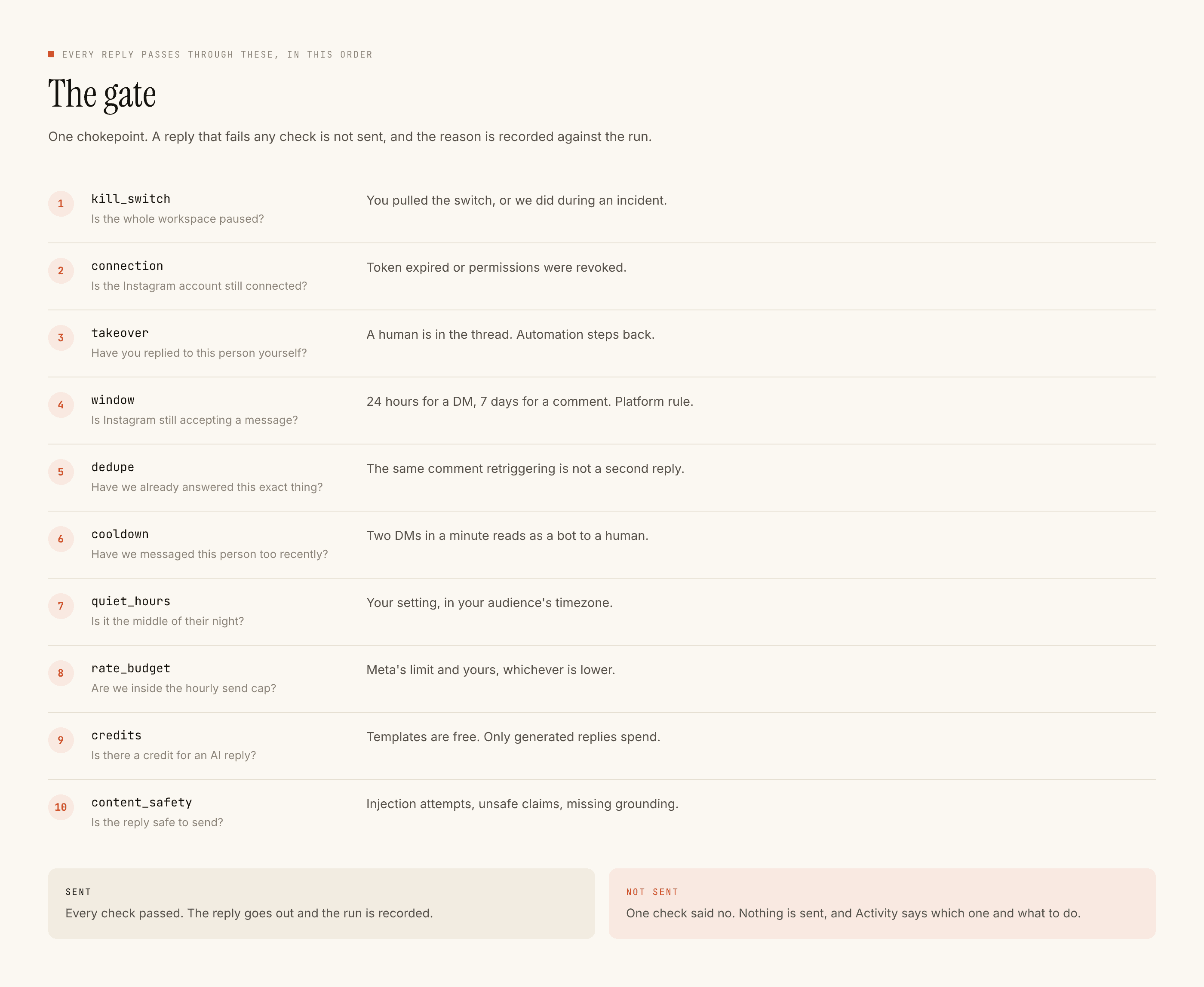
The checks worth having, whatever tool you use: never reply twice to the same person for the same trigger, never reply to your own team's comments, stop replying to a thread the moment a human joins it, and cap how many replies can go out in an hour so a viral post cannot turn into a thousand identical messages.
What those checks actually catch, on a live system
Every vendor in this category describes safety and none of them publish what their own safeguards stopped. Here are ninety days from this product's database, in full, including the parts that are unflattering.
| Outcome | Count | What it means |
|---|---|---|
| Delivered | 2,926 | passed all ten checks and sent |
| Cooldown | 35 | this person had already heard from us too recently |
| Rate budget | 19 | the hourly ceiling, kept below Meta’s on purpose |
| Duplicate | 9 | the same event arrived twice and the second was dropped |
| Burst | 5 | too many sends bunched into too short a span |
| Platform rejected | 23 | Meta refused it — usually a closed window |
| Send failed | 16 | our problem, recorded rather than hidden |
Read the ratio rather than the totals. Sixty-eight sends were stopped by a policy check against 2,926 delivered — about 2.3%. That is the number a working safeguard produces on an account behaving normally.
If you ask a vendor for this figure and it comes back as zero, that is not a safer product. It is a product that is not checking. And if it comes back at thirty percent, something upstream is misconfigured and they should be able to say what.
The two most-fired checks are worth naming because they are the two most people do not think to ask for. Cooldown is what stops a keen customer being answered five times in an evening. Duplicate exists because Instagram genuinely redelivers the same webhook — nine times in three months here — and a tool without it sends that person a second copy.
How to tell which kind you are looking at
Thirty seconds, three questions.
Does it ask for your Instagram password? Official API tools never see it. You authorise through Meta and come back with a token. If a signup form has a password field next to your handle, close the tab.
Does it need a browser extension or a phone that stays online? Both are ways of borrowing your logged-in session. A server-to-server integration needs neither.
Does it work without a professional account and a linked Facebook Page? The Instagram Messaging API requires both. A tool advertising that you can skip them is telling you it is not using the API.
The short version
Automation on the official Meta API is safe in the sense that matters: Meta knows about it and has approved it, and no amount of volume turns it into a terms violation. Automation that signs in as you is a loan against your account, and the interest is charged in feature blocks at the worst possible time.
Pick the compliant one, then spend your attention on the harder question, which is whether the replies are any good.
Questions people ask
Can Instagram automation get my account banned?
Not automation through the official Meta API, which Meta knows about and approved. What gets accounts restricted is tools that sign in as you through a password, a browser extension or a borrowed session — plus spam reports from real people, which count against you no matter how you authenticated.
How do I tell a compliant tool from a risky one in thirty seconds?
Three questions. Does the signup ask for your Instagram password? Official API tools never see it. Does it need a browser extension or a phone that stays logged in? Both borrow your session. Does it claim to work without a professional account and a linked Facebook Page? The Instagram Messaging API requires both, so a tool that skips them is not using it.
Does sending a lot of automated replies increase the risk?
On the official API, volume alone is not a terms violation. What matters is whether the replies look like a person keeping up or a machine broadcasting: identical text at inhuman speed collects spam reports, and Meta reduces delivery on reputation signals regardless of how you authenticated.
What percentage of replies should a safe tool refuse to send?
On this system it is about 2.3% over ninety days — 68 sends stopped by policy checks against 2,926 delivered. A vendor reporting zero is not being careful, it is not checking. One reporting thirty percent has something misconfigured and should be able to tell you what.
Does Instagram really send the same event twice?
Yes. Nine duplicate deliveries in three months on this account set. A tool without a dedupe check sends that person a second copy of the same reply, which is exactly the behaviour that gets reported as spam.
What happens if I reply by hand while an automation is running?
A well-built tool stands down for that thread the moment a human joins it. Ask any vendor whether they do this and what it is called; if there is no answer, the automation will talk over you in front of a customer.