Of the eleven products we compare ourselves to, SetSmart has the meter closest to ours. Their pricing page, checked on 26 August 2026, opens with the line that every feature is included on every plan and the only difference is how many AI messages you need each month. That is the same conviction our pricing rests on: the expensive part is the model writing, not the person receiving.
Then the two products diverge, hard, on what they are for.
Their shape, from their page
SetSmart describes itself as an AI DM setter for coaches, consultants and agencies, automating lead qualification and appointment booking. Their published tiers on that date: Light at $25 a month including 250 AI messages with a hard cap and no top-up; Pro at $97 with 1,000 included and extra thousands at $100; Scale at $297 with 4,000 included and extras at $70; Enterprise at $797 with 15,000 included and extras at $40. Automatic top-ups add a pack at the plan rate when you run out, with a spend cap you set or turn off entirely.
Their feature table lists WhatsApp, Instagram DMs and Messenger on every plan; booking integrations for Calendly, Cal.com, GoHighLevel and iClosed; DM keyword triggers, comment auto-reply, story reply automation and broadcast campaigns; Shopify, API access and an MCP connector; and a unified inbox with contacts, tags and an analytics dashboard. On counting, their page states each AI reply is one message and that WhatsApp templates and mini-AI replies count as half.
Ours, and the one number that differs
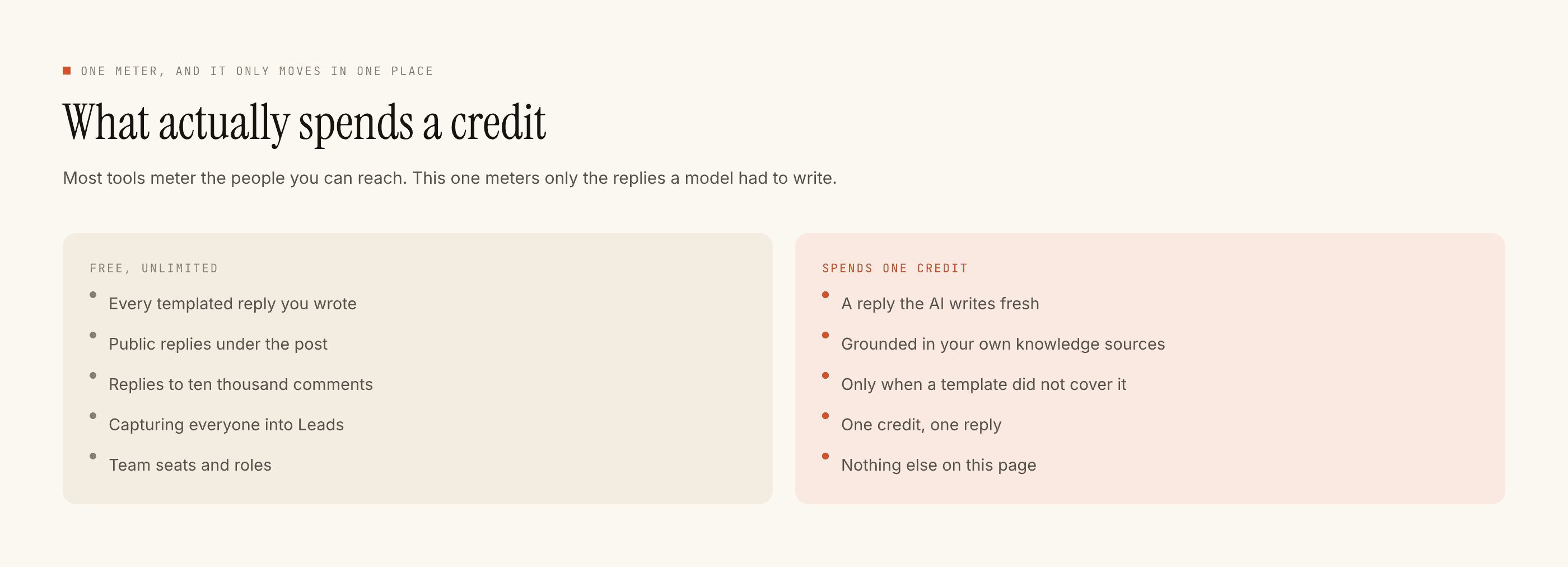
One credit is one AI-written reply. A reply sent from a template you wrote costs nothing at all — not half, nothing — because no model was involved. Nothing is metered per contact or per follower, and there is no monthly plan to sit on top.
Free tier: 100 credits, no card. Packs: ₹499 for 500 credits, ₹1,699 for 2,000, ₹4,499 for 6,000, or $6.99, $22.99 and $59.99.
Both products decided the AI is the expensive part. We just disagree about what a template costs, and about what should happen when the meter runs out.
The job each one is doing
This is where a feature table stops being useful and the question becomes what outcome you are buying.
SetSmart's stated outcome is a booked call. Qualification, follow-ups, a calendar connection, a broadcast when you want to fill a week, an analytics dashboard to see whether it worked. For a coach or an agency whose entire funnel ends in a discovery call, that is a coherent product and every part of it earns its place.
Our outcome is narrower: the person who asked a question gets a correct answer quickly, in your words, and lands in a Leads list you can export. No calendar. No qualification scoring. No follow-up sequence — Instagram's windows mean we answer inside 24 hours of a DM and 7 days of a comment, and we do not chase people afterwards. No broadcast. No dashboard.
What we spent the narrowness on
Ten checks run in a fixed order before anything sends: kill switch, connection, takeover, window, dedupe, cooldown, quiet hours, rate budget, credits, content safety. The first failure ends the attempt and writes its reason into Activity, so a quiet automation is diagnosable instead of mysterious. Takeover sits third, so the moment you join a thread by hand the automation stands down.
Drafts are grounded in replies you actually wrote. When a draft is not grounded in those words, or the model is slow or unsure, your template goes out instead. The generated reply is the upgrade; the template is the floor, and the floor ships whenever anything is off.
A note on the half-message rule
Their page's counting rule is worth reading closely because it is unusually explicit and it tells you what kind of account the pricing was designed for. Templates and mini-AI replies counting as half means a high-volume, template-heavy operation gets a discount rather than an exemption — sensible, if some of your channels are WhatsApp, where a template send has a real cost behind it that somebody has to pay.
We have no WhatsApp, so we have no such cost, which is why a templated reply on our side is free rather than half. That is not a virtue; it is a consequence of a smaller product. If you ever do need WhatsApp, the free-template argument stops applying and a tool built for three channels is the one to buy. We wrote about the difference in WhatsApp versus Instagram automation.
Deciding
One question does it. Does your Instagram inbox end in a calendar, or in an answer?
If it ends in a calendar, SetSmart is built for that shape and this page has done its job. If it ends in an answer — a price, a shipping time, a link, a "yes we do that" — start on 100 credits with no card and see whether four templates cover most of a fortnight. Getting started walks the setup, keyword triggers is the part people get wrong first, and every tool we are asked about is compared with the date it was last read. How we source these claims is in our methodology.