Two products that overlap more than most pairs on this site. Both answer Instagram comments with a DM, both run on Meta's official API, and both are small enough that a person can set one up in an afternoon. The interesting difference is what each company decided to charge for.
Their pricing, from their page
Their pricing page, checked on 26 August 2026, lists two plans. Legend Pro at $9.99 a month covers unlimited contacts, DM automation, email collection inside the DM, custom questions and email support, with automation volume noted as unlimited at 750 an hour. Trendsetter at $24.99 a month adds an advanced account-safety mode, advanced dashboards, follow-up messages, a viral-mode handler, WhatsApp support alongside email, and API access covering webhooks and send message or comment. A seven-day free trial is offered with no card required.
Their feature table on that date also lists a follow gate, unlimited custom trigger words and flows, AI comment reply, audience city analytics, and a set of pacing features — smart slowdown, auto overload handling, smart DM failure handling — described as keeping sends inside Instagram's rate limits. Their pricing page states the product runs entirely on Instagram's official API as a Meta Business Partner, with no browser bots and no password.
Ours, for contrast
There is no monthly plan. One credit is one AI-written reply. A reply sent from a template you wrote is free and unlimited, however many people it goes to, because a repeated question does not need a model. Nothing is metered per contact, per follower or per conversation.
Free tier: 100 credits, no card. Packs: ₹499 for 500 credits, ₹1,699 for 2,000, ₹4,499 for 6,000, or $6.99, $22.99 and $59.99.
A flat monthly plan
A per-reply meter
Ask which sentence you would rather say: “it is nine dollars a month whatever happens”, or “it cost nothing this month because nothing needed writing”.
The comparison people actually mean
Most people choosing between two tools this similar are not comparing feature tables. They are asking which one they will trust with an account they cannot afford to have embarrass them.
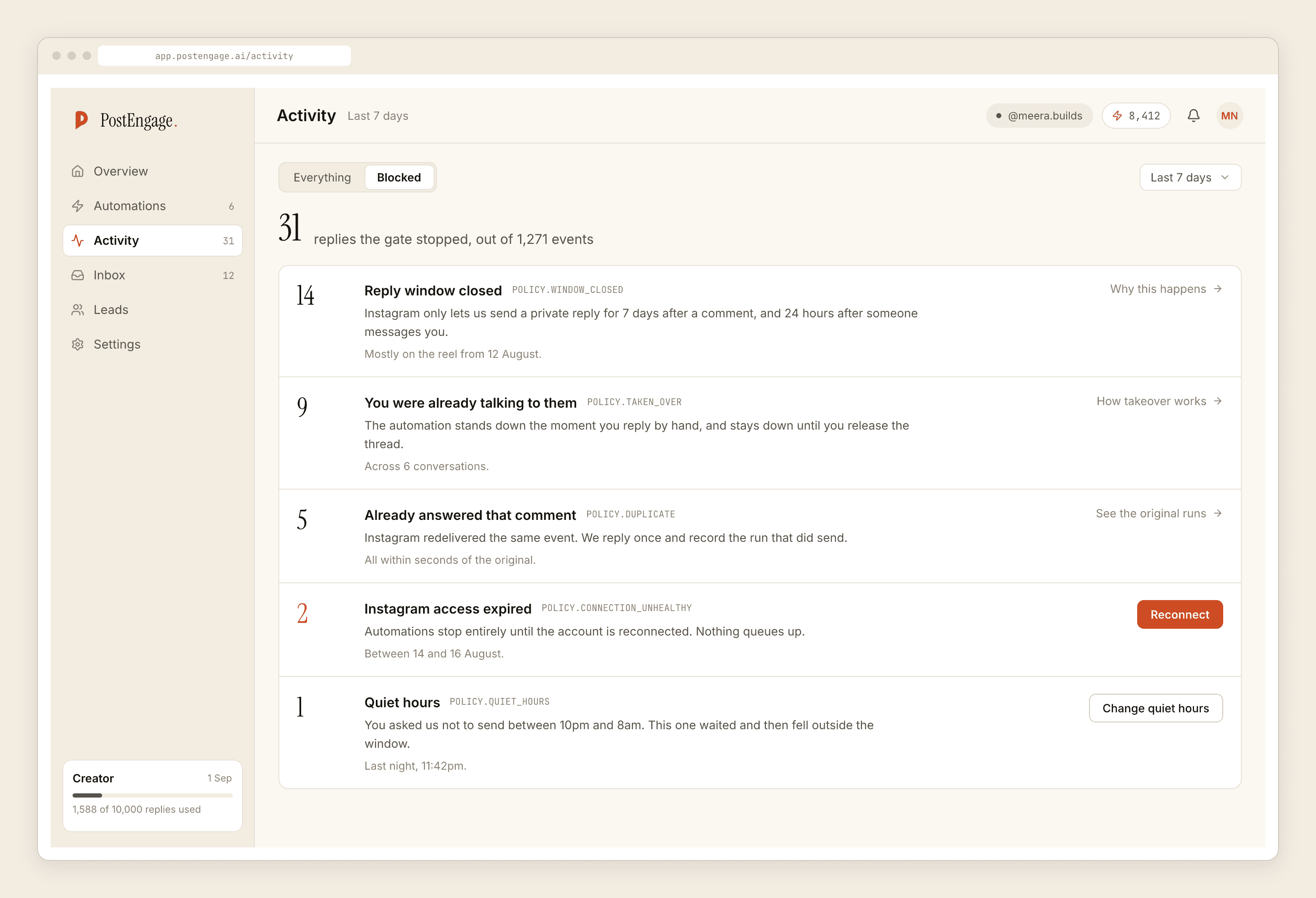
That question is answered by what a tool does in the awkward moment, not the happy one. Ours runs ten checks in a fixed order before every send: kill switch, connection, takeover, window, dedupe, cooldown, quiet hours, rate budget, credits, content safety. The first failure ends the attempt and writes its reason into Activity, so a reply that never went out is a line you can read rather than something you notice a week later. Takeover sits third on purpose — reply to a thread by hand and the automation stands down immediately rather than finishing its draft first.
Test both the same way
- 01
One post, one keyword, both tools
Do not point both at the same trigger or the same person will get two answers. Give each tool its own post for a week.
- 02
Comment twice from a second account
Dedupe should catch the second one. If a tool sends two identical DMs to the same person, you have learned something important cheaply.
- 03
Comment at midnight
Quiet hours are a promise about your brand, not a nicety. Check the reply waited.
- 04
Reply by hand mid-thread
The automation should notice and stop. This is the check most people never run and most regret not running.
- 05
Read twenty replies
Would you have sent those? That is the whole decision, and no dashboard answers it.
The clock neither of us controls
Both products work through the official Instagram API, so both live inside the same two windows: a comment can be answered for 7 days, a DM for 24 hours after that person's last message. Cold messaging people who never contacted you is not a permission any vendor on the official API holds.
That matters when you read pacing features on either side. Rate handling — ours is the rate budget, theirs is described as smart slowdown and overload handling — is not a way around a limit. It is a way of staying inside one gracefully when a post travels and the queue is suddenly nine hundred long. Worth testing on purpose rather than discovering live, and the shape of it is set out in is Instagram DM automation safe.
Where each of us lands
If Facebook Page comments and Messenger matter, if a follow gate is how your lead magnets work, or if you want webhooks and an API to build on, InstantDM lists all three and we list none of them. That is a real answer and it should win where it applies.
If your Instagram inbox is mostly the same handful of questions and you would rather not carry another monthly subscription for it, our templated tier handles that volume for nothing and credits cover the rest. Start with 100 credits and no card, test it on yourself first, and read what the free tier actually gets you before you assume it is a trial in disguise.
For the wider field, every tool we are asked about is listed with the date each was last read, and our methodology explains what we will and will not say about a competitor.