Two Indian products, both on Instagram, both billing in rupees. Everything about the other side here comes from DMGO's own pricing page, checked on 24 September 2026.
The line that makes their pricing unusual
Most tools in this category charge a month and stop. DMGO's pricing page lists a second number on every tier: a platform fee on sales. 30 per cent on the free Starter plan, 20 per cent on Growth at ₹249 a month, 5 per cent on Pro at ₹499, and none at all on Elite at ₹1,249. The same page shows unlimited DMs and comment replies from Growth upward, one Instagram account on the lower plans, three on Pro and ten on Elite, and states that every plan runs on the official Meta API.
That is a coherent model: the cheaper the plan, the larger the share of a sale. It also means the price of the tool depends on how much you sell through it, which is a different question from how much you reply.
What we charge, which has no percentage in it
One credit is one reply written by the model. A reply sent from a template you wrote is free and unlimited, however many people receive it. The free tier is 100 credits with no card, and packs start at ₹499. There is no checkout here, no product hosting and no payout, so no share of a sale is possible in either direction — we never see the money.
| DMGO | PostEngage | |
|---|---|---|
| Monthly | ₹0 to ₹1,249, per their pricing page | None. Packs from ₹499, or a plan |
| Share of a sale | 30% to 0% by plan, per their page | None — we are not in the payment path |
| Sending volume | Unlimited from Growth, per their page | Templated replies unlimited and free |
| AI-written reply | Not priced separately on their page | One credit each |
| Instagram accounts | One to ten by plan, per their page | One on free, more on paid plans |
A percentage grows when you succeed. A credit grows only when a model had to write something.
The part neither price list explains
Both tools will send a DM in about a second. The interesting second is the one before, when something is slightly wrong: the person already got this reply, or a human is mid-conversation with them, or it is 2am, or Instagram's window has shut.
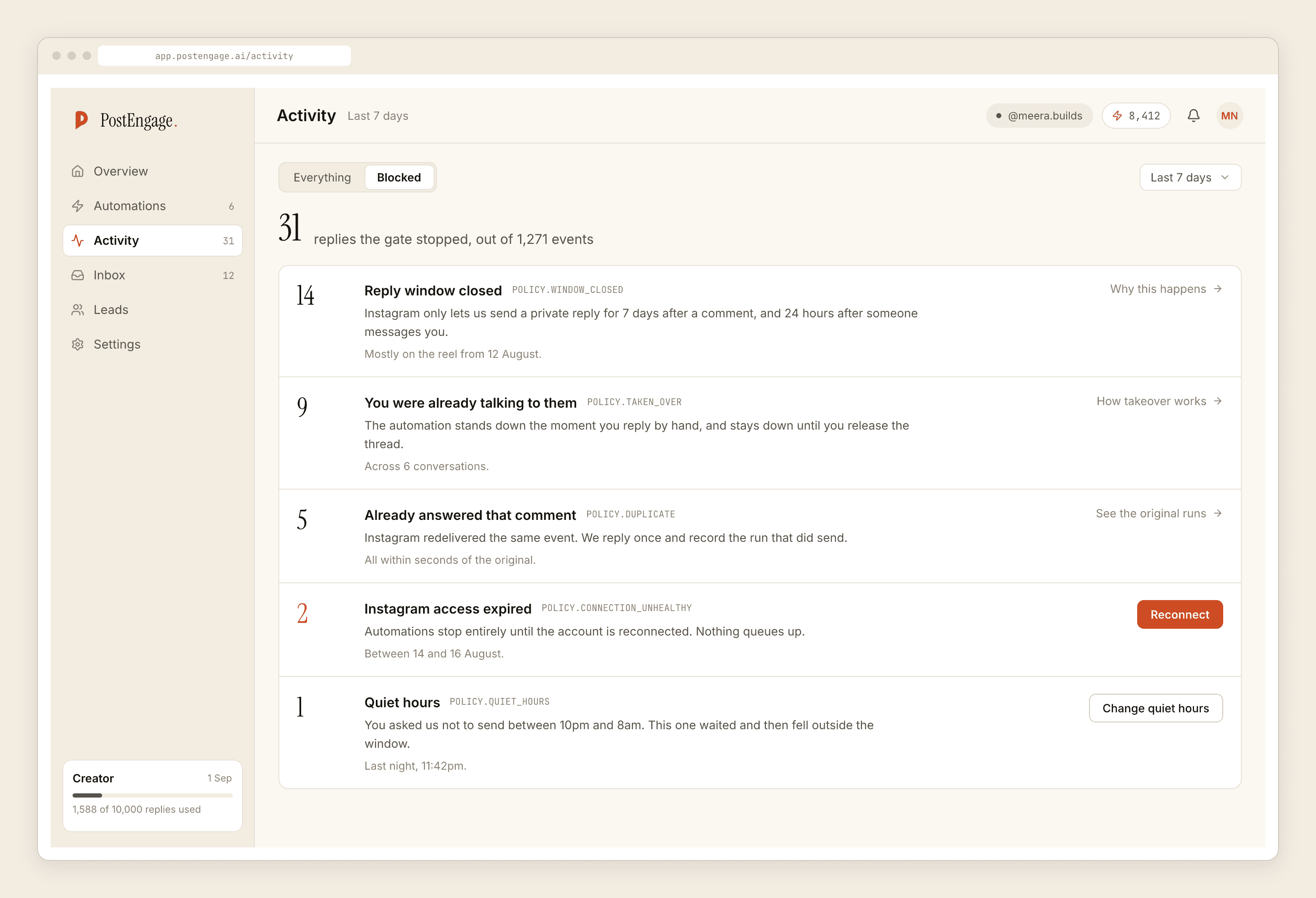
Here, ten checks run in a fixed order before every send — kill switch, connection, takeover, window, dedupe, cooldown, quiet hours, rate budget, credits, content safety. The first failure stops the send and records the reason, so a reply that did not go out is a line you can read. Takeover is the one creators notice: the moment you answer somebody by hand, the automation stands down on that thread.
Setting it up, screen by screen
- 01
Connect Instagram
Three permissions — read comments, reply to them, send the DM you wrote. Meta runs the login, so no password reaches us, and you can disconnect from the same screen.
- 02
Write the trigger
Any post, a specific post or your next post. Then the words people actually type, Hinglish included, plus a negative keyword such as "not interested" to hold the reply back.
- 03
Write the two replies
The public reply that keeps the post moving, and the private reply that carries the link. Both are templates, so both cost nothing however often they fire.
- 04
Test on yourself, then go live
The test runs the whole pipeline and the same ten checks against your own account and spends no credits. Nothing reaches a follower until you press Go live.
- 05
Read Activity in the first week
Sends and refusals both, each with a reason. If the tool is going to embarrass you, this is where you will see it before your audience does.
What is the same, and cannot be changed by either of us
Both products sit on Meta's official API, so both live in the same box: a DM inside 24 hours of that person's last message, a comment answered inside 7 days. Neither can message a stranger, and neither can broadcast to your followers. The shape of that is in is Instagram DM automation safe.
Both bill in rupees, with no forex markup and a GST invoice at the end — the arithmetic on what a USD-billed tool costs an Indian business is in the cheapest way to automate Instagram DMs in India.
How to choose without a spreadsheet
Ask one question: does money reach you through the tool, or through something else?
If it reaches you through the tool, compare their fee at the plan you would actually buy against nothing, and remember that the fee is a running cost on your best months. If money reaches you through your own site, Razorpay link or a storefront you already pay for, then the fee column is irrelevant and the choice is between a flat monthly and a meter that only moves when a model writes.
We are the second shape. The full price list is on pricing, the Indian comparison to read beside this one is ReplyKaro, and if what you actually want is a storefront with automation attached, read SuperProfile instead — that is a closer match to what DMGO's fee column is really selling.