These two are close enough that a feature grid would mostly be ticks in both columns. Both are Instagram-only. Both do comment-to-DM, story replies and keyword triggers. Both connect through Meta's OAuth screen and describe themselves as running on the official Graph API. Both have a free tier that does not ask for a card at the door.
The difference is what the free tier is measuring.
What CreatorFlow meters
Their pricing page, checked on 26 August 2026, prices DMs sent per month per workspace, alongside how many Instagram accounts you can connect. Free is $0 with one account and 500 automated DMs a month, including comment-to-DM triggers, story reply automation, unlimited keyword triggers and templates. Pro is $15 a month, or $12 billed annually at $144 a year, with two accounts and 5,000 DMs a workspace. Growth is $30 a month, or $24 annually at $288 a year, with five accounts, 10,000 DMs a workspace and five team seats. Paid plans start with a fourteen-day free trial that requires a payment method. Their page states pricing is flat-rate with no per-contact fees, so cost does not move with follower count.
Their site also lists click and conversion tracking, engagement timing analysis, geographic audience data, a Rewind feature for messaging past commenters, email capture before a link is handed over, and multi-workspace support for agencies.
What we meter
One credit is one AI-written reply. A reply sent from a template you wrote is free and unlimited — five hundred of them, five thousand, the balance does not move, because nothing there needed a model. Nothing is metered per contact, per follower or per conversation, and there is no monthly send allowance to exhaust.
Free tier: 100 credits, no card. Packs: ₹499 for 500 credits, ₹1,699 for 2,000, ₹4,499 for 6,000, or $6.99, $22.99 and $59.99.
A monthly DM allowance
A per-draft credit
Ask what your busiest week looks like. One model charges you more for it; the other mostly does not notice it happened.
The honesty this cuts against us: if your automation always sends the same one message and volume is modest, a flat plan is a perfectly good deal and the difference between us is small. Where the shapes really separate is the month something performs — and the month nothing does.
Where they genuinely win
Analytics. Their site lists click and conversion tracking, timing analysis and geographic data. We have no analytics product and are not building one. What we keep is a record: what each automation did, what it sent, and why a blocked reply was blocked. That is a log, not a dashboard, and if the question you need answered is which link converted better, we cannot answer it.
Multi-account. They connect two and five Instagram accounts with team seats. We are one workspace, one account, no seats, no client switcher, no white-label. An agency should read that as a limitation rather than a simplification.
Where we spent the difference
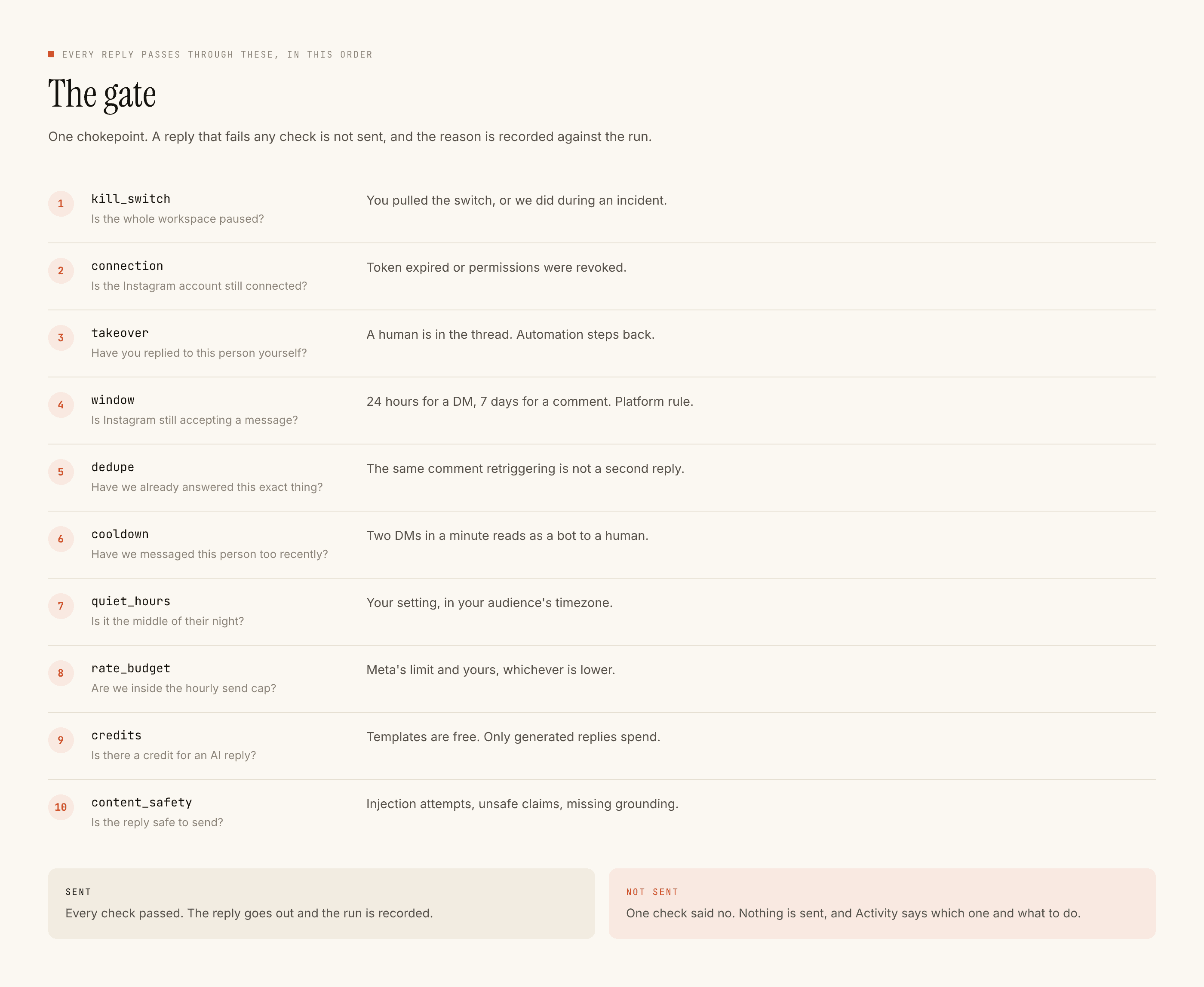
Kill switch, connection, takeover, window, dedupe, cooldown, quiet hours, rate budget, credits, content safety. The first failure ends the attempt and records why in Activity. Takeover is third, so the instant you reply by hand the automation stands down rather than finishing what it started. Credits is ninth, which is why running out never means silence: the AI draft is skipped and your own template goes out.
And the voice. Drafts are grounded in replies the account owner actually wrote, not a tone dropdown. When a draft is not grounded in those words, or the model is slow or unsure, the template ships instead. The generated reply is the upgrade; the template is the floor.
Running both for a fortnight
Because the two products are so similar in shape, the comparison that settles it is not a spreadsheet — it is a week of real comments.
Give each tool its own post and its own keyword so nobody receives two answers. Then break them deliberately: comment twice from a second account and check dedupe held; comment at midnight and check quiet hours held; jump into a thread by hand and check the automation noticed and stopped. Finally, open twenty replies each one sent and read them properly. Would you have sent those, to those people, in those words?
That last question is the entire decision, and it is the one no pricing page and no dashboard will answer for you.
Choosing
If you want to know what happened after the DM went out, they measure it and we do not. If you are running client accounts, they connect several and we connect one.
If you mostly want the same four answers sent quickly, in your words, without a monthly ceiling in the month something takes off, start on our free tier — 100 credits, no card — and test it on yourself before it touches anyone. The full field is here with the date each page was read, and our methodology sets out what we will and will not say about anybody else's product.