We make one of these two products, so read this the way you would read any comparison written by an interested party. What we can do is put the concessions first and source every claim about the other side to a page you can open yourself.
respond.io is aimed at a company. Its pricing page — checked on 20 September 2026 — describes a product with a reach ours does not attempt, and for a lot of businesses that reach is the whole decision.
Start with the part where we lose
On their pricing page, not on ours
What we do instead
That is not a preamble before the real argument. For a company with a support team it is the argument, and if you are that company you can stop reading and go set up respond.io with a clear conscience.
The meter is the actual difference
Everything else here follows from what each pricing page says it counts.
respond.io's, checked on 20 September 2026, counts two things at once: users and Monthly Active Contacts. It puts the idea as paying only for the contacts you talk to, and defines an active contact as someone you have talked to over calls or chat during the billing month. Their published tiers on that date are Starter at $79 a month with five users included, Growth at $159 with ten, and Advanced at $279 with ten, with an Enterprise tier priced on application. Extra users are listed at $12, $20 and $24 a month respectively, and contact overage at $12 per 100 on Growth and $15 per 100 on Advanced. There is a seven-day trial with Growth features and no card.
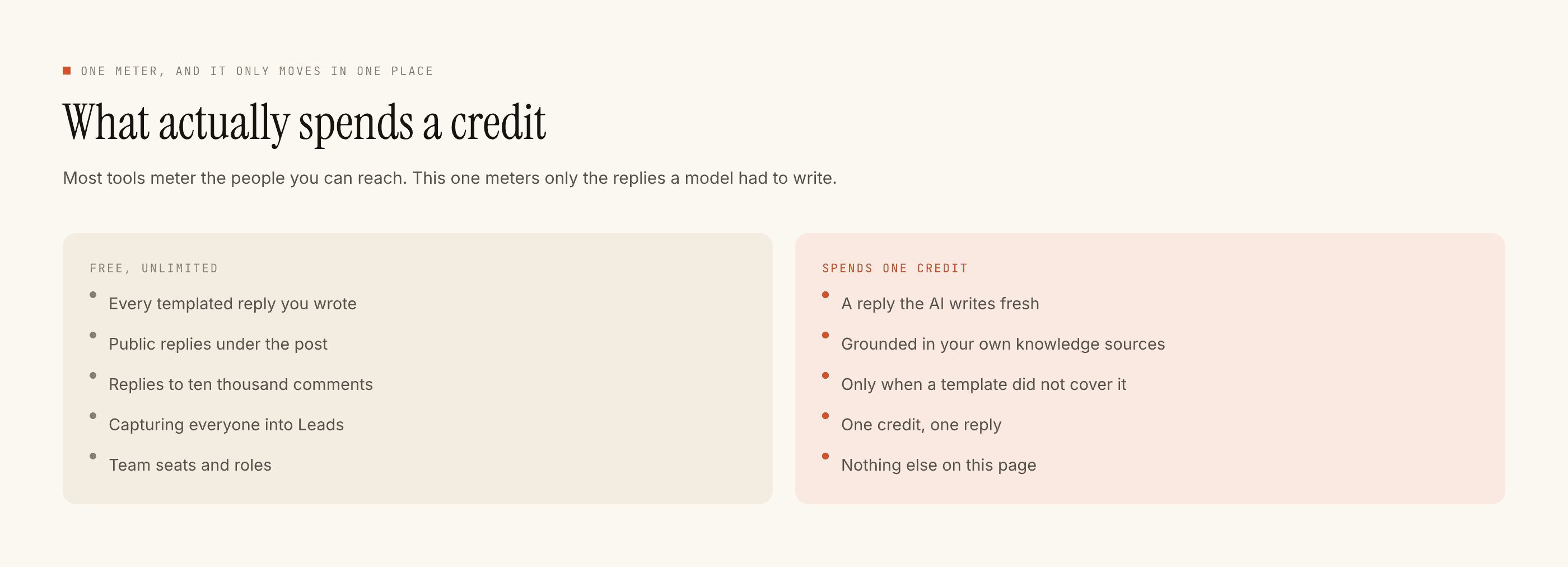
Ours counts one thing. One credit is one AI-written reply. A reply sent from a template you wrote costs nothing, however many people it goes to. The free tier is 100 credits with no card, and packs are ₹499 for 500 credits, ₹1,699 for 2,000 and ₹4,499 for 6,000, or $6.99, $22.99 and $59.99.
One meter counts the people your company spoke to. The other counts the sentences a model had to write.
Where each shape hurts
Neither is a trick. They break in different places, and which one breaks for you is knowable without a spreadsheet.
A seats-and-contacts meter is comfortable when several people answer messages all day across several channels, because the alternative is several tools and no shared history. It is uncomfortable when one person answers one channel, because the floor is a team price and the team is you.
A per-reply meter is comfortable when your inbox repeats itself, because repetition is exactly what a free template absorbs. It is uncomfortable when every reply genuinely needs composing from scratch, and it is useless the moment revenue arrives somewhere we cannot see.
Neither of us can change the platform
Both products reach Instagram through Meta's official API, so both live in the same box. You can reply to a DM within 24 hours of that person's last message and to a comment within 7 days. Nobody sells an exemption from that, and a tool implying otherwise is not describing the official API. The whole shape of it is in is Instagram DM automation safe.
What differs inside the box is what a tool refuses to do. Ours runs ten checks in a fixed order before anything sends — kill switch, connection, takeover, window, dedupe, cooldown, quiet hours, rate budget, credits, content safety — and the first failure stops the send with its reason recorded in Activity, so a reply that did not go out is something you can read rather than a mystery. Out of credits is a refusal like any other, and the fallback is your own template rather than silence.
Decide it in a fortnight, not in a spreadsheet
- 01
Count the people who answer
If the answer is more than one, the comparison is already over and respond.io wins it. Seats are the feature we do not have.
- 02
Count the channels revenue arrives on
If any of them is WhatsApp, email or a phone call, same answer. We can only see Instagram.
- 03
If both answers were one, give us one surface
Comments on Reels, or story replies. One trigger, so nobody gets two answers and you can read every reply we produced.
- 04
Paste in your four most common answers
Templated sends cost nothing, so this covers the bulk of your volume at no running cost and gives the AI fallback something to fall back to.
- 05
Read twenty replies end to end
Would you have sent those? No dashboard answers that question, and it decides the whole thing.
The honest summary is that these two products are aimed at different buyers rather than at each other. respond.io sells a company the ability to answer everyone everywhere with a record of who said what. We sell one person their evenings back on one channel.
If you want the longer list of options rather than a head-to-head, it is in respond.io alternatives, and the comparison most people read first is PostEngage vs ManyChat. How we source every claim on pages like this one is set out in our methodology.