Inrō is the comparison in this set that we take most seriously, because it is aimed at roughly the same person: an Instagram-only account owner who wants comments and DMs handled without a five-node canvas. The products diverge on one decision, and their pricing page states it clearly enough to quote.
Their meter, in their words
Read on 26 August 2026, Inrō's pricing page says: "Any campaign, segmentation, data enrichment, or automation contributes to 'activating' a contact. Manual actions like sending a DM manually are not considered activations." It adds that once a contact is activated you may run any number of automations on them for the month, because "the quota is set per contact, not per interaction", and that the quota resets monthly. It also states that you are warned at eighty per cent, and that going past the maximum pauses activations until you add capacity or the month turns over.
Their published tiers on that date: Free at €0 a month with 100 active contacts, unlimited contacts in the CRM, three active automations, three campaigns a month, fifty AI Agent credits and no card required. Pro at €12.99 a month with 500-plus active contacts, unlimited automations and campaigns, the AI Agent included and up to ten team members, after a 14-day trial. An annual plan at €1,249 a year covering ten thousand-plus active contacts. And a managed account, done for you, starting at €200 a month.
Our meter, for contrast
One credit is one AI-written reply. Replies sent from a template you wrote are free and unlimited. Nothing is counted per contact, per follower or per conversation, so there is no equivalent of an activation and no quota that can pause.
Free tier: 100 credits, no card. Packs: ₹499 for 500 credits, ₹1,699 for 2,000, ₹4,499 for 6,000, or $6.99, $22.99 and $59.99.
What Inrō charges for
What we charge for
Their quota rewards you for working the same contacts hard. Ours rewards you for having answers that repeat.
Neither is a trick. If your strategy is to build a list and message it repeatedly, a per-contact-per-month quota is the cheaper shape and ours is the wrong one. If your strategy is to answer whoever turns up on a post, a per-reply meter with free templates is the cheaper shape, and the difference gets wider the more your inbox repeats itself.
What they have that we do not
Their site lists an AI Agent that answers, qualifies and follows up in DMs; DM campaigns to followers and past buyers; comment and DM automation; and an inbox with tagging and segmentation. There is a managed plan where their team builds and runs the thing for you.
We have none of the outbound half. No campaigns, no broadcasts, no sequences, no segmentation, no enrichment, no managed service, and one workspace rather than a team of ten. If the pitch that made you look at Inrō was "message my past buyers about the new drop", we cannot do that and are not going to.
What we have that is worth the narrowness
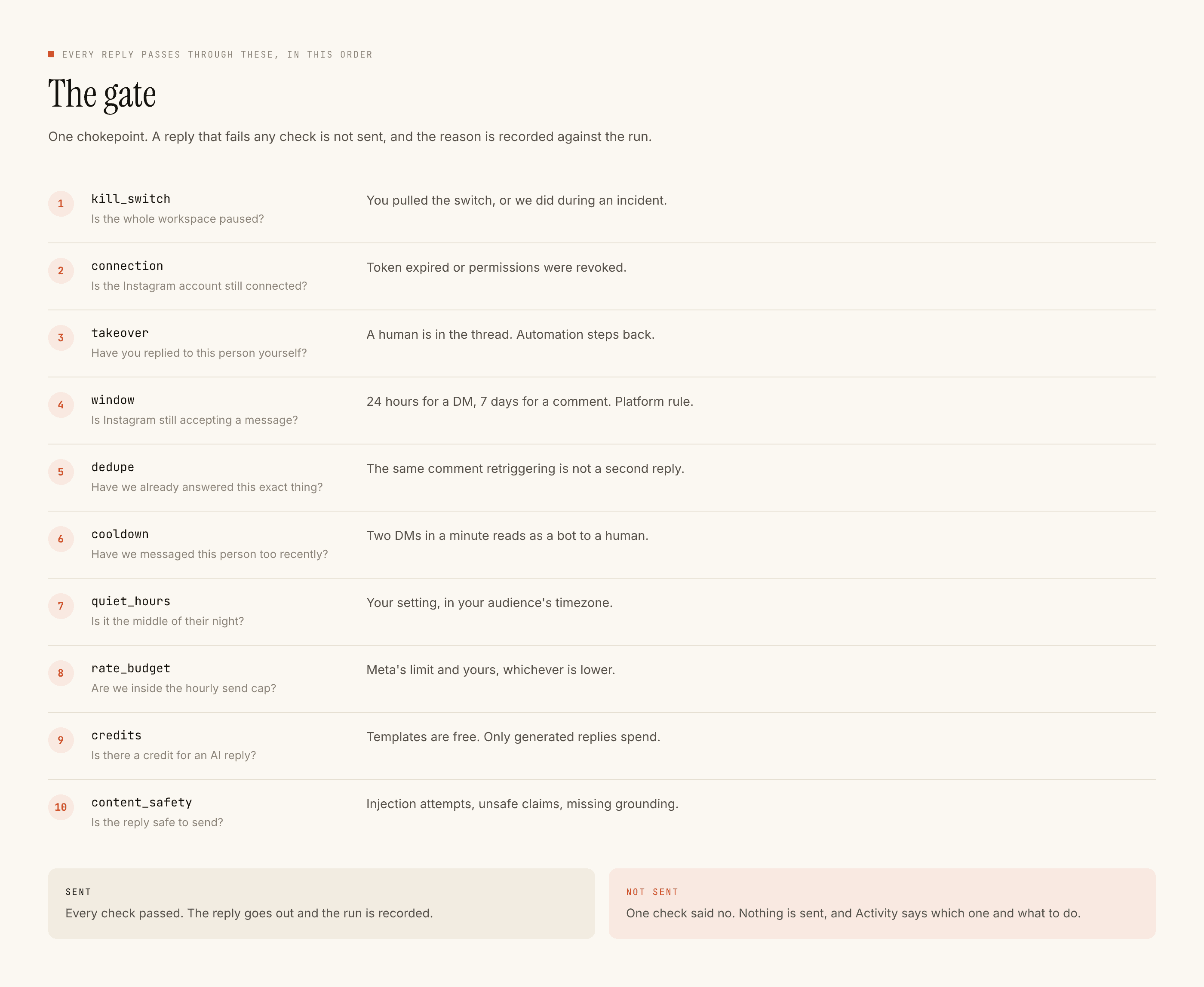
Ten checks in a fixed order before anything sends — kill switch, connection, takeover, window, dedupe, cooldown, quiet hours, rate budget, credits, content safety — with the first failure recorded in Activity beside its reason. Takeover sits third: the moment you answer a thread by hand, the automation steps back. Voice DNA is built from replies you actually wrote rather than a tone setting, and when a draft is not grounded in those words, your template goes instead.
The same box, for both of us
Both products work through Meta's official Instagram API, which means neither can move the two clocks that govern everything. A comment can be answered for 7 days. A DM can be answered for 24 hours after that person's last message. No vendor sells an exemption, and any tool implying it holds one is not describing the official API.
Inside that box, the differences are real but they are differences of design rather than of permission: what each tool refuses to send, what it does when a human takes over a thread, what it records when it decides to stay quiet. That is the part worth testing in a fortnight, and it is the part no feature table shows you. We wrote out what the limits actually mean in is Instagram DM automation safe.
How to pick
Write down the last five things you wished your Instagram account had done automatically. If three of them start with "message everyone who…", Inrō is the product and this page has done its job. If three of them start with "reply to the people who…", start on our free tier: 100 credits, no card, one automation on one post, and test it on yourself before it touches anybody else.
For the wider field, every tool we are asked about is here; for the per-contact model most of the category still uses, read the ManyChat comparison; and for how these claims get sourced and re-checked, our methodology.