We are going to lose the price argument on this page, so it is worth doing it first and doing it plainly.
Their pricing, from their own site
Read on 21 October 2026. A free forever plan with no credit card: one Instagram account, three active automations and 1,000 DMs a month. Starter Pack at $3 a month, or ₹99 in India, with ten automations and 30,000 DMs a month. Pro Pack at $9 (₹299) with unlimited automations and DMs. Above those, Scale, Growth and two Agency packs run from $15 to $29 for more speed or more accounts. Indian customers pay in rupees through Razorpay with UPI, cards or net banking; everyone else pays in dollars by card. Payments are final, the same policy we run.
Their pricing page that day showed 6,433,572 DMs sent in total, 9,326 sign-ups and 99.7% of sends accepted by Instagram's API over the previous seven days, with a note that accepted does not mean opened.
The headline on that page is that every plan includes every feature, and you upgrade for limits. The list is longer than ours: comment-to-DM, Story reply and mention automation, DM keyword automation, a follow gate, follow-up DMs, a visual flow builder and canvas, broadcasts, product mode, Fan Mode loyalty rewards, link tracking, a developer API, and Facebook Messenger plans beside the Instagram ones. They now sell AI replies too, by credit: none on Free, 30 a month on Starter, 100 on Pro.
Ours, for contrast
A free plan and a meter. One credit is one AI-written reply. A comment reply sent from a template you wrote is free and unlimited, however many people it goes to, on every plan, because a repeated question does not need a model. A templated DM is free too, up to Free's 1,000-every-30-days cap; Lite at $4 a month (₹149) removes it. Creator at $12 (₹899) includes 3,000 AI replies a month and Studio at $29 (₹2,499) includes 8,000. Nothing is metered per contact, per follower or per conversation.
Free tier: 100 credits once, 1,000 DMs every 30 days, no card. Packs: $3.99 for 1,000 credits, $14.99 for 4,500, $39.99 for 12,000.
$3 a month, flat
Nothing until a model writes
The arithmetic favours them on templated volume: $3 covers 30,000 DMs a month and $9 covers unlimited, against our $4 Lite. It favours us only when a model is writing a real share of the replies, because 3,000 written replies a month on our Creator plan ($12) is thirty times the 100 credits on their Pro ($9). If your inbox is the same five questions, ReplyKaro's flat plan will be cheaper and we would rather you knew that here than found it out in month three.
Where the two products actually differ
Not features. On features they are ahead. Two things.
The voice. We build a profile from replies you wrote yourself and draft against it, and when the model produces something ungrounded, or is unsure, or is simply slow, your own template goes out instead. The generated reply is the upgrade, not the default. Their AI credits cover conversation learning too, so ask both tools for a few drafts on your own comments before you decide.
What happens when a reply should not go. Sixteen named checks run in a fixed order before every send, the first failure stops it, and the reason is recorded where you can read it. On a healthy account a small share of sends is refused on purpose — by cooldown, the rate budget, duplicate delivery or a burst — and each refusal carries its name.
The useful question to put to any tool in this category is what its refusal rate is. Zero is not a good answer.
Any tool here can send a message in seconds. The interesting part is what it does in the second before, when something is slightly wrong.
What is the same
Worth stating so the differences are readable. Both run on Meta's official Instagram API. Neither asks for your Instagram password. Neither can message somebody who has not messaged you, broadcast to your followers, or send after the window closes — seven days from a comment, twenty-four hours from a DM — because those are Meta's limits and they apply to every tool identically.
Both price in dollars by default and in rupees in India, and neither gives refunds. One difference for registered businesses: we are not registered for GST, so our rupee price is the whole amount and there is no GST invoice from us.
Setting ours up, screen by screen
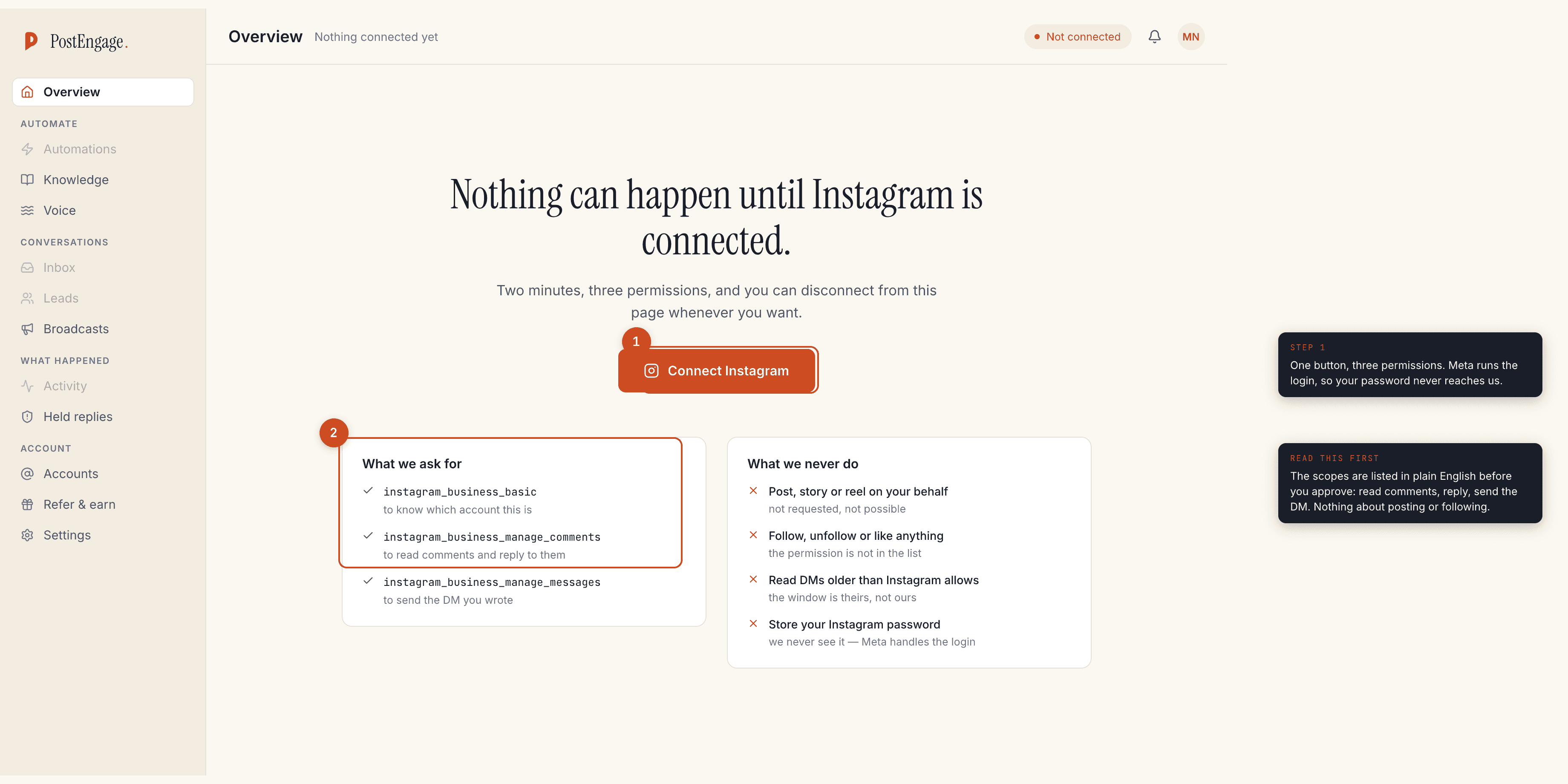
If you do trial both, this is the whole of it on our side. Five screens, and the first live reply usually lands inside fifteen minutes.
- 01
Connect Instagram
Three permissions — read comments, reply to them, send the DM you wrote. Meta runs the login, so your password never reaches us, and disconnect sits on the same screen.
- 02
Write the trigger
A post or your next post, then the words people actually type, Hinglish included. Matching ignores case and punctuation, and a negative keyword holds the reply back.
- 03
Write both replies
The public reply that keeps the post moving and the private reply that carries the link. Both are templates, so neither spends a credit however often they fire — the public reply is unlimited on every plan, the private one free up to the Free plan DM cap of 1,000 every 30 days.
- 04
Try it, then go live
Try it takes a pretend comment, runs every check against the live account and shows the replies exactly as they would go out. Nothing is sent, and nothing reaches a follower until you press Go live.
- 05
Read Activity in week one
Every send and refusal with a reason — window closed, takeover, duplicate, quiet hours — which is the screen that tells you whether to widen the keywords.
The full price list on our side is on pricing, the closest comparisons to read beside this one are DMKaro and SuperProfile, and the tools that bill per contact are on the ManyChat alternative page.
Who should pick which
Pick ReplyKaro if price is the deciding factor, if you want branching flows or a follow gate, if you need broadcasts or Messenger, or if your replies are genuinely the same handful of sentences and a model would add nothing. That is a large share of accounts and it is not a consolation prize.
Pick us if you want a model writing a real share of your replies in your voice, and if you want to be able to ask afterwards why a specific reply did not go out and get a named answer. If neither of those is worth the dollar between their Starter and our Lite, the honest recommendation on this page is the other product.