Comparison · 4 min read
Respond.io Alternatives: The One Question That Sorts Every Option
PostEngage does not ship WhatsApp. Respond.io is one of the products people shortlist for it; we are not, because we run one channel and it is not that one. So there is no like-for-like comparison here, and inventing one would be the first dishonest thing on the page.
What is worth writing instead is the scenario every multi-channel tool is evaluated on last and judged by first: the morning something stops working.
Everything breaks, including the good tools
Tokens expire. A number gets flagged for review. A webhook silently stops delivering. Meta has an incident. A permission that was granted last year is no longer granted because somebody in your team tidied up an account.
None of that is a vendor being bad at their job. It is what running on somebody else's platform means, and every product in this category lives with it. The comparable part is not whether breakage happens — it is what the tool does during the twenty minutes before you notice.
Every tool works on the good day. You are choosing between behaviours on the bad one.
The three failure behaviours
There are only really three, and a product picks one, usually without documenting which.
Fails loud
Fails quiet
The third is worse than both: it fails partially. Some messages go, some do not, nothing is marked as failed, and you spend a week believing your automations are unreliable rather than that your connection is.
Ask a vendor directly which of the three theirs does. Ask what a broken connection looks like on screen, and ask them to show you.
Multi-channel makes this harder, not easier
The pitch for a tool covering several channels is one login, one set of answers, one bill. Genuinely worth wanting.
The risk it introduces is coupling. If a broken Instagram connection can stop WhatsApp, or a WhatsApp review can pause an unrelated channel, the channels are more entangled than the marketing implies. That is a specific thing to test, not to assume, and it is the same argument as running two channels at all.
- Break one deliberately. During the trial, revoke a permission or disconnect an account and watch what the other channel does. Five minutes of testing beats any answer a salesperson gives you.
- Check where the alert goes. An in-app banner is useless if nobody logs in on Sunday. Email or a message to a phone is the difference between an hour of downtime and a weekend of it.
- Ask what happens to queued messages. Held and sent on recovery, or dropped? Both are defensible, and a customer receiving a delayed reply to something they have forgotten asking is its own problem.
- Ask how a stoppage is recorded. If the log shows nothing during an outage, you cannot reconstruct who was affected — and reconstructing that is the first thing you will want to do.
Health is a check, not a status page
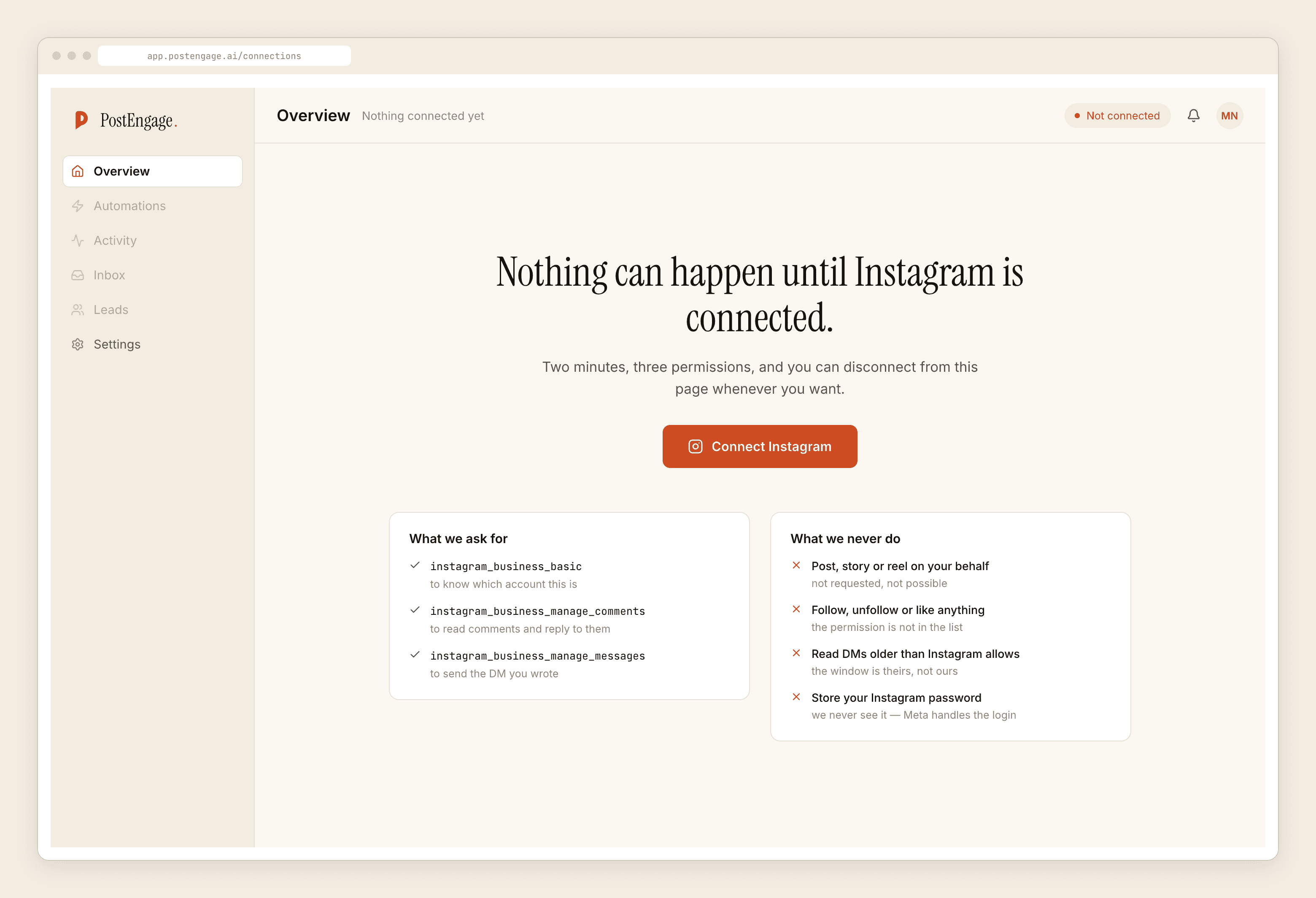
The version we think is right — and this applies to any vendor on any channel — is to treat connection health as one of the checks that runs before a send, rather than as a dashboard widget somebody might look at.
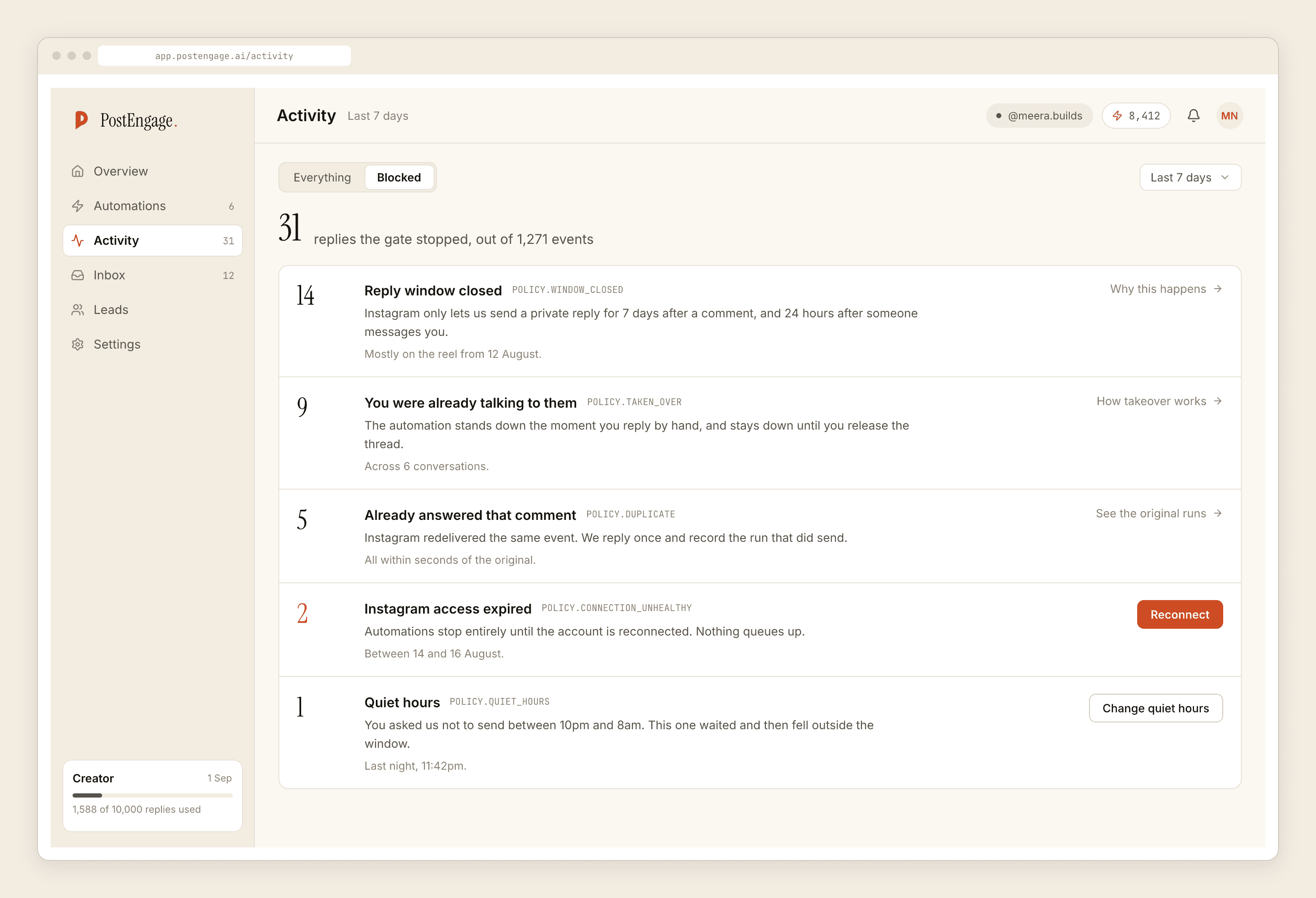
If the connection is not healthy, nothing goes out, the attempt is recorded with that as the reason, and the record survives for you to read afterwards. That way an outage produces evidence instead of silence.
What we can honestly claim
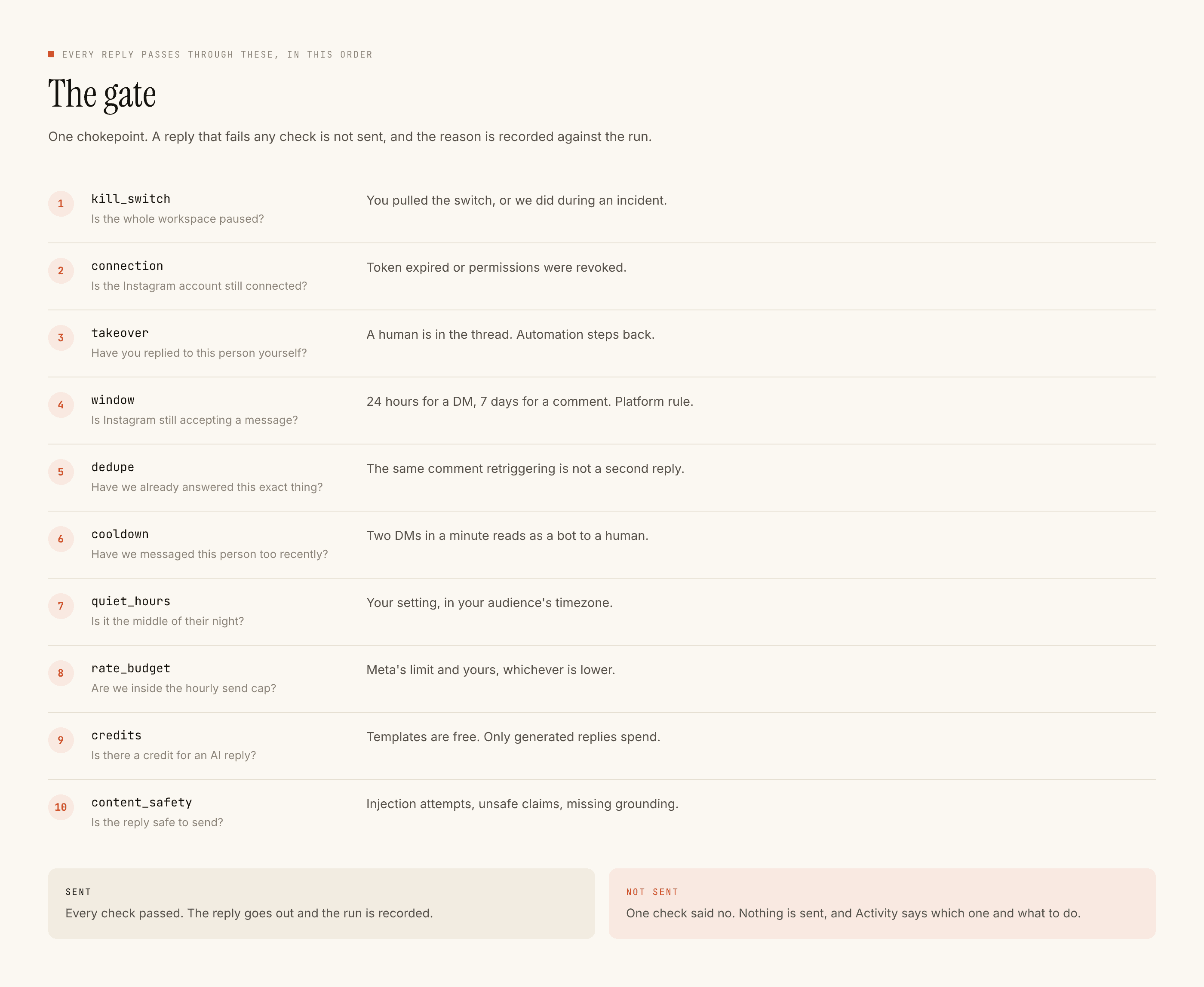
One channel, carefully. Instagram comments and DMs on the official Graph API, inside a seven-day comment window and a twenty-four-hour messaging window that only the other person's message restarts. Ten named checks before every send, connection among them, and every refusal recorded with its reason. There is a kill switch that stops everything immediately, which exists precisely because the worst outages are the ones where the tool is working perfectly and sending the wrong thing.
Templated replies are free and unlimited, credits move only when the model writes something new, the free tier is 100 credits with no card, and packs start at ₹499.
If you are evaluating WhatsApp vendors, start with what is metered and then ask what the tool refuses.