
Route one: what Instagram gives you without any tool
Start here, because it is genuinely free, it is under-documented, and for a small account it may be all you need.
Open Meta Business Suite with the account linked to your Instagram, go to Inbox → Automations, and you get three things:
- Instant Reply. Fires the first time somebody messages you, at any hour. Good for a thank-you, a confirmation that the message landed, or a link to the thing most people are about to ask for.
- Away Message. The same idea on a schedule — after hours, weekends, while you are away. You set the window.
- Keyword responses. Up to five keywords per automated response, so a message containing "sale" gets a specific answer rather than the generic one. In the same section there is a Frequently Asked Questions panel with a Show Questions toggle that surfaces common questions in the thread.
That is a real setup and it costs nothing. Two things to know before you rely on it.
The second limit is bigger: none of this does comment-to-DM. Instagram has no feature, anywhere in the app or in Business Suite, that sends a private message to somebody who commented a keyword on your post. That is available only through the official Instagram Messaging API, which is what every tool named below is using.
So the honest split is: if your need is "answer DMs when I am asleep", Meta's own tools may finish the job for free today. If your need is "somebody commented LINK on a reel and should get a DM", you need a tool, and the rest of this matters.
Route two: the free tiers, and what each one actually meters
The numbers move without notice — that is the subject of a whole other post — so treat these as of August 2026 and check before you commit.
| Tool | Free tier | The meter | Runs out when |
|---|---|---|---|
| ReplyRush | ~1,500 DMs / month | sends | you send a lot |
| LinkDM | ~1,000 DMs / month | sends | you send a lot |
| CreatorFlow | ~500 DMs / month | sends | you send a lot |
| InstantDM | ~500 DMs / month | sends | you send a lot |
| ManyChat | 25 active contacts | people | one reel travels |
| Chatfuel Light | unlimited contacts | AI processing | the bot pauses |
| PostEngage | 100 AI replies, templates uncapped | generated replies only | never, for templates |
The column that decides your bill is the third one, not the second.
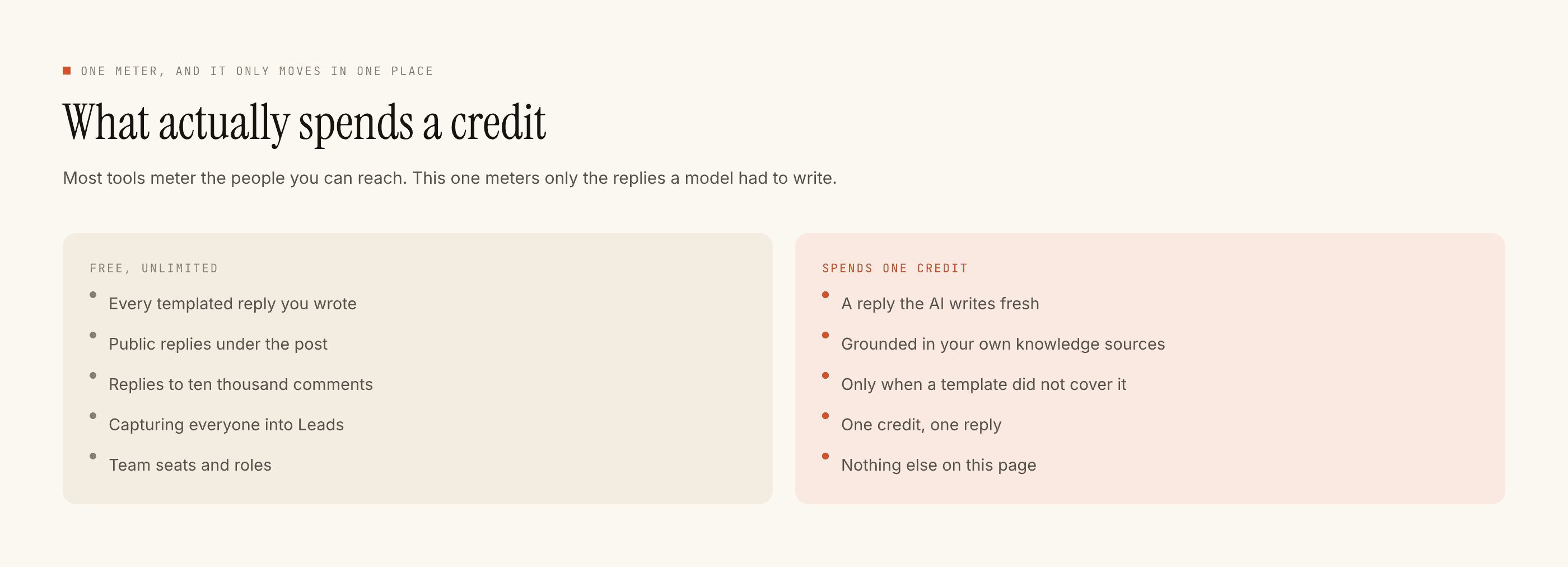
A send meter counts every message. A hundred people who each ask three questions costs you 300. A contact meter counts people, so those same hundred cost you 100 — but they keep costing you, because a contact you acquired in March is still on the count in September. An AI meter only charges when a model writes something new, so a template answering the same question four hundred times costs nothing.
Which is cheapest depends entirely on the shape of your inbox, and you can find out in ten minutes: read fifty of your own DMs and count how many distinct questions they represent. A low number means templates carry you and a send meter is expensive for no reason. A high number means you want something that can actually write.
Route three: setting one up free, properly
Checklist
Two posts on this site already answer the money question. What our free plan covers and where you outgrow it is the specific one, and how to judge any free tier in this category is the general one. Neither needs repeating.
This one is about the other ledger. Free automation has real costs that are not denominated in rupees, they are the reason most free setups quietly stop working, and nobody puts them on a pricing page. Five of them, in the order you meet them.
One: the afternoon
The setup is not three minutes, whatever the headline says. Three minutes gets one automation live. Getting it right is an afternoon, and the afternoon is where nearly all of the value is.
You write four or five templates in your own register, which means reading your own past replies and noticing how you actually talk. You build a keyword list that matches what people type rather than what you would have typed. You add negative keywords, which almost nobody does on the first pass. You scope to specific posts, because a one-word comment is only unambiguous when the post makes it so. Then you run Test on myself and read the result on a phone as the recipient.
None of that is billable and all of it is work. A free plan does not remove it — it just means nobody invoiced you for the hours, which makes it easy to skip and then wonder why the thing underperforms.
Two: the fifteen minutes a week, forever
An automation is not a slow cooker. Prices change. Stock changes. The Diwali line is wrong in February. People invent phrasings your keywords do not catch. Instagram redelivers events. A token expires and the connections screen still shows your account name, so nothing looks broken and nothing sends.
The recurring cost is fifteen minutes on a fixed day: check the connection, check that anything sent at all, read the refusals grouped by reason, clear the review queue, glance at the credit ledger. Skip it for a quarter and you have a system confidently sending last season's prices to strangers.
A free automation nobody reads is not free. It is an unsupervised employee with your name on the badge.
Three: the wrong reply, at whatever scale you reached
This is the asymmetry that matters and it does not scale the way people assume.
Under-automation costs you a slow reply. Somebody waited until Monday. That is a real cost and a recoverable one.
Over-automation costs you a wrong reply, sent confidently, to everybody who typed the trigger word. A price automation scoped to any post answers price? under the reel it was built for and also under the unrelated one, with the same number. The people who received the wrong answer mostly do not tell you; they just do not come back.
The free-plan version of this is worse for a specific reason: templated replies are free and unlimited, so nothing throttles a mistake. The meter does not stop you, because the meter only watches generated replies. What stops you is negative keywords, post scoping, and having read the thing on a phone before you turned it on.
Four: the questions you stop hearing
The subtle one. Before automation you read every message, which meant you knew — without trying — that four people this week were confused about delivery, that two asked about a size you stopped stocking, that somebody keeps asking whether you ship to Guwahati.
Once the templates answer all of that, the signal stops reaching you. The inbox is handled, which is the point, and you have also unsubscribed from the most direct market research you had.
The fix is cheap and deliberate: read the credit ledger. Every generated reply is a question your templates did not cover, which makes that ledger the closest thing to the old signal. A recurring theme in it is either a template you should write or a thing about your business you should change.
Five: what you cannot take with you
Worth thinking about on day one rather than in month nine, because it decides where you put your effort.
Portable: the templates you wrote, the keyword and negative-keyword lists, and your leads as a CSV. Those are yours in a form any other tool can accept, and they represent most of the afternoon from cost one.
Not portable: anything you built inside a vendor's own structures. A flow assembled on somebody's canvas does not export. Neither does a history that lives only in their screens.
So keep the assets in a form you own. A document with your templates and keyword lists in it costs nothing to maintain and turns a migration from a rebuild into a paste. This is not advice against staying; it is advice against being unable to leave, which is a different thing and a better position to negotiate from.
The honest framing
A free tier is an evaluation budget, not a gift. The question worth spending it on is not how many messages you can send before it stops — it is whether this thing behaves acceptably against your actual audience, which takes very few sends to find out and quite a lot of reading.
Spend the free plan on four answers: does keyword matching survive how your audience types, does the automation stand down the instant you reply by hand, does it refuse the things it should refuse, and would you have sent these replies yourself. The general version of that evaluation walks each one, and what happens on the day a free plan ends works through the arithmetic of the meter you chose.
Questions people ask
Is there a genuinely free way to automate Instagram DMs?
Yes, two of them. Instagram itself gives you an Instant Reply, an Away Message and keyword responses inside Meta Business Suite at no cost. Separately, most third-party tools have a free tier that sends real DMs through the official API. What Instagram does not give you free — or at all — is comment-to-DM.
Can I do comment-to-DM without paying?
You cannot do it inside Instagram at any price, because the app has no such feature. You can do it on the free tier of several tools that use the official Instagram Messaging API, with monthly caps of roughly 500 to 1,500 sends depending on the tool.
Why is Instagram’s own keyword automation slow?
By design. Meta’s Business Help Center documentation says the inbox waits about 15 minutes before sending a keyword automation, so that a human has the chance to answer first. It is a reasonable default and it is also the main reason the third-party category exists.
Which free tier is actually the biggest?
On raw sends, ReplyRush at roughly 1,500 DMs a month as advertised. But the meters are not comparable — one counts sends, another counts people, another counts AI processing — so the biggest headline number is often not the cheapest for a given inbox. Count your own distinct questions before comparing.
Do free plans use a different, riskier API?
Not among the tools listed here — the free tier runs the same official Meta API as the paid one, so a free plan sends real DMs from your account exactly as a paid plan would. The risk sits entirely with tools that ask for your Instagram password instead of sending you through Meta’s permission screen, free or not.
What does free actually cost me, then?
An afternoon to set up properly, about fifteen minutes a week forever to keep it honest, the risk of a wrong reply going out at whatever scale you reached, and the market signal you lose once your templates answer everything. Those four are the subject of the rest of this post.