
Everybody shopping for this in India starts at the same place: sort by price, pick the lowest number, get on with the day. It is a reasonable instinct and it produces the wrong answer often enough to be worth twenty minutes.
The reason is that the number on the page is a rate, not a bill. Two tools with identical headline prices can differ by a multiple over a year because they are counting different things, and only one of those things grows with your reach.
An earlier version of this post refused to quote anyone's prices, on the grounds that vendors change them and a stale figure is worse than none. That was half right. A figure with a date and a source on it is not stale — it is a figure you can check. So here are the numbers, dated, and then the part that actually decides your bill.
What the category costs an Indian buyer, in rupees
| Plan | Listed | Approx ₹/month | What you get |
|---|---|---|---|
| ManyChat Free | $0 | ₹0 | 25 active contacts |
| ManyChat Essential | $14–15 | ₹1,165–1,245 | 250 active contacts |
| ManyChat Pro | $39–45 | ₹3,200–3,735 | 2,500 active contacts |
| ManyChat at 10,000 contacts | ~$145 | ~₹12,000 | 10,000 active contacts |
| Chatfuel Light | $0 | ₹0 | unlimited contacts, fair-use AI |
| Chatfuel AI PRO | $49 | ~₹4,100 | unlimited contacts |
| InstantDM | reported ~$9.99 | ~₹830 | metered on sends |
| PostEngage | ₹499 packs | ₹499 | free tier 100 AI replies, templates uncapped |
Now the three costs that are on nobody's pricing page and are specific to buying this from India.
GST, and whether you can claim it back
Eighteen percent applies to international software subscriptions. That is not the annoying part. The annoying part is that most USD-billed foreign vendors do not issue a GST invoice in a form your accountant can use, so a registered business pays the 18% and cannot take input credit on it.
For a ₹3,735 plan that is roughly ₹672 a month you simply lose — about ₹8,000 a year — on top of a bill already denominated in a currency you do not earn in.
The forex spread nobody quotes
A USD subscription on an Indian card is charged at your bank's rate plus a markup, typically 2–3.5%. Then the dollar itself moves. A plan that was ₹3,200 when you signed up is a different number in nine months without the vendor having changed anything, and you find out on the statement.
A contact meter is worse in India than the same meter elsewhere
This is the one that actually matters and it is structural rather than a fee.
Contact pricing assumes reach and revenue rise together. In India they often do not: an account can reach very large numbers cheaply while the value of a single customer stays modest. A reel that pulls 3,000 keyword comments costs a US business the same in contacts as an Indian one, but the Indian business has to recover it from smaller orders.
So the same plan that is fair at $100 average order value is punishing at ₹800. If your reach is large and your ticket is small — which describes most Indian creator and D2C accounts — the contact meter is the single most expensive shape you can pick, whatever its headline price.
Sorting by price gets you the cheapest rate. Sorting by unit gets you the cheapest year.
Establish what is being counted first
Ask one question of every pricing page before you look at the amount: what is the unit?
Contacts. Distinct people your automation has ever spoken to. This is the common shape in the category and it has a specific property — it only goes up. A Reel that travels further than usual permanently raises your floor, because everyone who commented once is now a contact you carry.
Conversations. A thread, usually inside a time window. Better behaved than contacts, because a dormant one costs nothing next month.
Messages or replies sent. Tracks work rather than audience. A quiet month is a cheap month. Only genuinely cheap if the answers you already wrote are free to send, otherwise it is per-contact pricing with extra steps.
Automations, keywords or seats. Capability rather than volume. Predictable, and it bites when you want a second account rather than more traffic.
The headline price tells you the rate. The unit tells you the bill.
Then ask the questions that change the total
- Does the unit ever go back down? Some plans roll off inactive contacts after a period. Some never do. This single footnote changes a year's total by a multiple.
- What happens at the cap? Sending stops, or sending continues and an invoice follows. Both are defensible. Only one is safe to discover during a festive-season launch.
- What currency is the contract in? A plan billed in dollars is a plan whose rupee cost moves with the exchange rate, plus whatever your card issuer adds as a foreign transaction fee. That markup is invisible on the pricing page and lands on your statement every month.
- Is the cheap price the annual price? Frequently the number in the largest font assumes twelve months paid upfront. The monthly rate is elsewhere and higher.
- Is GST included or added? It is a real difference on a real invoice and vendors display it differently.
The arithmetic that actually settles it
You do not need a spreadsheet. You need one number from your own account.
Go to your last month of comments and count two things: how many people commented, and how many distinct questions were asked. Not how many comments — how many genuinely different questions.
If a handful of questions cover the bulk of it, a meter that charges for replies while letting your own written answers go free is the cheapest shape available to you, because most of your volume never touches the meter at all. If every comment is a different question, that shape works against you and a flat capability-based plan will cost less.
Most Indian creator and D2C accounts we see are firmly in the first case. "Price kya hai", "rate?", "kitne ka hai", "COD available?", "delivery Bangalore?" — five templates, one keyword each, and the tail is small. But count before you assume, because if you are the second case, the honest answer is that our pricing shape is wrong for you.
What cheap costs somewhere else
Price is one of several places a vendor can charge you. If the money is low, it is worth checking the others before deciding you found a bargain.
The account. The genuinely free tools in this space are often free because they are not paying Meta for anything — they sign into your account and drive the app instead of using the API. That is not a discount, it is a deferred cost, and it is charged in feature blocks at the worst possible moment. The mechanism is worth understanding once.
Your audience. A promotional footer on every reply is the free plan's price and your customers pay it, in the form of messages that read as machinery.
Your data. No export means your templates and your record of who asked what are a deposit rather than an asset. Check before you build six months of history inside a tool.
Your evenings. A tool that is cheap because it has no shared inbox, no lead capture, and no record of what it blocked will save you a few hundred rupees and cost you hours reconstructing what happened.
The replies themselves. Cheap replies you would never have sent are not a saving. They are a slightly worse version of your business, delivered at volume.
Where we sit, plainly
Free tier is a hundred credits and no card. Credit packs start at ₹499. Billing is in rupees, so nothing on your statement depends on the dollar that week.
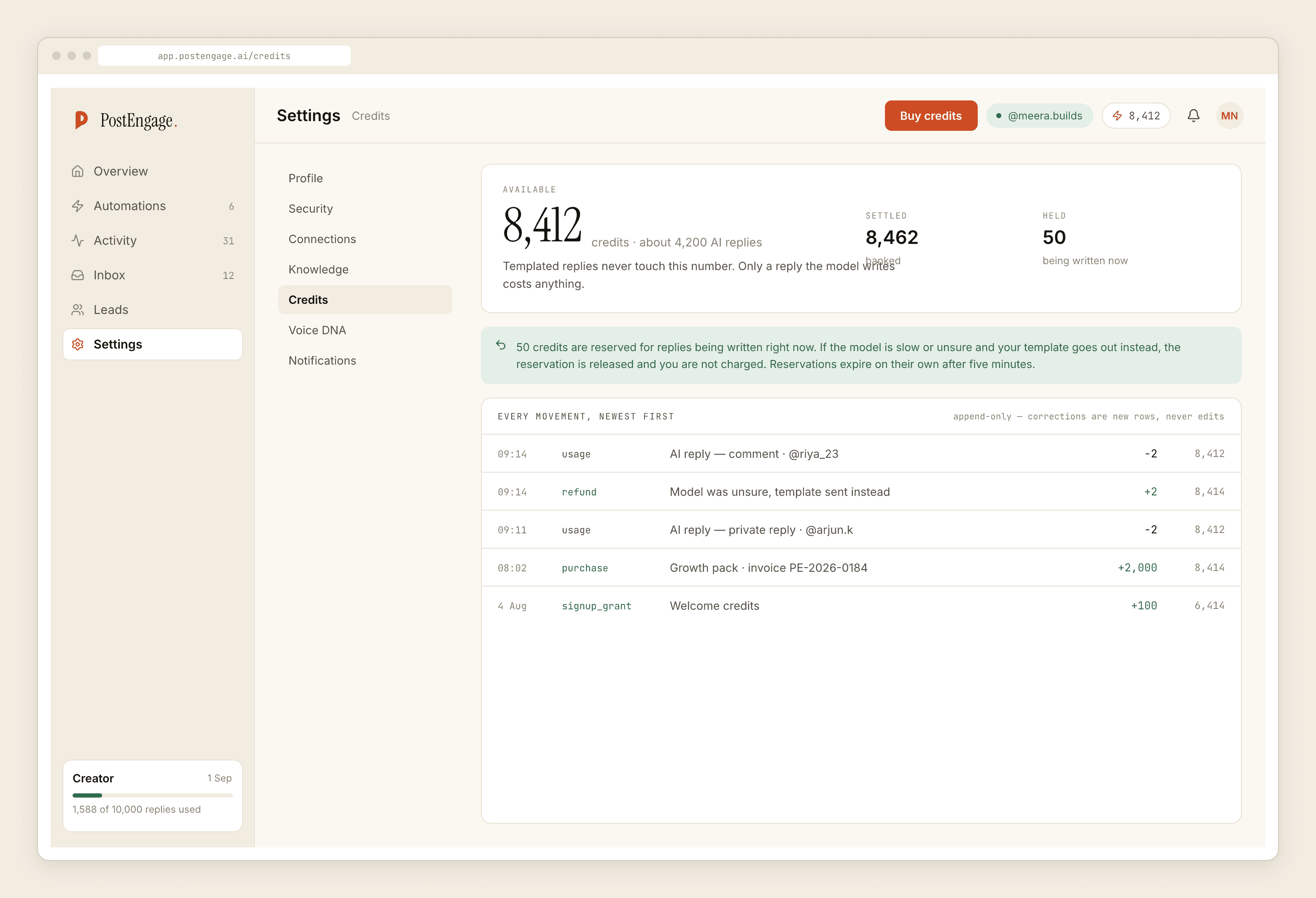
Templated replies — the ones you typed yourself — are free and unlimited on every plan. A credit is spent only when the model writes a new reply for a question no template covered. One credit, one reply, and when the balance is empty the template goes out instead, so running dry lowers reply quality rather than stopping the automation.
What we do not do: WhatsApp, scheduling, publishing, a visual flow builder, or a long integration list. If any of those are part of what you are pricing, we are not the cheap option, we are the wrong one. The head-to-head with a larger platform is the honest version of that comparison.
If you have not tried anything yet, what our free plan covers is the shortest way to find out whether the shape suits your inbox — for nothing, and without a card.
Questions people ask
What is the cheapest Instagram DM automation tool in India?
On headline price, the free tiers — Chatfuel Light and the free plans of the send-metered tools cost nothing to start. On a year, the answer depends entirely on the unit: a contact-metered plan that looks cheap at 250 contacts is roughly ₹12,000 a month by 10,000, while a send-metered or reply-metered plan tracks your work rather than your reach.
Do I pay GST on these tools?
Yes, 18% on international software subscriptions. The problem is not the rate, it is that many USD-billed foreign vendors do not issue a GST invoice a registered business can claim input credit against — so you pay it and cannot recover it. On a ₹3,735 plan that is about ₹8,000 a year lost.
Why do USD-priced tools cost more than the conversion suggests?
Two reasons on top of the sticker: your bank adds a forex markup of roughly 2 to 3.5% on an international card charge, and the exchange rate itself moves. A plan quoted at ₹3,200 today is a different number in nine months with no change from the vendor.
Is contact-based pricing worse for Indian businesses?
Structurally, yes, and it is the biggest hidden cost here. Contact pricing assumes reach and revenue rise together. Indian accounts often have very large cheap reach against a small average order value, so the reel that works costs the same in contacts as it would for a US business but has to be recovered from much smaller orders.
Does anyone bill in rupees?
Some Indian-built tools do, including ours. It removes the forex spread and makes a GST invoice straightforward, which together are worth more than a small difference in sticker price for a registered business.
How do I compare two plans properly?
Write down one real month of your own traffic — messages sent, distinct people, accounts needed — and ask both vendors for a total including tax. Then do the identical exercise at twice the volume. The plan that wins at your current size frequently loses at the size you are planning for.