Playbooks · 5 min read
The Comment to DM Funnel, Step by Step and Where It Leaks

The comment to DM funnel is the most reliable way to start conversations on Instagram, and it is also the one most often described as if it were a single action. Post, get comments, get DMs, get sales.
It is six steps. Each one loses people, some for reasons you can fix and some because Instagram has decided so. Knowing which is which stops you optimising the wrong stage for a month.
- 01
The post asks for a comment
A Reel or post that says "comment PRICE and I will send the details". The ask has to be specific and the word has to be short. This step is content, not software, and it is where most funnels fail.
- 02
Someone comments
Public, on your post. Instagram gives you 7 days from the comment to respond to it, which is a generous window compared to DMs.
- 03
The comment gets caught
A webhook fires and the trigger matches. Match loosely — people type "Price", "price?", "PRICE PLS" and "prize". Exact-match keyword rules lose a chunk of a real audience.
- 04
The checks run
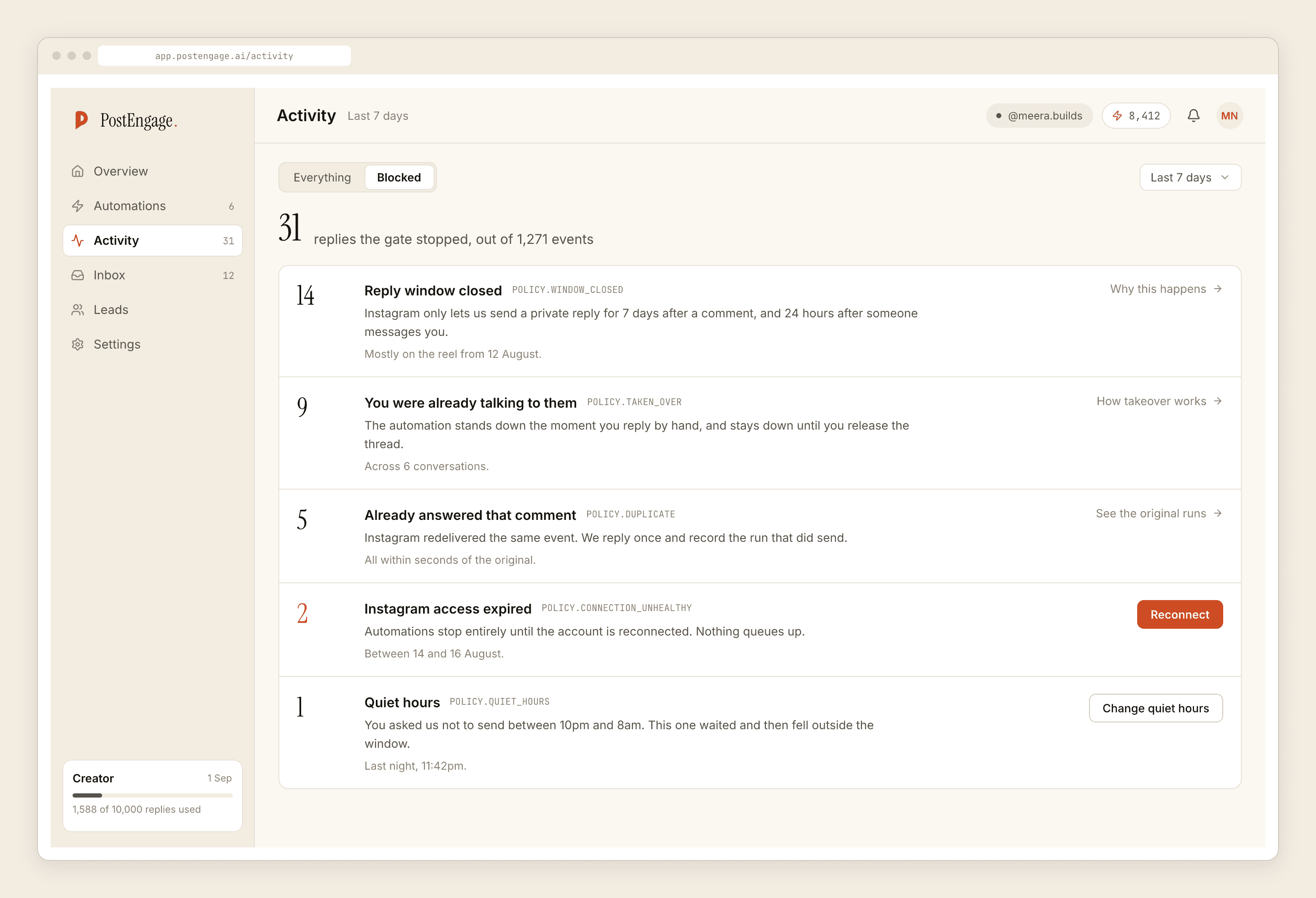
Ten of them, in a fixed order: kill_switch, connection, takeover, window, dedupe, cooldown, quiet_hours, rate_budget, credits, content_safety. The first failure stops the send and records the reason on the run.
- 05
The DM goes out
The conversation moves from a public comment to a private thread. From here you are inside the 24 hour rule rather than the 7 day one.
- 06
They reply, or they do not
A reply reopens the window and gives you another turn. Silence closes it. This is the step everyone under-designs.
Where it leaks, stage by stage
Step one loses the most people and no tool helps. If the post does not clearly say what to comment and what they get, nobody comments. Vague asks produce vague results. "Comment below!" is not an ask.
Step three leaks on strict matching. Every exact-match rule is a decision to ignore the people who typed it slightly wrong, and in a Hinglish-heavy audience that is not a rounding error. Match on the word appearing anywhere in the comment.
Step four leaks in ways you can read. This is the useful part of having the reason recorded. A pile of window failures means your trigger is firing on comments from posts older than 7 days. A pile of dedupe failures means two triggers overlap on the same person. A pile of rate_budget failures means a post travelled and the cap did its job, which is a good outcome that looks like a problem in a log.
Step five leaks on the DM itself. The most common mistake is sending a link and nothing else. It reads as a broadcast, it moves the person off the app, and it ends the conversation. Answer the question first, then offer the link on the second turn, which is one of the few DM tactics that survives the window.
Step six is where the funnel actually dies. Most setups treat the DM as the finish line. It is the start. A first message that ends with a question gets a reply, and a reply resets your 24 hours. A first message that ends with a link gets a tap and silence.
The two windows, which people confuse constantly
Comments: 7 days
DMs: 24 hours
The practical consequence is that multi-day nurture sequences do not work here. A five-message drip over a week assumes a window nobody has. Design for one good message and a question.
What a cap does to a viral post
A Reel travels overnight and two thousand comments arrive by morning. Without an hourly cap, two thousand DMs go out as fast as the API accepts them, a chunk of people report the messages, and the account picks up a delivery problem that outlasts the post.
With a cap the same two thousand become a queue. The last person gets their DM some hours later, still inside the 7 day comment window, and nothing about the account changes.
The cap looks like a limit on your best day. It is insurance against your best day.
Cost, because it shapes the design
Templated replies are free and unlimited. Credits are spent only when the model writes something new.
For this funnel that is convenient, because the first DM after a keyword comment should almost always be a template. The person typed one word. You know exactly what they want. There is nothing to compose.
The model earns its keep on the second turn, when they reply with something specific that no template anticipated, and it writes in a voice built from replies you wrote yourself. If it is slow, unsure, or writing something it cannot ground, your template goes out instead.
What to fix first
In order: the ask in the post, the loose keyword match, the question at the end of the first DM. Those three cover most of the loss in a typical setup and none of them require changing tools.
After that, read the blocked runs for a week. The reason codes will tell you which stage is leaking, which is a better use of an afternoon than guessing. If comments are not producing enough volume to work with, story replies feed the same inbox from a different direction, and they are the trigger almost nobody sets up.