Comparison · 5 min read
Comparing Instagram DM Tools by Meter and by Refusal

This is a comparison post that will not rank anybody, will not quote anybody's price, and will not tell you a competitor is unsafe. Rankings are the writer's preferences with numbers glued on. Prices change and a stale figure in an article is worse than no figure. And we make one of these products, so a ranking from us is an advert.
What is left is more useful anyway. Two questions cut through this entire category, and neither of them appears on a feature grid.
What does the meter count. What will the tool refuse to send.
Run those against anything, including us.
Question one: what the meter counts
Every tool in this space charges for something. The variable it charges for decides whether your bill tracks your business or drifts away from it, and it is the single most consequential difference between products.
Three shapes exist.
Metered on contacts. You pay for distinct people your automation has ever spoken to. This number only climbs. Somebody who asked one question in March is on the December invoice, and a Reel that keeps travelling raises your floor permanently. The bill grows with history rather than with activity.
Metered on messages sent. Closer to work, but it charges the same for a one-line canned answer as for anything else, which quietly discourages replying to everyone.
Metered on work that required something. Cheap operations are free, expensive ones are not.
Ours is the third. Templated replies are free and unlimited — a reply you wrote costs nothing however many times it goes out. A credit is spent only when the AI writes a new reply, one credit for one reply. The free tier is a hundred credits with no card, and credit packs start at ₹499.
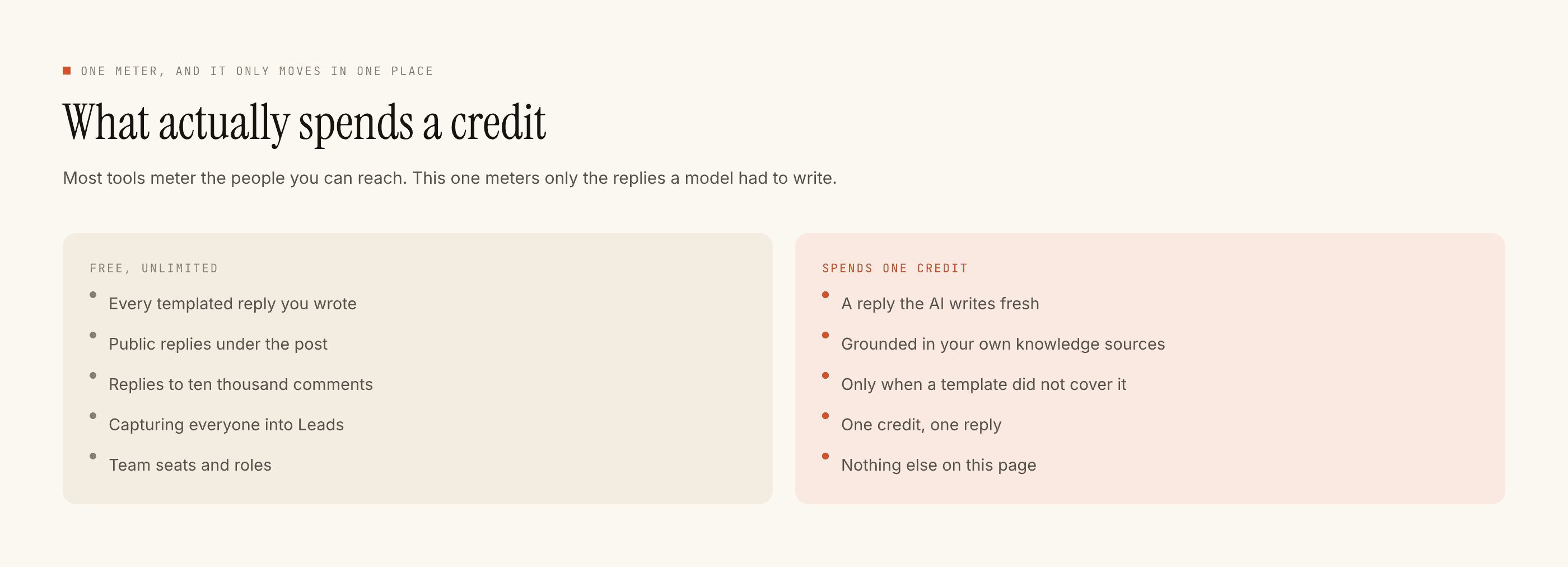
Ask what happens to the bill when a Reel travels. That single scenario separates these products more cleanly than any table.
Ask it as a scenario, not as a feature question. A post gets picked up, four hundred people comment, most ask the same three things. On a contact meter your bill steps up permanently. On our meter those replies are templates and cost nothing, and the handful of genuinely new questions spend a credit each.
The failure mode of our shape is worth naming too: if you never write templates and let the model answer everything, the meter runs. Rising credit spend is a signal to write a template, not a reason to buy a bigger pack.
Question two: what it will refuse to send
This is the question nobody asks in a demo and the one that decides whether the tool embarrasses you.
A tool that always sends is not more capable. It is a tool with no opinion, and the day a Reel travels it will reply to a complaint with a discount code at three in the morning. What you want to know is whether refusal is a designed part of the product or an absence.
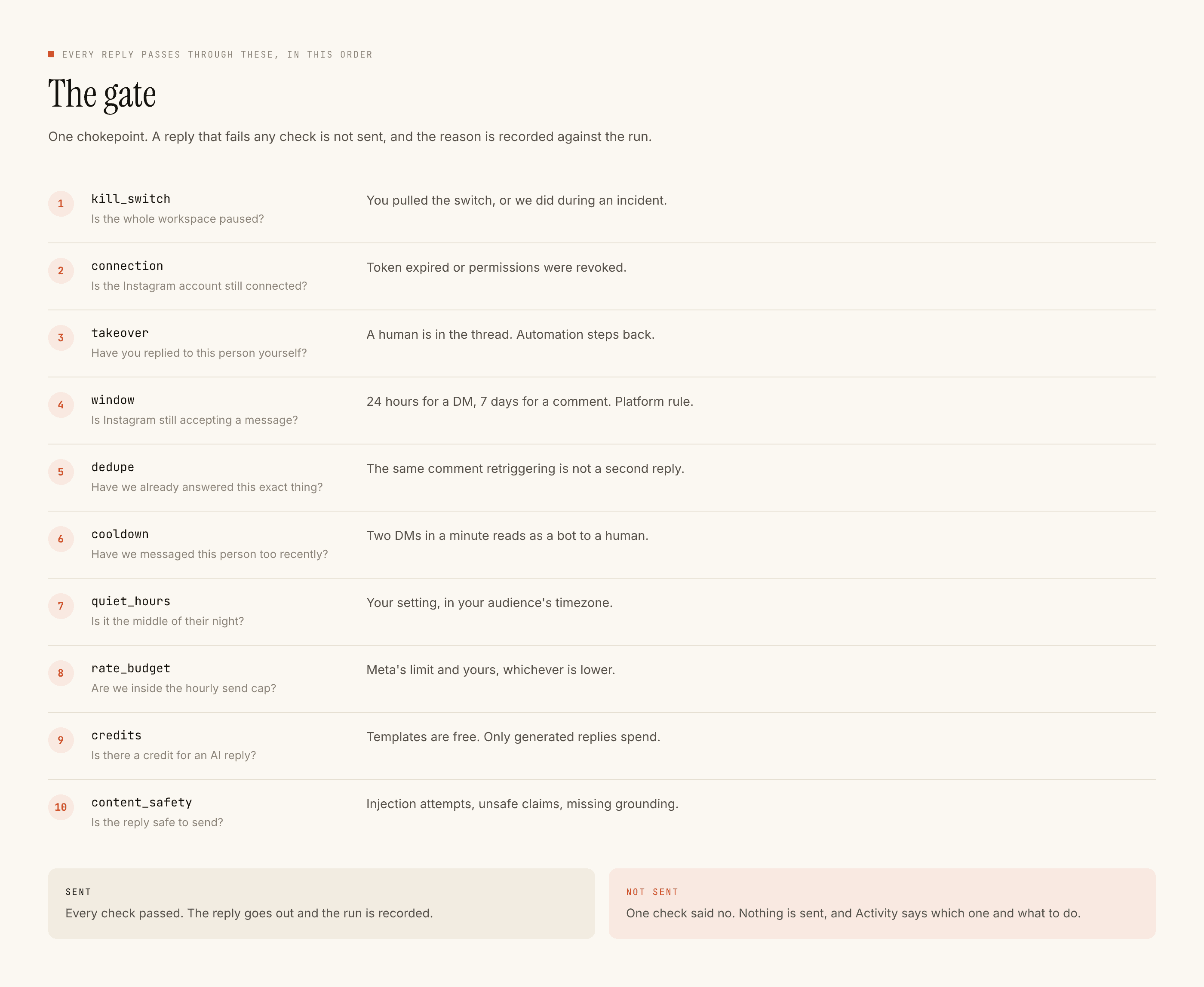
Four things to establish about any product, ours included.
- Is there an ordered list of checks, and can you read it? Ours runs
kill_switch,connection,takeover,window,dedupe,cooldown,quiet_hours,rate_budget,credits,content_safety, in that order. Order matters — a kill switch should not wait behind a model call. - Is a refusal recorded with its reason? A skipped reply you cannot investigate is indistinguishable from a bug. Every block here is written to Activity with the name of the check that stopped it.
- Does a human reply stop the automation? Takeover means the moment you answer by hand, the automation stands down in that thread. Without it you will talk over your own team.
- What does it do when the model is unsure? Ours sends your template instead. The generated reply is the upgrade; the template you wrote is the floor, and the floor is what ships when anything is off.
The third question, briefly: getting out
Cheap to ask and it tells you a lot.
Can you export what you have collected, in a format you can read, without asking anyone. Here the answer is a CSV and only a CSV — there are no one-click integrations and we do not pretend otherwise. A tool whose data only leaves through an integration it also sells is a tool you cannot leave on a Tuesday.
Why the feature grid misleads
What a feature grid compares
What these questions compare
Every item on the left is real and some of them will matter to you. Channels especially: we do Instagram and nothing else, no WhatsApp, no Messenger, and if that is disqualifying it is disqualifying. But feature counts are easy to compare, which is why they dominate, and they are close to uncorrelated with whether your replies are any good in six months.
Running it on ourselves
For completeness, since the framework demands it. We are Instagram only. There is no analytics product, no flow canvas, no broadcast, no sequences. Leads leave as a file. The meter is work performed, the refusal list is the one above, and every block is readable.
That is a narrow product and the questions above are the ones it was built to answer well. If you want the version with the competitor named, the head-to-head is here, and what the free tier actually gets you is the cheapest way to test any of this against your own inbox rather than against an article.