
Two Instagram tools both cost $39 a month. One of them will bill you four times that by December and the other will not. Nothing on either pricing page tells you which is which, because the thing that decides it is not the price — it is what the number next to the price is counting.
There are four meters in this category. Every tool you are comparing uses one of them, and once you can name which, most of the comparison does itself.
We build one of these products, so read this knowing that. The meters are described from each vendor's own published pages, with the date we read them, because they move.
The four meters
| Contacts | AI usage | Messages | Work done | |
|---|---|---|---|---|
| You pay for | people reached | model processing | each message sent | each AI reply written |
| A viral post | expensive | expensive | expensive | free if templated |
| One customer, fifty messages | free | expensive | expensive | depends what is written |
| Over the limit | you are billed | the bot pauses | you are billed | replies fall back to templates |
| Typical of | ManyChat | Chatfuel | WhatsApp providers | us |
Read the second and third rows together, because that pair is the whole decision. A contact meter charges for breadth and ignores depth. A message meter charges for depth and ignores breadth. If your account is a thousand people asking one question each, those two produce wildly different bills from identical work.
Contacts: your best month is your most expensive
A contact meter counts people who have ever triggered your automation. It climbs, and it does not come back down on its own.
ManyChat is the category example. Its free tier was cut to 25 active contacts in March 2026, with paid entry around $14 a month for 250 contacts and roughly $39 for 2,500, and contacts past your allowance billed at about five cents each. We could not read the pricing page directly while writing this — it sits behind a bot check, which is ordinary anti-scraping — so those figures are as consistently reported by independent pricing trackers rather than quoted from source. Check it yourself before committing. We wrote up the free tier change in the 25-contact cut.
The structural point matters more than the numbers. On a contact meter, the reel that works is the invoice that grows. Five hundred contacts past a 2,500 allowance is roughly another $25 on top of the $39, and the people who caused it are mostly people who asked one question and left.
AI usage: it stops instead of charging
The second meter leaves people and messages unlimited and bills the model instead.
Chatfuel is the example, and it is also the reason this post carries a warning about stale comparisons. Reading chatfuel.com/pricing on 24 September 2026, the plans shown were Business at $20 a month including $20 of AI credits, and Agency S at $90 a month including $100 of AI credits and support for three companies, with usage limits applying and a separate limits page. Several widely-linked comparison articles still describe the older structure — a free Light tier and an AI PRO plan around $49 to $69. Their own page is the one to trust.
What has been consistent is the failure direction. Where a contact meter sends a bigger invoice after a good week, this one goes quiet in the middle of one: exceed the AI allowance and the bot pauses until the period resets, with no overage charge. There is an escape hatch — supply your own OpenAI key and the limit stops applying, with OpenAI billing you directly. The migration path is in the Chatfuel alternative, and the two philosophies sit side by side in ManyChat vs Chatfuel.
Neither behaviour is a trick. They are opposite answers to the same problem and they fail in opposite directions. A launch with a deadline cannot afford silence; a thin-margin business cannot afford an uncapped bill. Decide which of those you are before you compare features.
Messages: a small number multiplied by a big one
The third meter is the WhatsApp business providers, and it is worth understanding even though it is a different channel, because the arithmetic shows up in blended quotes.
Gupshup's self-serve pricing, read on 24 September 2026, is a flat platform fee of $0.0010 per message on template and session messages, with WhatsApp's own per-message charges billed at actuals on top. There is no plan and no contact allowance: cost scales directly with volume.
A tenth of a cent sounds like nothing, and for most accounts it is. The thing to watch is that it is a markup on a meter you do not control, sitting on top of Meta's own conversation pricing, which moves on its own schedule. Two meters compounding is a different risk from one meter rising.
We do not do WhatsApp at all, so this section is here for completeness rather than as a pitch.
Work done: the meter we chose
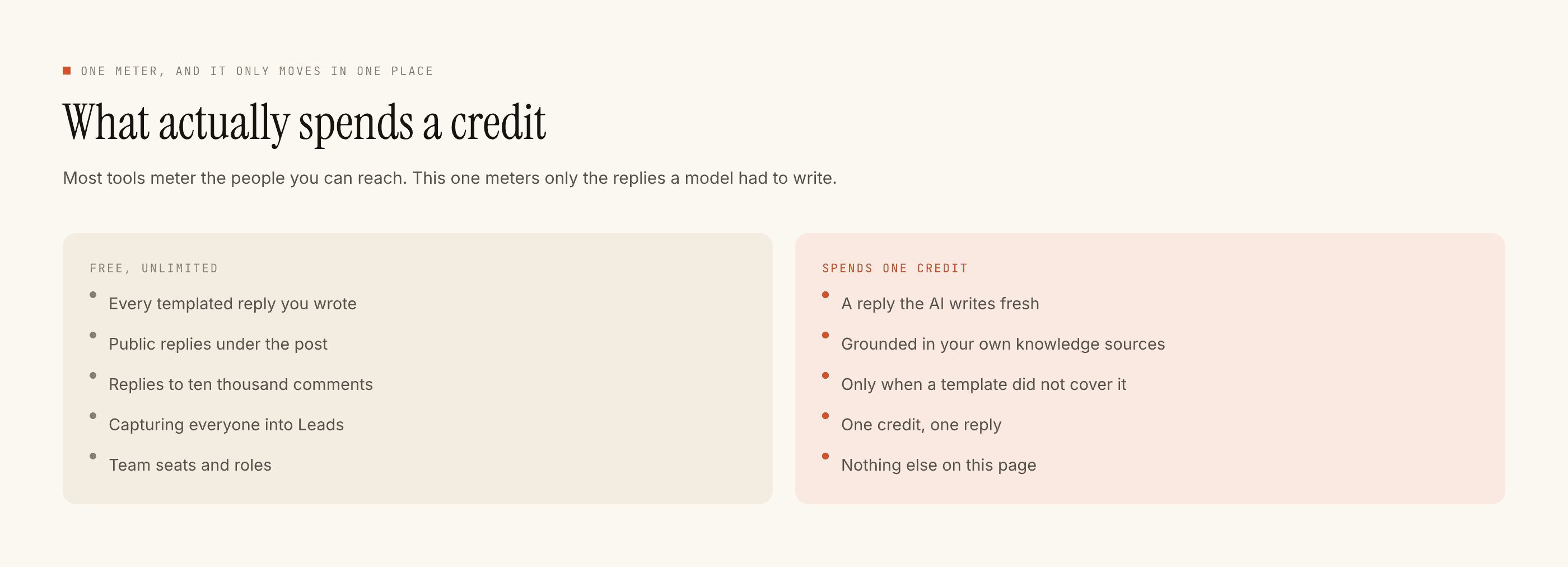
Ours counts AI replies. A reply sent from a template you wrote is free and unlimited, however many people receive it, because nothing there needed a model. A credit is spent when the model composes something new. Nothing is metered per contact, per follower or per conversation, and going over does not pause anything — it falls back to your template, which is the reply you would have sent anyway.
The free tier is 100 credits with no card. Packs start at $6.99.
That shape is better if most of your inbox is the same handful of questions, which for most small accounts it is. It is worse if every reply genuinely needs writing from scratch, and it is worth knowing that before signing up rather than after. It also does less than the tools above: Instagram comments and DMs through the official API, no scheduling, no flow-builder canvas, no other channels.
What a tool meters tells you what it wants you to do more of. Check that against what you actually want to do more of.
Before you compare a single price
Checklist
The last check is worth a minute of anyone's time. Every figure in this post came from a page that can change tomorrow, and while writing it we watched one vendor's structure move ahead of the articles describing it. Treat a comparison as a way to know what to look for, never as a substitute for looking.
Questions people ask
Why can I not just compare the monthly prices?
Because the numbers are not measuring the same thing. One plan buys a number of people, another buys an allowance of AI processing, another buys nothing at all and charges per message sent. Two plans at the same price can differ by a multiple on the same account, depending entirely on which way that account grows.
What is an active contact?
On a contact-metered tool it is a person who has interacted with your automation, counted once no matter how many messages they send. This is why the allowance empties faster than people expect: it is filled by reach, not by conversation volume. A reel that travels can consume a month of allowance in an afternoon.
Which meter is cheapest?
Whichever one matches the shape of your account. A business with few customers who each talk a lot is punished by a per-message meter and barely touched by a contact meter. A viral account with thousands of one-line comments is the opposite. Work out which of those you are before comparing anything.
Why do comparison sites show different prices from the vendors?
Because pricing in this category moves and the trackers lag. Checking these pages while writing, one vendor own site showed a plan structure that several third-party pricing articles still described the old way. Always open the vendor own pricing page before deciding, and treat any article including this one as a starting point.
Does PostEngage charge per contact?
No. Nothing is metered per contact, per follower or per conversation. Replies sent from a template you wrote are free and unlimited however many people receive them. A credit is spent only when the model composes something new, so the bill tracks writing rather than reach.