Playbooks · 5 min read
We Are Instagram Only. What Cross-Platform Really Costs

This product does Instagram. Comments and direct messages, through the official Graph API, and nothing else.
No WhatsApp. No Messenger. No Telegram. No cross-posting, no unified multi-channel inbox spanning apps, no rule that fires on Instagram and sends somewhere else. If your revenue runs through WhatsApp, this comparison is over in the first paragraph and you should buy a WhatsApp tool — that is a real need and a bigger product serves it properly.
For everyone still reading, the interesting question is not whether more channels is better in the abstract. It is what the second channel actually costs, because that bill is paid weekly and nobody itemises it before signing up.
A channel is not a checkbox
The pitch treats channels as destinations for the same message. They are not. Each one is a separate regime with its own rules, and the rules are not similar.
Different consent models. Different message windows. Different template approval processes, or none. Different definitions of spam, enforced by different teams. Different quality scoring that can throttle you without an email. Different tone conventions, because a message that reads as friendly in a DM reads as intrusive on a phone number.
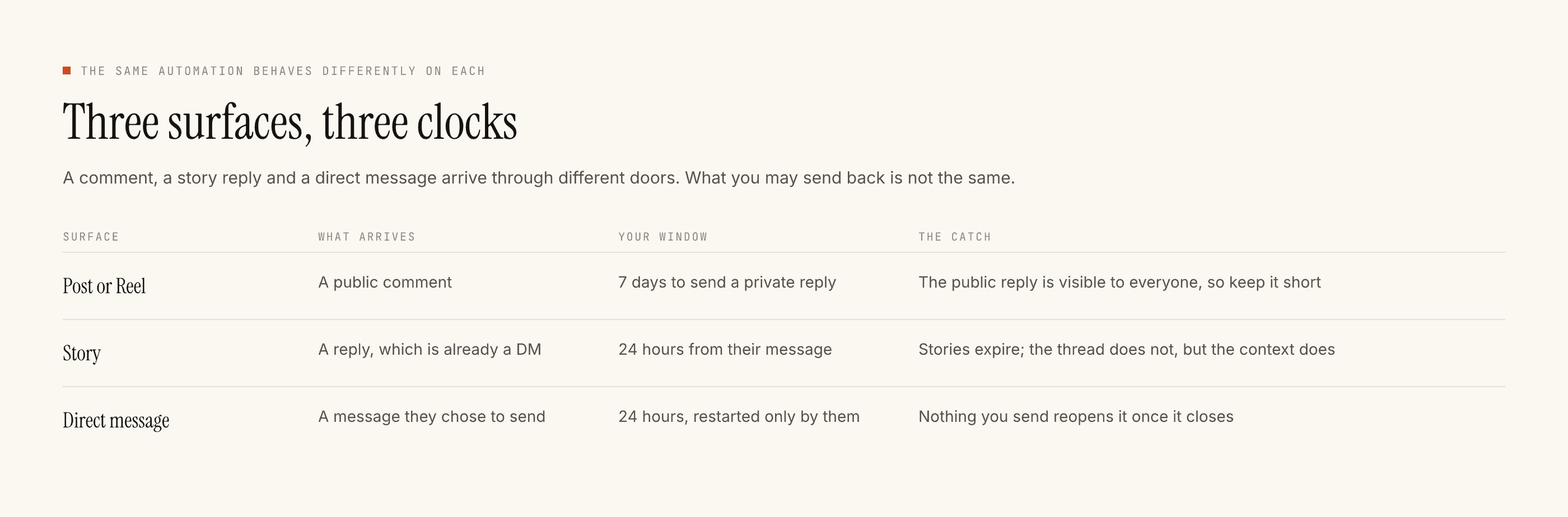
Even inside Instagram this is already true across surfaces.
What the second channel adds to your week
Not features. Work, in five specific places.
- A second consent regime to get right. Instagram permission comes from the person messaging you. Other channels want an opt-in you collected and can prove. Getting that wrong on a phone-number channel is a different order of consequence than getting it wrong in a DM.
- A second voice to maintain. The same sentence cannot go to both. A WhatsApp utility message is terse and functional. An Instagram DM reply is conversational. Copying between them is the most visible tell that a business has automated without thinking.
- A second inbox somebody has to watch. Automation answers the known questions. The unknown ones arrive in whichever inbox they arrive in, and a human has to be looking. Two inboxes with one person means one of them is stale, and it is always the newer one.
- A second failure surface you will notice late. A broken token, a rejected template, a rating drop. On your main channel you notice in an hour because the volume is obvious. On the second one you notice in eleven days.
- A message that fits nowhere. Teams eventually write for the lowest common denominator so one message can go everywhere. That message is worse on every channel than a channel-specific one would have been.
One channel done properly
Three channels done thinly
Nobody has ever lost a customer because a business was only reachable on Instagram. Plenty have lost one because the reply on Instagram was slow, generic or wrong.
What "properly" costs, for comparison
The whole of it is one permission grant and then attention to a small number of things.
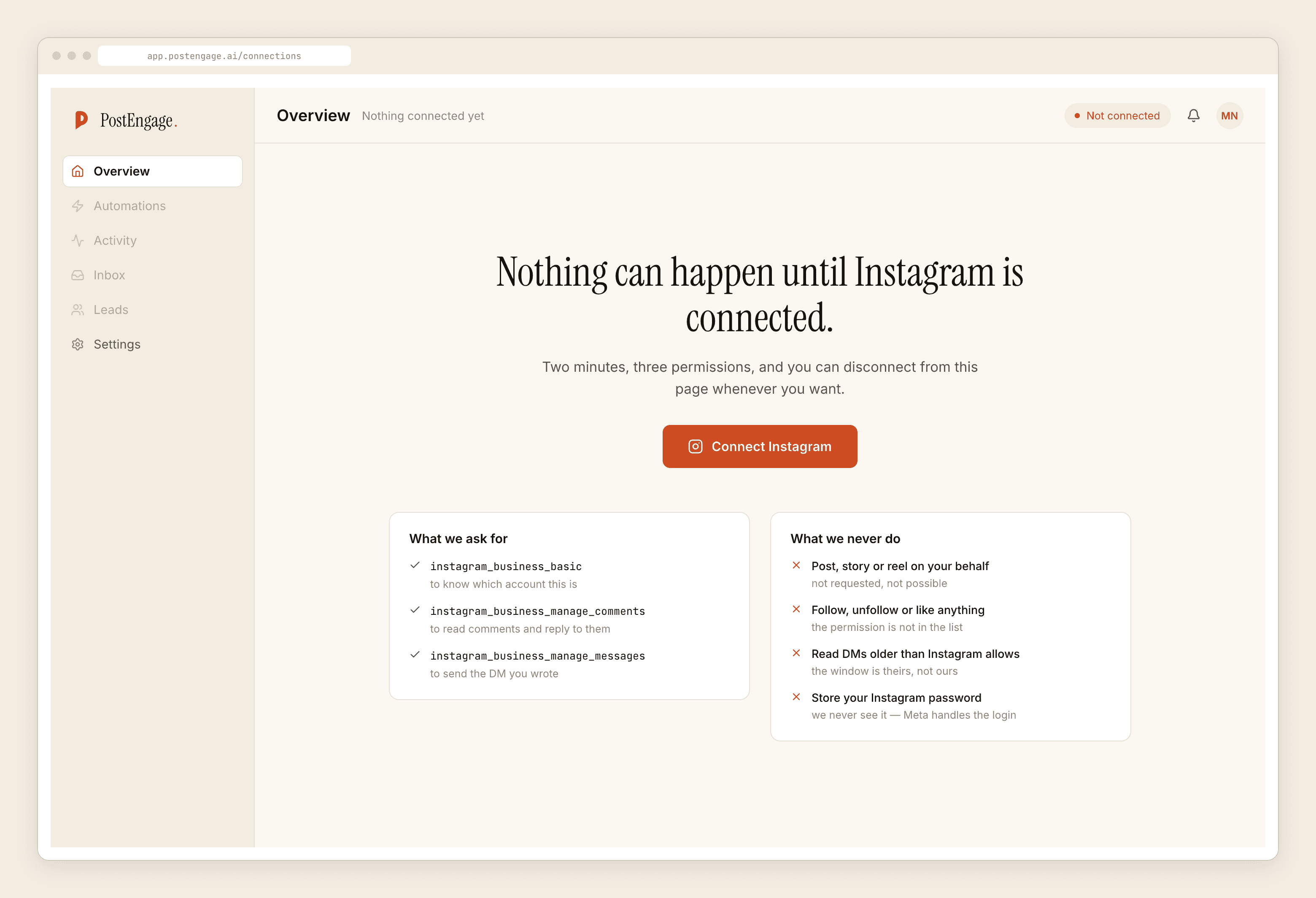
Then: a trigger list that covers the spellings people use, templates that answer the literal question, negative keywords for the cases that embarrassed you, and a weekly look at what got refused and why. That is a genuinely small amount of work, and it is small precisely because it is one channel. Multiply it by three and it stops being a weekly habit and becomes a job nobody has.
Moving somebody to another channel is a sentence, not a feature
This is worth separating out, because people conflate the two.
You can absolutely tell someone in a DM that your team is on WhatsApp and give them the number. That is not cross-platform automation. It is one message, written by you, and the person decides whether to move. It costs nothing, it breaks nothing, and it works fine.
What it is not is a bridge that carries the conversation, the context and the consent across for you. That bridge does not exist here, and where it does exist in other products it is usually thinner than the diagram suggests — the person still has to send the first message on the other side, because that is how permission works everywhere.
When a second channel is genuinely right
When it carries orders. Not enquiries, orders — payment confirmations, delivery updates, the things people expect on a phone. That is a different job from answering a question under a Reel, it needs a tool built for it, and running both is legitimate.
The mistake is adopting a second channel because a feature grid made one channel look small. Channel count is the easiest thing to compare and the least predictive of whether your replies are any good. The honest head-to-head with a multi-channel product puts our missing channels at the top of the page for exactly that reason, and what running on the official API actually constrains explains why these windows are not ours to widen. If the real requirement is getting leads out to another system, that is a CSV, and we are blunt about it.