These two get compared constantly in India, almost always on WhatsApp features. This is the other comparison: what each one offers a business whose customers arrive through Instagram comments.
We make an Instagram-only tool, so the disclosure is upfront. Every claim below was read from their own pricing pages on 24 September 2026.
What Interakt published
Starter is free and limited to one channel — Instagram only or WhatsApp only. Growth is ₹2,799 a month plus taxes, or ₹2,240 a month billed yearly, carrying WhatsApp and Instagram together with bulk campaigns, a shared team inbox, FAQ automations and linear chatbot flows, catalogues, native payments and carousels. On the Instagram side that tier lists unlimited DMs and comments, price automation and giveaway features. Advanced is ₹3,799 a month plus taxes with branching flows, API calls and conditions, chat auto-assignment and advanced webhooks. Enterprise is on request and adds RCS. Meta's per-message template rates for India are listed separately on the same page.
What AiSensy published
A WhatsApp platform. A free forever tier with the WhatsApp Business API and ₹50 of conversation credits, then Basic at ₹1,500 a month, Pro at ₹3,200, Premium at ₹9,100, Unlimited at ₹45,000 and Enterprise on request. Agent logins are included per plan with extra seats at ₹750 a month. Two builders are priced separately: a drag-and-drop chatbot builder at ₹2,500 a month for five chatbots and a WhatsApp AI agent builder at ₹1,350 a month including 1,000 AI messages. An Indian virtual number is ₹2,000 plus GST a year. Per-message rates for India are listed as marketing ₹1.09, utility and authentication ₹0.145, and service messages free.
When we read that pricing page, Instagram messaging was not on it. Instagram appears elsewhere on their site in the context of ads that click through to WhatsApp.
The cost shapes are genuinely different
A WhatsApp platform has four layers of cost: the subscription, the add-ons, the seats, and Meta's per-message charge every time you reach somebody. The last one grows with volume and is not the vendor's choice — every Indian WhatsApp platform passes it through and both of these publish the rates.
Instagram messaging inside the official API windows does not carry a per-message charge of that kind. That is a Meta difference rather than a vendor difference, and it is the reason an Instagram-only tool can be an order of magnitude cheaper than a WhatsApp stack without being a worse product.
The question is not which platform is better. It is whether you are buying a WhatsApp stack to fix an Instagram problem.
Three businesses, three answers
A D2C brand doing order updates, COD confirmation and abandoned carts. The money is in WhatsApp. Compare these two on WhatsApp terms — seats, broadcast speed, chatbot builder pricing, integrations — and ignore this page's angle entirely.
A coach or clinic whose enquiries arrive under Reels. The whole funnel is comment, DM, question, booking. A WhatsApp suite is capacity you will not use, and the one to look at first is whichever product answers the comment well.
A brand doing both. Interakt's paid tiers put both channels in one inbox, which is a real advantage for a team that does not want two tools. Whether it beats two specialised tools depends on how much of your volume is Instagram.
- Count where last month’s enquiries actually started. Not where they finished — where the first message came from.
- Add Meta’s per-message charge to any WhatsApp plan you are comparing. The subscription is not the bill.
- Check who needs a seat. Seat pricing is where WhatsApp stacks get expensive quietly.
- Then decide whether one inbox matters enough to pay for the channel you use less.
What neither page tells you about Instagram
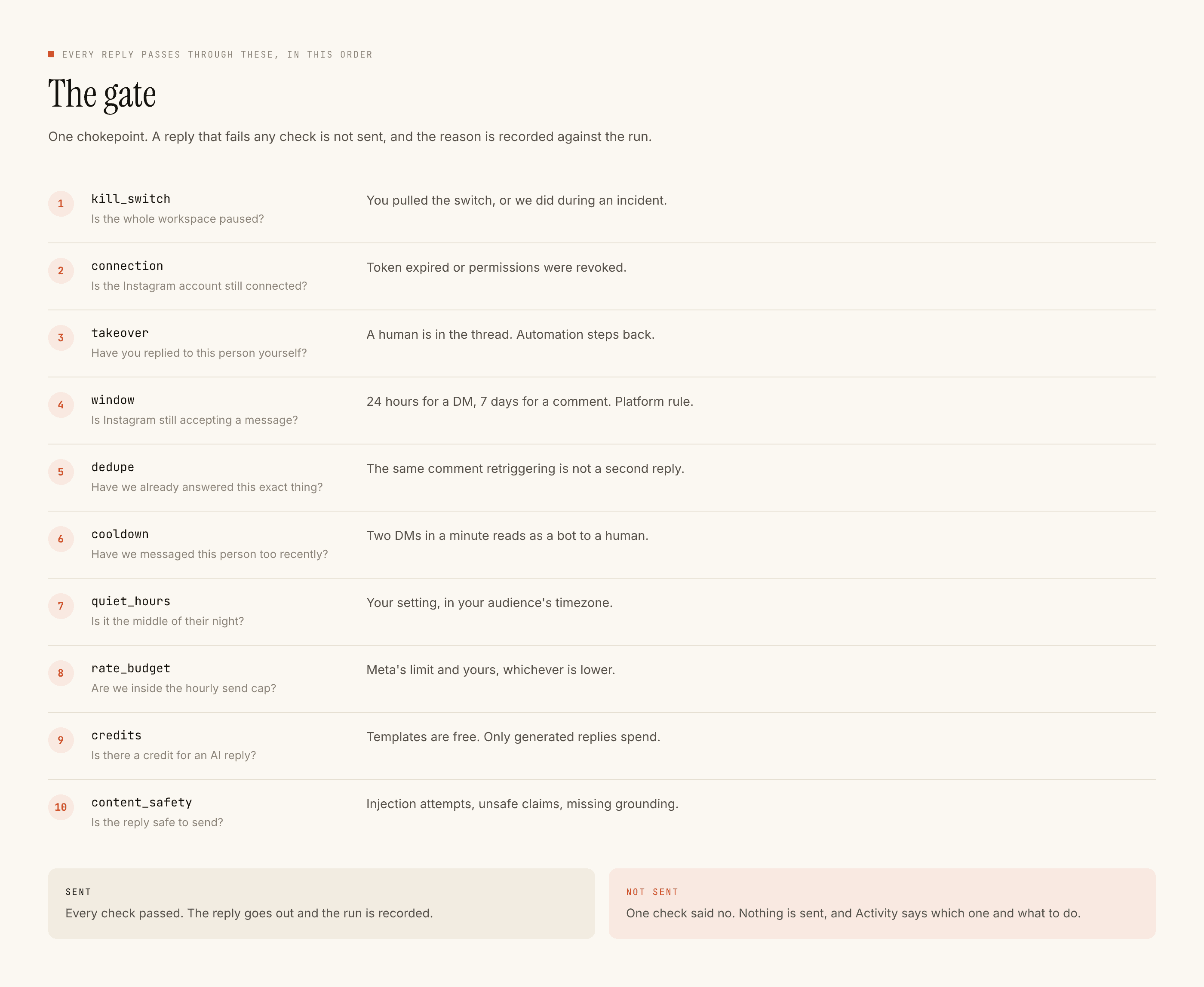
Both products, like every product on the official API, are bound by the same two clocks: a DM can be sent within 24 hours of that person's last message, and a comment can be answered within 7 days. No plan, on any platform, extends either.
What differs between tools is what happens at the edge of those clocks. A reply that arrives at hour twenty-five is not sent, and the useful question for any vendor is whether you can see that it was refused and why. On a multi-channel suite that information tends to live in a log designed for WhatsApp operations; on a specialised tool it is the main screen. Neither is wrong — they are built for different jobs — but it is worth checking before you assume Instagram will behave like the WhatsApp side of the product.
Where we fit, and where we do not
PostEngage does Instagram comments and DMs on the official Graph API and nothing else: no WhatsApp, no campaigns, no catalogue, no payments, no RCS. Templated replies are free and unlimited, and one credit is spent only when the model writes a new reply in your voice. The free tier is 100 credits with no card.
If WhatsApp carries your revenue, buy one of the two products above. If Instagram comments are where it starts, the sourced head-to-heads are on Interakt and AiSensy, and what an Instagram tool can and cannot do inside Meta's windows is in is Instagram DM automation safe.
The rupee and invoice questions worth settling before any of these subscriptions start are in GST and Instagram automation.