Comparison · 4 min read
AiSensy Alternative: Judge a Tool by What It Refuses
The disclosure that makes the rest of this readable: PostEngage does not ship WhatsApp. AiSensy does. We are not the alternative, we will not rank a product we have not run at your scale, and we are not going to imply anything about anyone's compliance — every vendor in this category operates on Meta's Business API and works inside the same rules.
What is left is the evaluation question that separates these tools more than any feature grid, and it is the one demos are structurally bad at showing.
Sending is the easy half
Every product in this category sends messages. That capability was solved years ago and it is not where the engineering goes.
The hard half is declining to send. A message that should not have gone out cannot be recalled, it goes to a real person, and on WhatsApp it lands next to their family chats rather than in a feed they scroll past. The cost of a bad send is asymmetric, and a tool's attitude to that asymmetry is the most informative thing about it.
A demo shows you what a tool does. What it declines to do only shows up on your worst week.
The six refusals worth asking about
Ask these of any vendor. They are the same questions we would want asked of us.
- What happens when the model is unsure? Two acceptable answers: send a fixed message you wrote, or hold it for a person. One unacceptable answer: send something plausible. A product with no answer here is sending confidently and being wrong in public, under your name.
- What happens when a human replies by hand? The automation should stand down for that thread instantly, stay down, and require nothing to be remembered.
- Does the same person get answered twice? Someone who asks the same thing in two messages should get one reply. Deduplication is unglamorous and it is the difference between an assistant and a machine.
- Is there a never-send list, and can you edit it? Refunds, complaints, anything about money that has already left an account, anything medical. If that list is not yours to write, volume will eventually put a cheerful template on top of a furious customer.
- Are there quiet hours, and are they per-timezone? A 2am reply is technically fine and socially not.
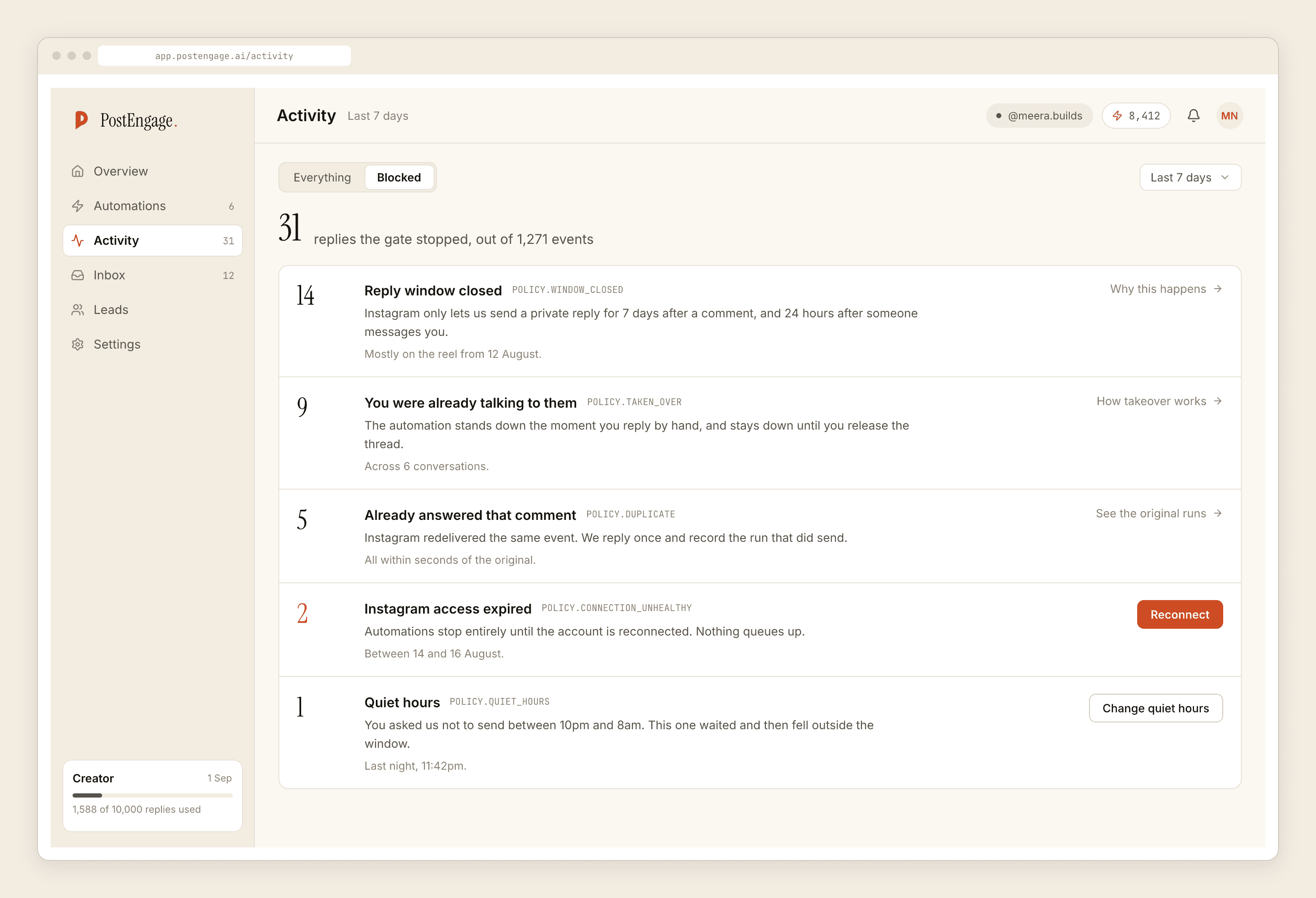
- Can you see what was not sent, and why? This is the one that makes the other five verifiable.
The refusal log is the load-bearing feature
If a tool records only what it sent, every question about its behaviour becomes a guess. Why did that customer not get a reply? Did the automation fire? Was it blocked? Nobody can tell you, including support.
A refusal with a named reason turns that into a lookup. Not "something went wrong" — the specific check, on the specific message, at the specific time. Debugging becomes reading rather than reasoning, and you stop needing the vendor for routine questions.
This is also the honest test of whether a vendor believes its own guardrails. Refusals are embarrassing to display. A company that shows them has decided your ability to audit matters more than its screenshots looking clean.
Refusals cost you something, and that is the trade
Be clear-eyed: a tool that refuses more sends less. Dedupe means the person who asked twice gets one answer. Quiet hours mean a midnight question waits until morning. A narrow trigger means a genuine customer sometimes gets nothing automatic at all.
Tools that always send feel more responsive in a demo and produce a worse month. But it is a real trade, not a free win, and you should choose your position on it deliberately rather than absorb whichever one your vendor happened to pick.
What we can honestly claim
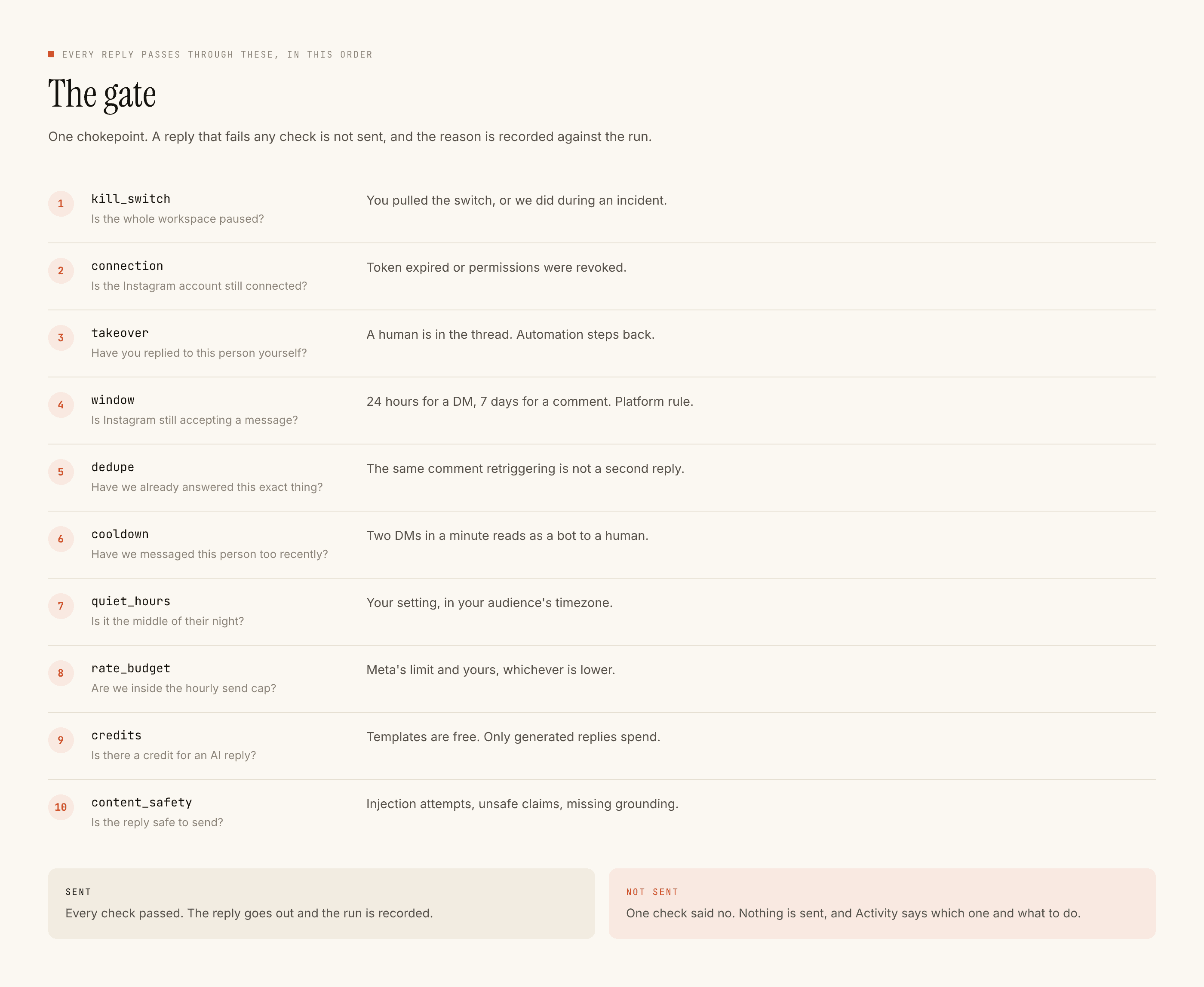
Instagram comments and DMs, official Graph API, nothing else. Ten named checks before every send, in a fixed order, and a blocked reply recorded with the reason it was blocked. A generated reply has to be grounded in something you supplied; if it is not, or the model is unsure, your own template goes out instead or the draft waits in a review queue.
Templated replies are free and unlimited, a credit moves only when the model writes something new, the free tier is 100 credits with no card, and packs start at ₹499.
If WhatsApp is where your revenue is, buy a WhatsApp tool and take these six questions with you. Then ask what is metered and ask what the exit looks like. For how grounding actually works on our side, that has its own explanation.