Playbooks · 4 min read
Your Reply Rate Is Decided by the Last Sentence You Write

Most of the numbers people want from this channel are either invisible or not yours to move. Reply rate is the exception, and it is worth more attention than it gets for two reasons.
It is the only unambiguous evidence available to you that a human read the message. And their reply is the only thing in existence that restarts your twenty-four hour window, which makes it the difference between one turn and an actual conversation.
Nearly all of the movement in it comes from a single sentence: the one you end on.
Everything before the question is table stakes
Briefly, because they are covered properly elsewhere and because getting them wrong makes the question irrelevant.
Answer the thing they actually asked, first and specifically. Do not open with a link — a link with no answer reads as a broadcast, gets tapped or ignored, and either way ends the conversation. Do not defer; "our team will get back to you shortly" spends the guaranteed turn saying nothing. Write in the register you would speak in, on a phone, at arm's length. The four things that quietly suppress replies is the longer version of this paragraph.
Assume all of that is right. Now the last sentence.
Five kinds of closing question
- The open field. "Let us know your requirements." "Tell us more about what you're looking for." This asks the person to compose something, which is work, and work is what they were avoiding by typing one word in a comment.
- The choice. "M ya L?" Two options, one thumb, three characters. This is the one that works and it is not close.
- The confirmation. "Bangalore mein deliver karna hai?" A yes or a no. Slightly weaker than a choice because a no can feel like an ending, but it still costs nothing to answer.
- The manufactured. "Reply YES to continue." Everybody can see what this is for, and a window held open by a message nobody meant to send is not a conversation you can do anything with.
- The already-answered. "Want the price?" sent immediately after the price. It reads as not having listened, which is the impression an automated reply is most at risk of giving anyway.
Two of those five get answered reliably. The rest are the reason inboxes go quiet after one message.
The question is not there to gather information. It is there to buy another twenty-four hours, and it has to be cheap enough that somebody pays.
Four rules that hold across all of them
One question, not two. Two questions is a form, and people do not fill in forms in a DM. If you genuinely need two answers, ask the one that unblocks the sale and get the other next turn.
Put it last. A question buried in the middle of a paragraph gets read past. The final line is the one people actually respond to, because it is the last thing on the screen before the keyboard.
Make it about the thing they asked. Somebody who asked about a price and receives a question about their skincare routine has been handed a survey. The question has to be a natural continuation of their own message, or it is an interruption.
Ask something you actually need. If you would not use the answer, do not ask. A person notices being processed, and the cost of noticing is the reply you wanted.
Register does more work than the wording
The same question in two registers gets different reply rates, and the gap is larger than most rewrites of the question itself.
"Kindly confirm your preferred size at your earliest convenience" and "M ya L?" ask for identical information. One sounds like a form letter from an organisation, the other sounds like a shop. People answer shops.
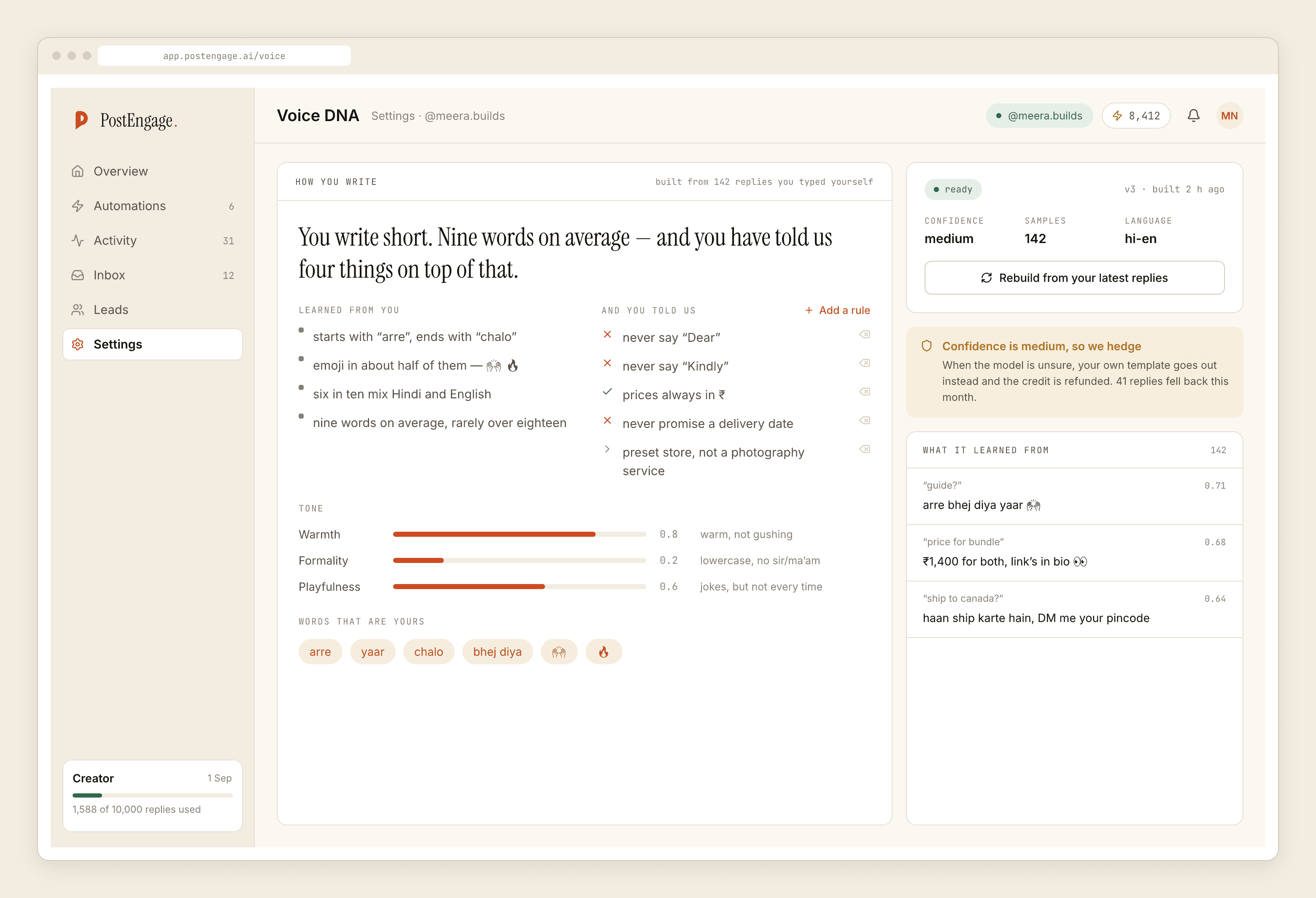
The failure mode is specific and it is almost universal on first setup: people write templates formally because writing a template feels like writing a document. Read every template out loud before it goes live. If it sounds like a bank, rewrite it.
Counting it, since nothing counts it for you
There is no dashboard, no response rate metric and no reporting. You count it by hand, weekly, and it takes about ten minutes: how many conversations started, how many came back with anything at all.
Write both numbers down somewhere you own. A single week's figure means nothing; six weeks of it tells you whether the last sentence you changed did anything. Six columns and ten minutes a week is the format worth stealing.
What to change first
If your replies currently end with a link, change that before anything else. If they end with an open field, replace it with a choice between two things. If they end with nothing at all, add a choice.
That is usually the whole intervention, and it costs an afternoon of rewriting templates. Designing the one message it sits inside is the next read, and it is built on the same fact: you get one turn unless somebody gives you another.