Playbooks · 5 min read
How to Write a DM Reply People Actually Answer

The word "script" is doing damage here, so let us drop it. A script implies a performance with a predetermined ending, and the thing you are actually writing is one message to one person who asked you a specific question. It is closer to a good text back than to a sales page.
There is also a hard constraint that shapes every sentence. Instagram's messaging window runs for twenty-four hours from their last message, and only another message from them restarts it. Nothing you send extends it. So a reply that does not earn an answer is not the start of a conversation — it is the whole conversation, and it has ended.
The only observable success of a reply is that they write back. Everything else is a guess.
Start with the question they asked, not the one you wish they had
The most common failure is a reply that answers a category rather than a person. Somebody asks whether a jacket comes in navy and receives a paragraph about the brand's commitment to quality.
Read the message literally. If it contains a question, the first sentence of your reply should answer that question. Not context, not a greeting that runs three lines, not a pitch. The answer.
Answers a category
Answers the person
The left one is not rude. It is just useless, and it costs the reader a second message to get the fact they came for. In a channel with a clock running, an extra round trip is an actual cost, not a stylistic preference.
Put one question in, and make it easy to answer
Because their reply is what restarts the window, the single highest-value element in your message is a question they can answer in one word.
"Which size?" works. "Let me know if you have any other questions!" does not, because it asks for initiative rather than an answer, and most people do not have any.
- Make it closed. "M or L?" beats "what size are you after?", which beats "let me know your requirements".
- Make it the last thing. A question buried in the middle of a paragraph gets skimmed past.
- Ask one. Two questions in one message reliably produce an answer to one of them, and you will not know which.
- Do not ask what you already know. If they said navy, do not ask which colour. It reads as not having been read.
Say the price
Half the DM advice in this category tells you to deflect the price question and "get them on a call". In a DM, deflection reads as evasion, and it is the fastest way to end a conversation that was going fine.
If you have a price, give it. If the price genuinely depends on things you do not know yet, say what it depends on and give the range you are confident about. "Depends on the piece — most of the commissions I take are between X and Y, and the size is what moves it" is a real answer. "DM me for pricing", sent inside a DM, is not.
The four things that make a human reply sound automated
Worth knowing because you will do at least two of them by accident.
- The wrong register. People write templates in a formality they never use in real life, because writing a template feels like writing a document. If you would normally say "haan hai, kal tak bhej dungi", write that. A template in a register your audience has never heard from you is the tell.
- The greeting stack. "Hi! Hope you're doing well! Thanks so much for reaching out!" is three sentences before any information. Nobody types this to a friend.
- Punctuation that never varies. Every message ending in an exclamation mark, every message the same length. Real writing is lumpy.
- Answering a thing they did not ask. The clearest possible signal that the reply was assembled rather than written.
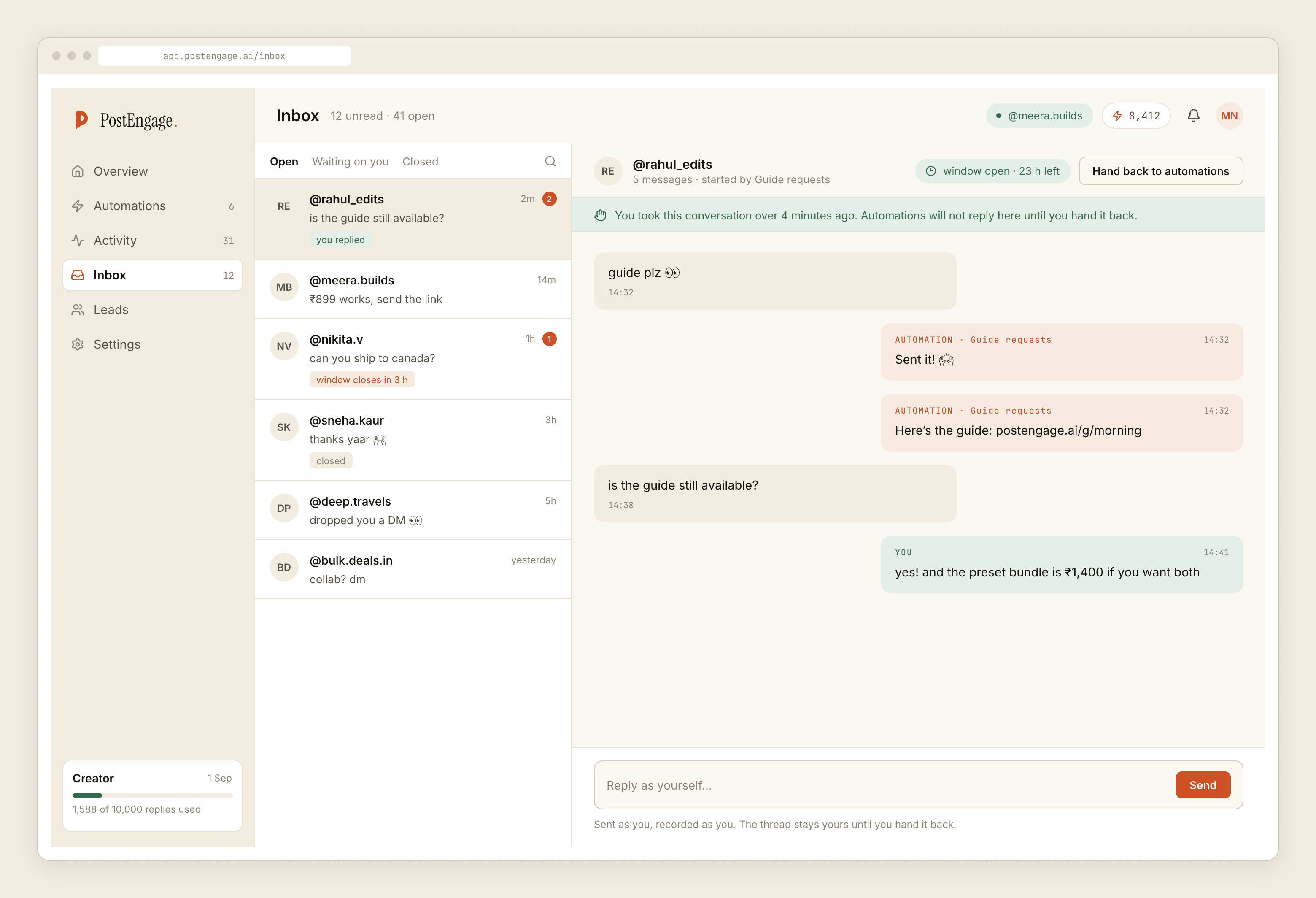
Write the templates for the questions that repeat
Once you have written a good reply once, the repeat version of that question should get the same reply, and it should cost you nothing. Templated replies are free and unlimited here — a credit is only spent when the model has to compose something new — so the work of writing four good ones pays back permanently.
Four usually covers most of an inbox: price, availability, delivery, and some version of "will this work for me". Write those four properly and the remaining messages are the interesting ones, which are also the ones worth your attention.
Never automate four things
Some messages should not get a written-in-advance answer at all, and the way to enforce that is a negative keyword list that stops the automation and puts the message in front of you.
Anyone who is angry. Anyone describing a problem with something they already bought. Anything about money that has already moved — refunds, failed payments, "paisa kat gaya". And anything you cannot verify, which for most businesses means a delivery date.
A template landing on top of one of those is the single worst message this kind of system can send on your behalf, and it is entirely avoidable.
The short version
Answer the literal question in the first sentence. Give the price. End with one closed question. Write it the way you talk. Template the four that repeat, and route the four that must not be templated to yourself.
If you want the mechanics of building that — triggers, negative keywords, testing before you go live — the setup guide covers it step by step. If you want the argument for why a template is often better than a generated reply, that is here.