Playbooks · 5 min read
Generative AI on Instagram: We Write Replies, Not Posts

Set the scope first, because "generative AI for Instagram marketing" is a phrase that covers two completely different jobs and most articles quietly do the easier one.
We do not create posts. No caption generator, no hashtag tool, no content calendar, no scheduling or publishing, no Reel performance prediction, no image or video generation. If that is what you came for, this post will not turn into it three sections down.
What we generate is replies. One at a time, to a real person who asked something, inside a window that closes. That is the other half of generative marketing on Instagram, it gets a fraction of the attention, and it is the half where a bad output has a named recipient.
Why a reply is the harder generation problem
A caption is a low-stakes generation task and it is worth saying why, because it explains the whole difference.
A caption has no recipient. You can regenerate it eleven times, read it in the morning, change one word, or throw it away at no cost. Nobody is waiting. Nothing expires. If it is mediocre, it is mediocre in public and then it scrolls away.
A reply has exactly one reader, who asked a specific question and is going to act on the answer. There is no second draft after it sends. There is a clock — seven days on a comment, twenty-four hours inside a DM thread, restarted only by their message. And a wrong answer about your price or your delivery area is not a bad piece of copy, it is a wrong statement to a customer, sent under your name.
The generative task everyone shops for has no stakes. The one that has stakes is the one nobody sets up carefully.
What actually gets generated here, and when
Not everything. The design assumes most of an inbox repeats, and the repeating part should never be generated at all.
A templated reply is something you wrote, stored, and sent as-is. It is free and unlimited, at any volume, forever. Generation happens only when nothing you wrote covers what somebody asked — and then it is one credit, one reply.
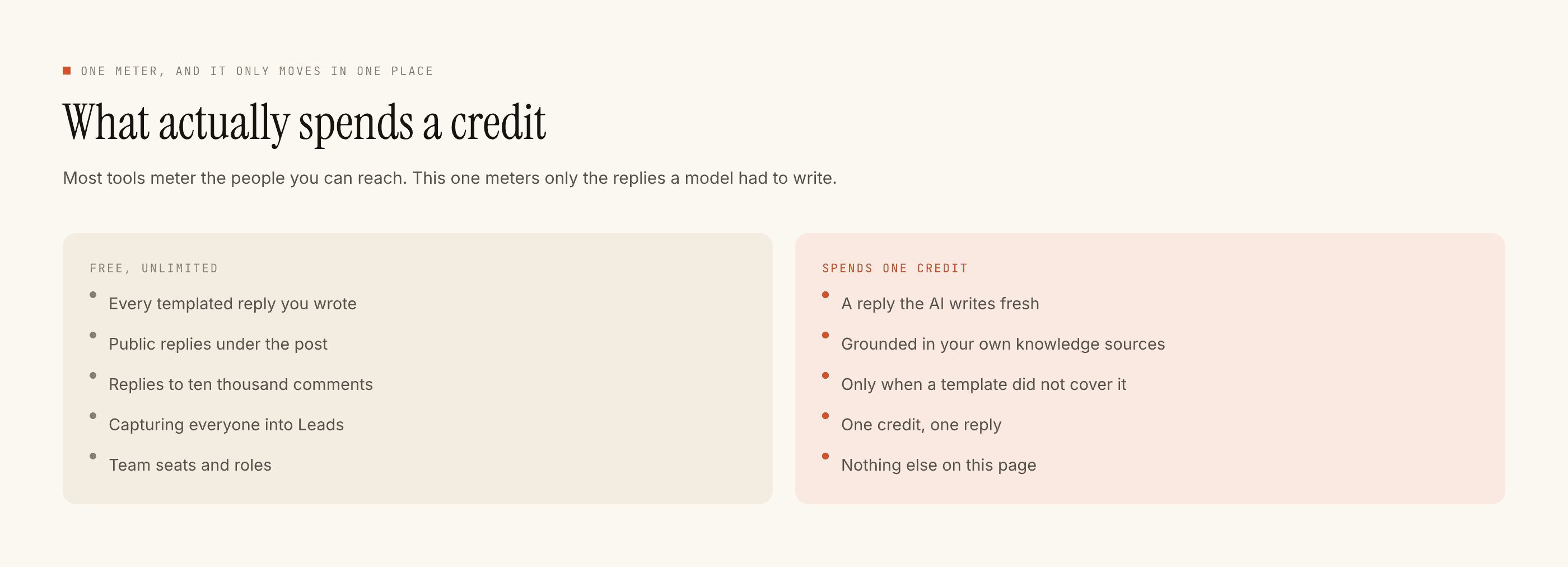
That shape has a consequence worth internalising. Generation is the exception path. If your credit ledger is long, that is not a billing problem to solve by buying a pack — it is a list of the questions you have no template for, which is the most useful document the product produces.
The register problem, which is the whole thing
Generated text has a house style, and it is not yours. It is slightly too complete. It answers in full sentences where you would have sent four words. It says "Absolutely!" and "I would be happy to help you with that", which is nobody's register in an Instagram DM. It never sends a bare "haan, available hai".
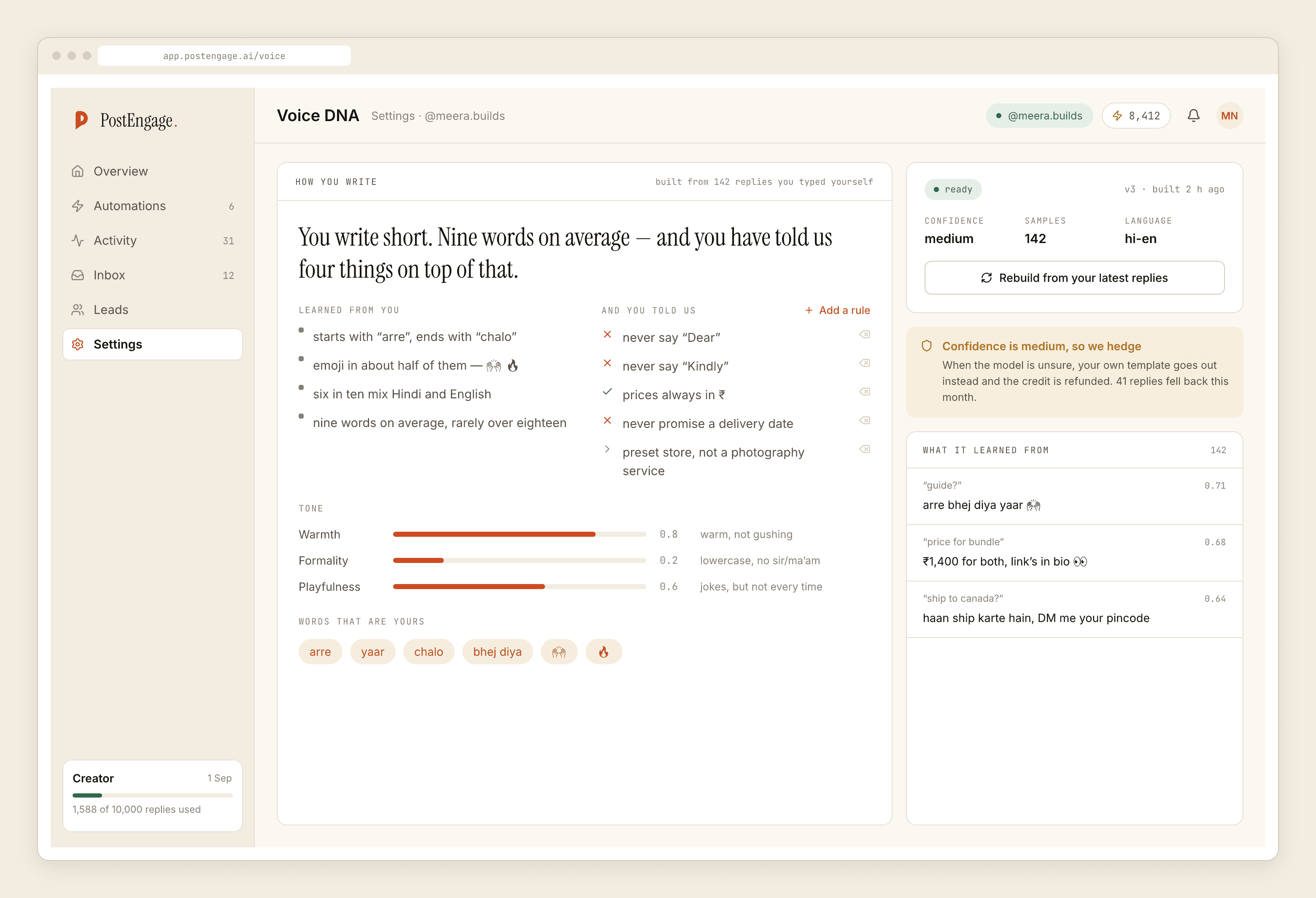
The correction here is that the voice profile is built from replies the account owner actually wrote, not from a tone dropdown. That is a real mechanism and it has a real limitation attached: a new account with no reply history has nothing to learn from, so the earliest drafts read flat. That is the cold start, we cannot design around it, and what a voice profile can and cannot know sets out the rest of the boundary.
Where generation is simply the wrong tool
Three cases, and they cover more of a normal inbox than people expect.
Questions with exactly one correct answer. Hours, price, delivery areas, the link. A stored sentence you wrote is more accurate than a fresh composition and it cannot drift. Generation adds variety where variety is a defect.
Anything about money, health, or a complaint. A model produces a fluent, plausible, general answer to a question whose real answer was "it depends". Keep those out with negative keywords and answer them yourself.
Anything you have never written before. If there is nothing in your history about how you handle an angry customer, generation will produce your usual cheerful register aimed at somebody who is furious, which is exactly wrong.
The one place captions genuinely connect to this
There is a real link between what you publish and what gets replied to, and it is smaller and more concrete than "content strategy".
The caption is where the trigger word lives. "Comment PRICE and I will send it" is a caption line that decides whether an automation fires at all, and the phrasing you choose determines what people type. Ask for a word people can spell, one word rather than a phrase, and one that does not collide with how they talk about something else. Then widen the keyword list to what they actually type anyway, because they will improvise. Choosing trigger words is the post on that, and what a caption tool would and would not do for you covers the publishing side we do not touch.
The short version
Generative AI for Instagram marketing splits cleanly. One half is drafting things nobody is waiting for. The other half is answering a person under a clock, in your own register, with a record of what went out.
We only do the second, we charge only for the part of it a model actually wrote, and the best result comes from generating less of it rather than more.