Playbooks · 5 min read
The DM That Gets Answered: One Reply, Five Drafts
On this page

There is no conversion rate in this product. No funnel report, no stage tracking, nothing that can tell you which version of a message did better. The argument for why that is structural rather than a gap is a separate post and worth reading first.
This one assumes you have accepted it and are now stuck with the actual work, which is choosing the words in one message. That sounds thin until you sit down and do it. Below is a real rewrite of an ordinary reply, one pass at a time, with the text at every stage.
The starting version is the one almost every account sends on day one:
Hi! Thank you so much for your interest in our products 😊 Kindly check the link in our bio for pricing and other information. Let us know if you have any questions!
Forty-two words. It is polite, it is grammatical, and it will not get a reply.
Pass one: delete everything before the answer
"Hi! Thank you so much for your interest in our products" is scaffolding. It exists because the writer felt they had to open a letter. Nobody opening a DM notification reads it — the preview line on the lock screen shows roughly the first seven words, and in this version all seven are throat-clearing.
Kindly check the link in our bio for pricing and other information. Let us know if you have any questions!
Twenty words now, and it got worse to read, which is the point of doing this in passes. The problem underneath is visible now that the padding is gone.
Pass two: the reply must contain the answer
They typed PRICE. This message does not contain a price. It contains directions to a price, which means the person has to leave the thread, go to your profile, tap out of the app, find the page, and scroll. Most of them will not, and the ones who do are annoyed by the time they get there.
This is the single most common reason a thread dies, and it is not a tone problem. It is a message that made someone ask again.
The kurta sets are ₹1,850 and the co-ord sets are ₹2,400. Delivery is 3-4 days across India. Let us know if you have any questions!
Now there is something in it. It is also now the longest version so far, which is fine — length spent on the answer is length well spent, and length spent on manners is not.
Pass three: use their words, not your catalogue's
They wrote "kurta set". Your product sheet says "ethnic co-ord". If the reply translates their vocabulary into yours, it reads like it came from a system, because it did.
The same applies to register. If you would say this out loud in Hinglish, write it in Hinglish. A reply that reads like a support macro gets treated like one.
Kurta sets ₹1,850 hain, co-ord sets ₹2,400. Delivery 3-4 din, all India. Let us know if you have any questions!
This is the pass with the largest effect and the one people skip, because writing a template feels like writing a document and documents get written formally.
Pass four: the ending is doing nothing
"Let us know if you have any questions" is not a question. It is a wave. It asks for nothing specific, so it gets nothing specific, and the twenty-four hour window starts running down.
Replace it with one question that can be answered with a thumb. Closed beats open, always.
Kurta sets ₹1,850 hain, co-ord sets ₹2,400. Delivery 3-4 din, all India. Kaunsa size chahiye — M ya L?
The window matters here in a way that is easy to underestimate. Their reply is the only thing that restarts your twenty-four hours. A message that ends in a wave is a message you sent into a room that locks behind it.
Every sentence in the reply is either the answer or the question. Anything that is neither is padding you are asking someone to read on a phone.
Pass five: read it where they will read it
Twenty-one words, two facts, one question. Now open Instagram on your phone and send it to yourself.
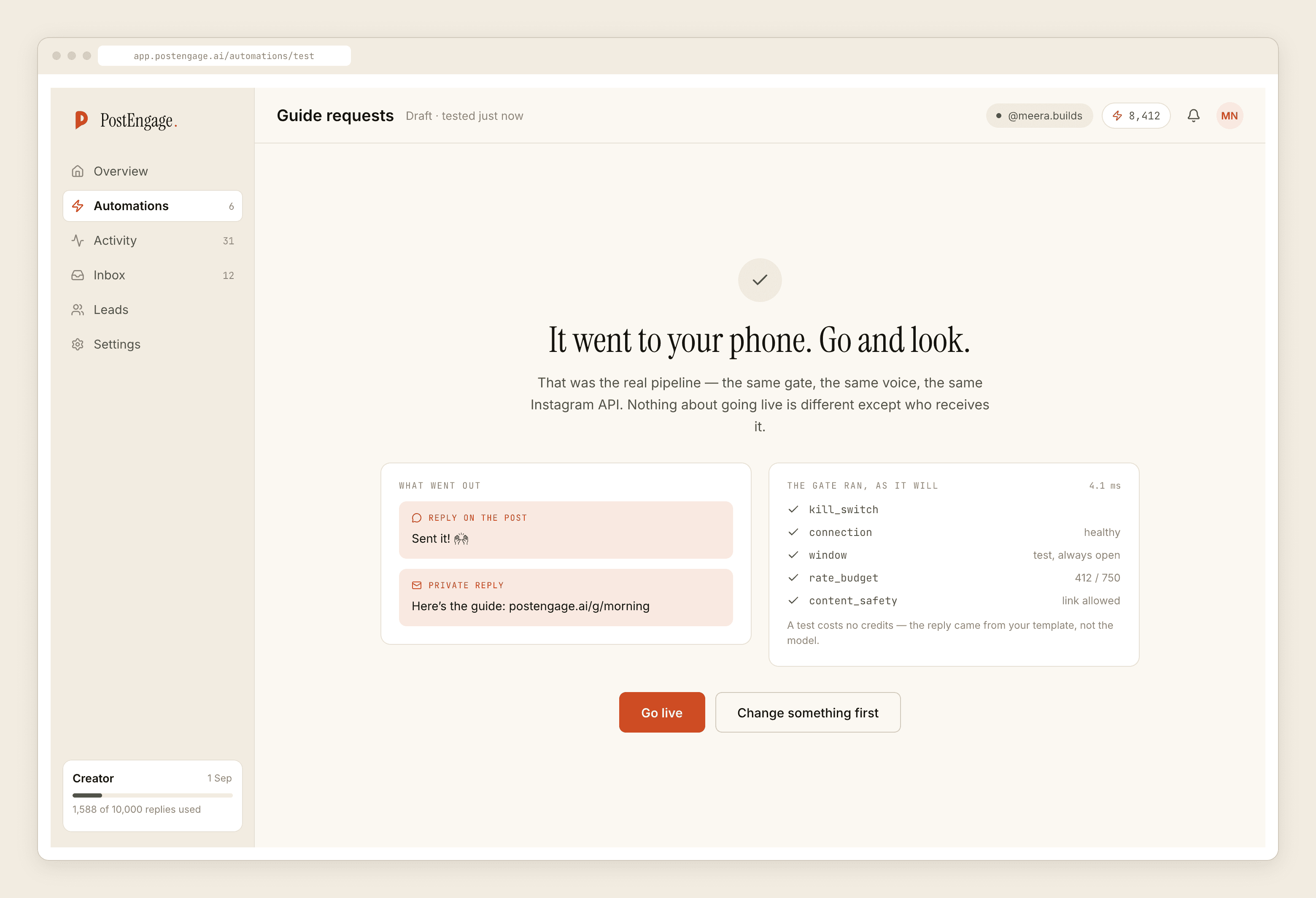
Three things become obvious in that second of reading and are invisible in a text editor. Whether the first seven words say anything. Whether the price is legible or buried mid-sentence. Whether it sounds like you or like a company that bought a tool.
What you are allowed to conclude from all this
Nothing statistical. You did not run an experiment, you edited a message, and before-and-after on a live account is not a test — traffic changed, the post changed, the week changed.
What you can do is read twenty of your own sent replies once a month as the person receiving them, and find the one sentence that keeps failing. That is slower and less satisfying than a dashboard. It is also the whole of the available method.
The three edits that are not edits
Some dead threads are not copy problems, and they look exactly like copy problems.
The reply fired on the wrong comment. A trigger set too wide answers a compliment with a price list. Negative keywords fix that, and rewriting the message does not.
The reply arrived at 3am. Quiet hours exist for this. A perfect message read at seven in a stack of forty notifications is a message nobody answers.
The reply arrived twice. Two overlapping automations. The dedupe check catches most of it, and Activity will tell you it did.
If the wording still feels off after all five passes, the problem is usually the profile the generated replies are grounded in rather than the template itself — that is where the register lives. And if you want the wider set of habits that survive a twenty-four hour window, they are collected here.