Lead generation · 5 min read
How to Optimize an Instagram Funnel You Cannot Measure

Funnel optimisation has a standard loop: measure each stage, find the worst one, change it, measure again. It is a good loop and it needs a first step that does not exist here.
There is no funnel analytics in this product. No stage-by-stage conversion view, no drop-off chart, no cohort, no link tracking, no attribution back to a sale. You cannot see who opened the DM, who tapped the link, or who bought afterwards. If a screen somewhere promised you a funnel dashboard, it was not this one.
That removes the usual method entirely. What remains is two levers you genuinely control, and one log that tells the truth.
Lever one: take stages out
A stage you cannot measure is a stage you cannot tune, and a stage you cannot tune is best removed. This is unglamorous and it is where nearly all the available improvement lives.
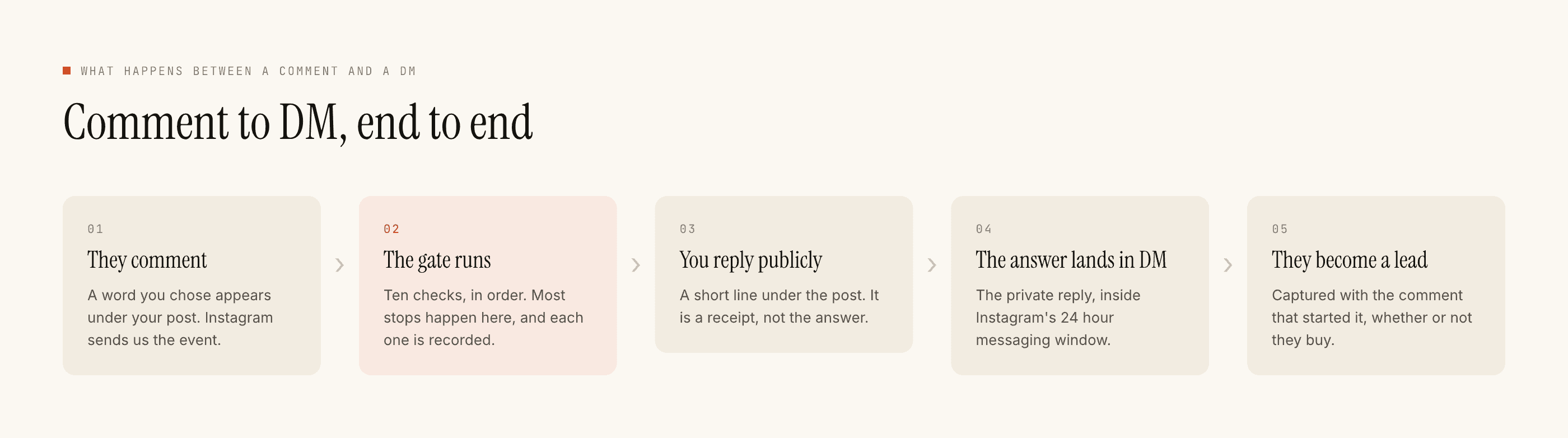
The subtractions worth making, in the order they usually pay:
- Put the thing in the message. If the answer is a price, send the price. Sending a link to a page that contains the price adds a stage, moves the person off the app, and swaps a conversation for a bounce.
- Delete the middle click. Link-in-bio, then a menu, then the product is three chances to lose someone who already told you what they wanted by typing a word.
- Do not ask for information you will not use. Every question in the first reply is a stage. If you are not going to email them, do not collect the email.
- Cut the second receipt. A public reply saying "check your DMs" plus a DM opening with "as promised, here is the link" is the same message twice. Say the useful thing once.
- Stop routing people to a form. A form is a funnel stage with a bounce rate you cannot see, replacing a conversation you were already inside.
Each removal is permanent, needs no measurement to justify, and cannot regress. That is a rare combination and it is why subtraction beats tuning in a channel with no instrumentation.
Lever two: the trigger word
The word in your caption is the highest-leverage single edit available, because every later stage is downstream of whether anybody types it.
A word that works is short enough to type on a phone with one thumb, unambiguous about what it gets you, and already in the reader's head. PRICE works because people were going to ask anyway. IGNITE does not, because it is your word, not theirs, and the reader has to translate.
Matching is loose on your side — case and punctuation fold, so Price? and price are one thing — but nothing folds a word nobody thought of. Pair the word with an explicit instruction in the caption. Not "drop a comment", which produces emojis. "Comment PRICE and I will send the range" produces the word.
The one honest instrument you do have
Every send that does not happen is recorded with the check that stopped it. The ten checks run in a fixed order — kill switch, connection, takeover, window, dedupe, cooldown, quiet hours, rate budget, credits, content safety — and the first failure is written against the run.
That log is not analytics. It is better than analytics for this purpose, because it explains rather than counts.
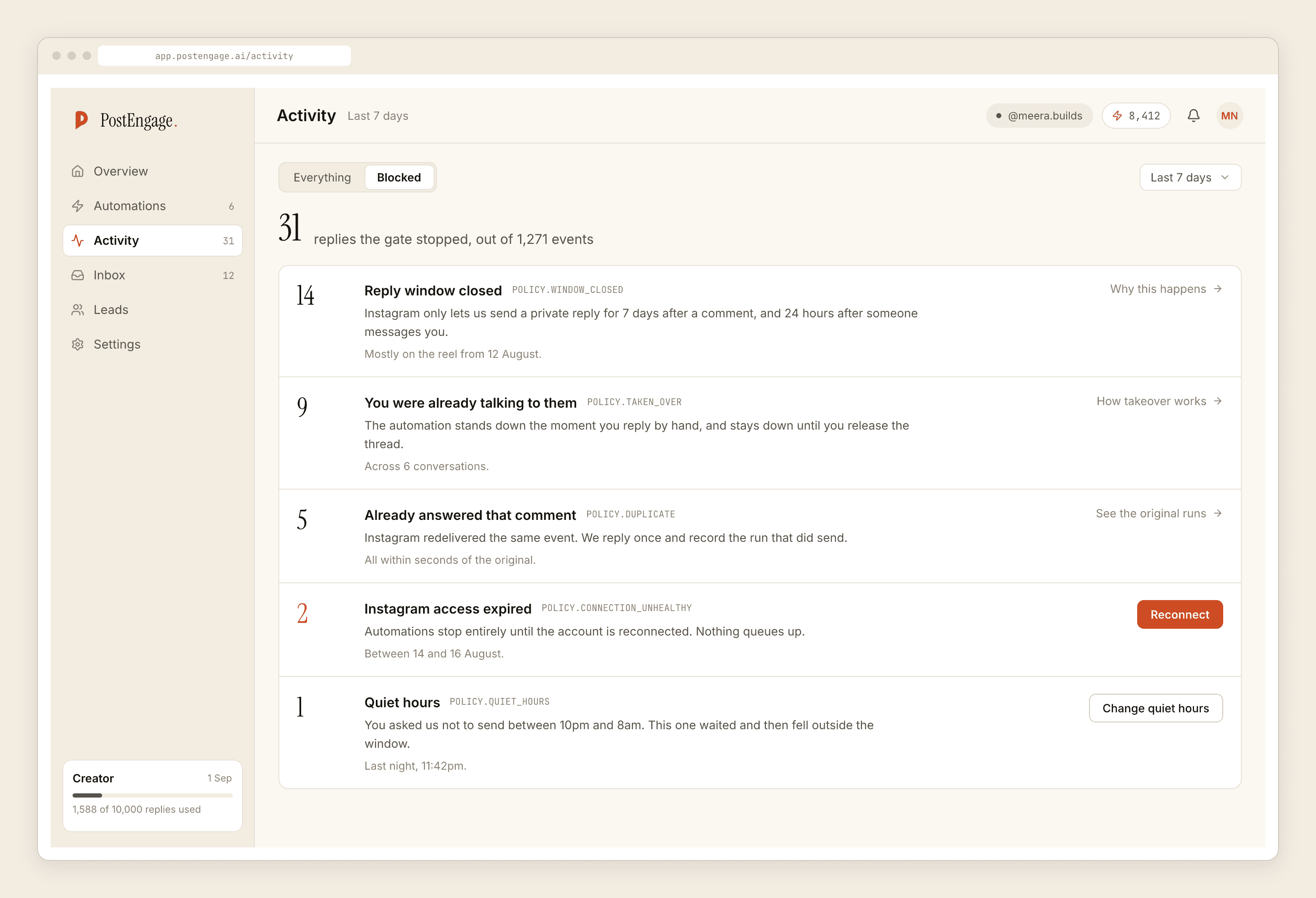
How to read it as diagnosis:
- A wall of
windowfailures means your trigger is catching comments on posts older than seven days. Narrow the automation to recent posts. - Steady
dedupemeans two automations are matching the same comments. That is a rule collision, not a platform quirk. rate_budgetmeans a post travelled and the hourly cap held the queue. Working as designed, and the alternative is a delivery problem that outlasts the post.- A lot of
takeovermeans you are answering by hand faster than the automation fires, which means the automation is aimed at the wrong comments. connectionmeans nothing is sending at all, and it is the only row on this list that is an emergency.
The comparison you are allowed to make
You will want to test two versions. You can, crudely: change one thing on the next post and see whether more people type the word. One thing, not four, and the change has to be visible in the caption rather than buried in settings.
What you cannot do is call the result. With the comment volumes a normal account sees, the difference between two posts is mostly which one the algorithm carried. Anybody quoting a confident conversion improvement from a two-post test is describing noise. Run the same change across five or six posts before you believe it, and even then treat it as a lean rather than a finding.
You are not measuring a funnel. You are forming an opinion, slowly, from things you watched.
What to fix first, and where this stops
In order: the ask in the caption, the trigger word, and the number of stages between the word and the thing. That is most of the available improvement in a normal setup.
After that, the remaining lever is the quality of the single message you send, which is a craft problem rather than a funnel problem and is treated properly here. The stage-by-stage anatomy of where a comment-to-DM flow leaks and why is in the funnel walkthrough. And if what you actually want is to know which sale came from which post, that is attribution, we do none of it, and asking people directly is the only version that survives scrutiny.