Playbooks · 5 min read
DM Sequences Do Not Exist Here: Design the One Reply

Start with the part that will save you an afternoon of looking for a feature: we do not have sequences.
There is no drip, no multi-step nurture, no day-two or day-five follow-up, no flow-builder canvas, no broadcast, and no scheduling of any kind. If you arrived from a tool that lets you draw a five-message journey on a canvas, that thing is not here and this post is not going to pretend otherwise.
The reason is not a missing feature on a roadmap. It is the shape of the platform, and it is worth understanding properly, because it changes what good looks like rather than merely limiting it.
The window is theirs to open, not yours
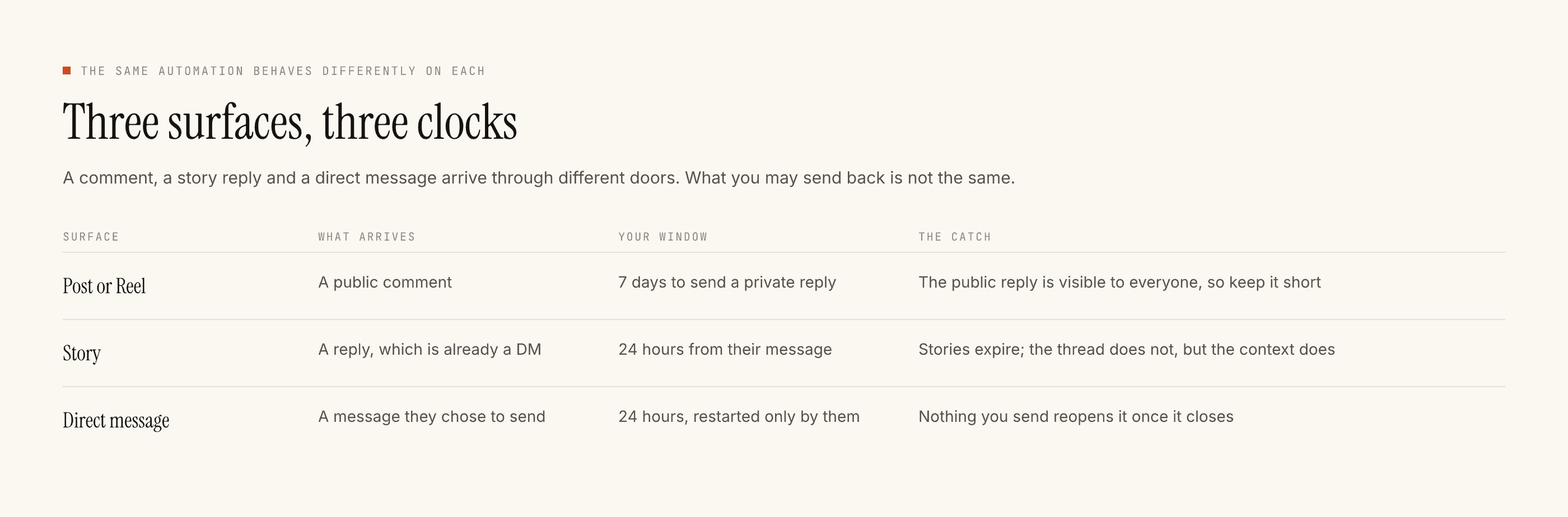
On the official Instagram API you have twenty-four hours to reply inside a DM thread, and that clock is restarted only by their message. Not by yours. Sending does not extend it. Waiting does not extend it. There is no mechanism, official or otherwise, by which your own message buys you another day.
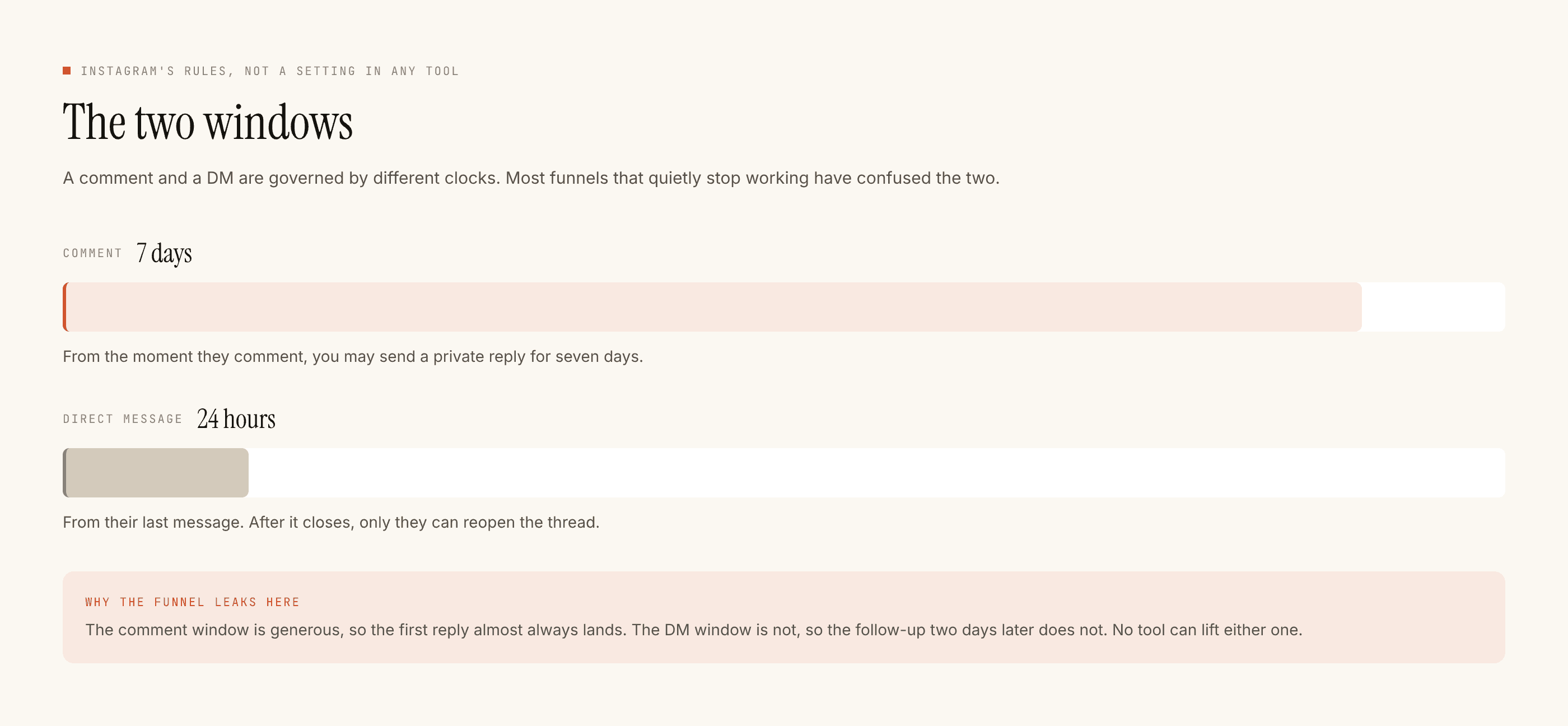
So a "day three follow-up" is not something we have chosen not to build. It is a message that cannot be sent. Any tool that appears to offer one is either sending inside a still-open window, or is doing something that puts your account at risk. There is no third option.
You do not own the cadence. The customer does, one message at a time, and every turn you get is one they granted.
What the "sequence" actually is
Once you accept that, the real structure becomes visible. It has four beats and you control exactly one and a half of them.
- Their comment. The only reason any of this starts. You influence it with the caption — "comment PRICE" — and that is the whole of your control here.
- Your public reply. Four to eight words, visible to everyone. A receipt, not an answer.
- Your private reply. The one message you fully own. Everything below is about this.
- Their answer, or silence. If they answer, the clock resets and you get another turn. If they do not, there is no turn.
That is it. Designing a sequence, here, means designing beat three so that beat four happens.
The anatomy of the one reply
Four parts, in this order, and it fits in a paragraph.
Acknowledge the specific thing. Not "thanks for your message" — name the post, the product, the question. It is the difference between a reply and a receipt.
Answer. Actually answer it. The most common failure in a private reply is that it defers: "our team will get back to you shortly." That sentence spends your one guaranteed turn saying nothing, and the window closes on it.
Give one next step. A link, an address, a phone number, an instruction. One. Two next steps is zero next steps.
Ask one question. This is the load-bearing part, and it is not there to gather data.
The question is the only mechanism that exists for getting another turn. Their answer restarts the twenty-four hours; nothing else does. So the question has to be genuinely easy — a choice between two things, not an open field. "Kaunsa size chahiye — M ya L?" gets a reply. "Let us know your requirements" does not.
What legitimately can follow
Here is the good news, and it is real: once they answer, you have another window, and an automation can absolutely handle that turn too.
This is what people mean by a sequence and it is built differently. Instead of one flow with five steps, you build several independent automations on the message trigger, each watching for a different thing:
- One for
size,sizes,medium,large - One for
cod,cash,payment,upi - One for
delivery,shipping,kitne din,how long - One for
order,buy,link
None of them knows about the others. There is no state, no step counter, no "they are on message three". Each one answers the message in front of it. And yet from the customer's side it reads as a conversation, because they asked three questions in order and got three good answers.
Two of the ten checks keep this from turning into noise. Dedupe stops the same event being answered twice when Instagram redelivers it. Cooldown stops several automations dogpiling one thread in the same minute. Both are on by default and both are the reason a set of independent automations behaves like a conversation rather than a pile-up.
And takeover means the whole thing steps aside the instant you reply by hand — which, in a thread that has already gone three turns deep, is usually the right moment for a person anyway.
What to do with the ones that go quiet
Most conversations end at beat four with silence, and there is no automated recovery for that. Saying otherwise would be the lie.
What exists is capture. Every conversation can write a lead record, and leads export as a CSV. There is no email tool here, no WhatsApp, and no CRM sync — the file is the handoff. If you want a genuine nurture sequence, it belongs in a channel that permits scheduled sending, and this product's honest role is to hand you the list.
For the front half of this — the caption, the comment, the public reply — the comment-to-DM funnel is documented here. For thinking about the whole path rather than one message, the customer journey post is the right next read, and lead magnets cover what makes beat one happen at all.