Playbooks · 5 min read
Win-Back Campaigns Cannot Be Sent. Be Worth Coming Back To
On this page
- The failure that is genuinely yours to fix
- Turn the automation off for people you have met
- The record is the actual product here
- Write templates that survive a returning customer
- The campaign-shaped thing you can honestly do
- If you genuinely need to reach them, use a channel that allows it
- What to measure instead of a campaign result

A win-back campaign, everywhere it is described, is one specific message. You take the customers who bought once and went quiet, you write something warm, and you send it to them.
You cannot send that here. Not on a paid plan, not with a setting, not with a clever trigger.
On the official Instagram API a business replies to people who have written to it. Somebody who ordered in March and has said nothing since has not written to you: there is no open thread, no window, and so no send. The DM window runs twenty-four hours from their last message, and ninety days of silence is not twenty-four hours. The structural version of that wall is set out in the retargeting post, and the reason there is no scheduled second message of any kind is argued here. Neither is repeated below.
What is left is more useful than it sounds, because lapsed customers do come back. They still follow you. They still see the post. They just come back on their own schedule, through a comment or a DM, usually at the worst possible moment for you to be improvising.
The win-back is not a message you send. It is what happens in the four seconds after a returning customer types.
The failure that is genuinely yours to fix
A woman who bought from you last Diwali writes: "hi, blue wala phir se aaya kya?"
If your automation fires, she gets the greeting you wrote for strangers. Hi! Thanks for reaching out — welcome to our page! That reply is worse than no reply. It tells somebody who has already paid you money that you have no idea who she is, and it does it instantly, which makes the not-knowing feel deliberate.
This is the thing to fix, and it is fixable, unlike the message you wanted to send in January.
Turn the automation off for people you have met
Under Advanced there is a setting called first-time senders only. Most accounts think of it as a way to avoid greeting the same follower on every reel. For returning customers it does something more valuable: it takes them out of the automated path entirely and puts them in front of a person.
That is usually the right trade. A returning buyer is a small number of high-value conversations. Automating them saves you a minute and costs you the one moment where being recognised matters.
The record is the actual product here
There is no CRM in this, no customer profile, no purchase history, no lifetime-value field. What exists is Leads: a row written when a conversation is captured, and a CSV when you want the whole list out.
That row is what makes recognition possible. Not automatically — nothing surfaces "this person bought in March" when a new DM arrives. You look it up. Handle, date, what they asked, whatever note somebody typed. It takes ten seconds and it is the difference between "welcome to our page" and "haan blue wala restock ho gaya, aapne last time M liya tha na?"
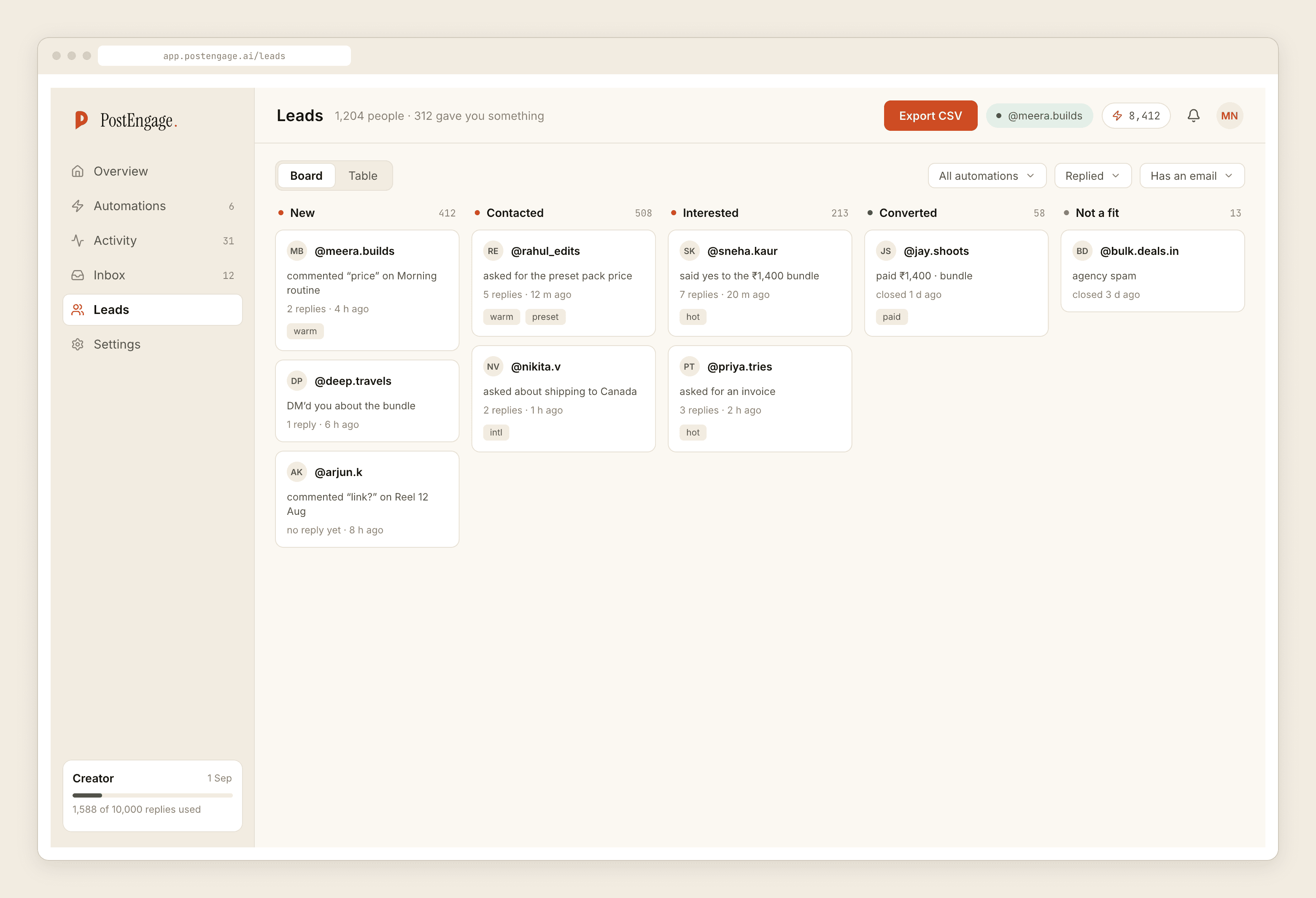
The habit that makes this work is unglamorous: when a conversation ends in a sale, write one line in the record saying what they bought. Nothing in the product asks you to. Six months later it is the only reason the win-back conversation goes well.
Write templates that survive a returning customer
Even with first-time senders only switched on, comment automations still fire under posts, and a two-year customer can leave a comment like anybody else. So the templates that go out publicly should read fine to somebody who already knows you.
Assumes a stranger
Works either way
The right-hand column is shorter, which is the usual finding. Warmth in a public reply is mostly performance. The specific thing goes in the private reply, where a person can add the sentence that only applies to this customer.
The campaign-shaped thing you can honestly do
Post something that gives a lapsed customer a reason to comment, and run an automation on that post. That is the only outbound channel in this building, and because it deserves more than a paragraph, it has its own post.
If you genuinely need to reach them, use a channel that allows it
Some of your lapsed customers gave you a phone number or an email at checkout. That is a channel where outbound messaging is permitted and consented to. Instagram is not.
So the honest handoff is the CSV. Export your leads, join them against your order records, and run the win-back where win-backs are legal. We do not sync to anything, do not send email, and have no other channel. The file is the entire integration story, and pretending otherwise would be the useful-sounding lie.
What to measure instead of a campaign result
You will not get a win-back conversion rate, because there is no campaign and no attribution. What you can look at is narrower and true: how many returning handles appear in your lead list this month, and whether the first reply they got sounded like it came from somebody who remembered them.
The second one you can only check by reading your own replies. That stays manual, and the honest limits of measurement here are worth reading before you build a dashboard nobody can fill.