Playbooks · 5 min read
Abandoned Cart DMs on Instagram: Why That Product Cannot Exist

Somebody adds a kurta to their cart on your website, gets to checkout, and closes the tab. Twenty minutes later they get an Instagram DM from your store: still thinking about it? Here is a code.
It is a lovely idea. It is also not a thing that can be built on Instagram, and the reason is not a missing feature on anyone's roadmap. There are three separate walls, and each one is sufficient on its own.
This post is about why. Its companion covers what you can actually build once you accept it, which is narrower and genuinely useful.
Wall one: Instagram has no idea your website exists
The Instagram Graph API sends your app events about things that happen on Instagram. A comment on your post. A message to your inbox. A story reply. A mention.
There is no abandoned-cart event, because there is no cart. The platform does not know your store exists, cannot see your checkout, and has no mechanism by which your website could tell it that a session went cold. This is not an omission to be worked around. Instagram is a social network that delivers you your own conversations, not a marketing automation bus for your storefront.
So the trigger you would need — the thing that fires when somebody bails at checkout — does not exist on the surface where you want the message to go out.
Wall two: you do not know who they are
Suppose your own site fires the event. You know a session, maybe an email if they got that far, maybe a phone number.
You do not know their Instagram handle. There is no lookup that turns an email address into an Instagram account, and there should not be one. The person browsing your product page and the person in your DMs are the same human being and two entirely separate identities, and nothing in the official API joins them.
For most abandoned carts you have no identifier at all. Someone arrived from an ad, added to cart, and left. You have a cookie.
Wall three: even knowing them, you have no permission
This is the wall that holds even if you somehow cleared the first two, and it is the one worth understanding properly because it governs everything else you do in DMs.
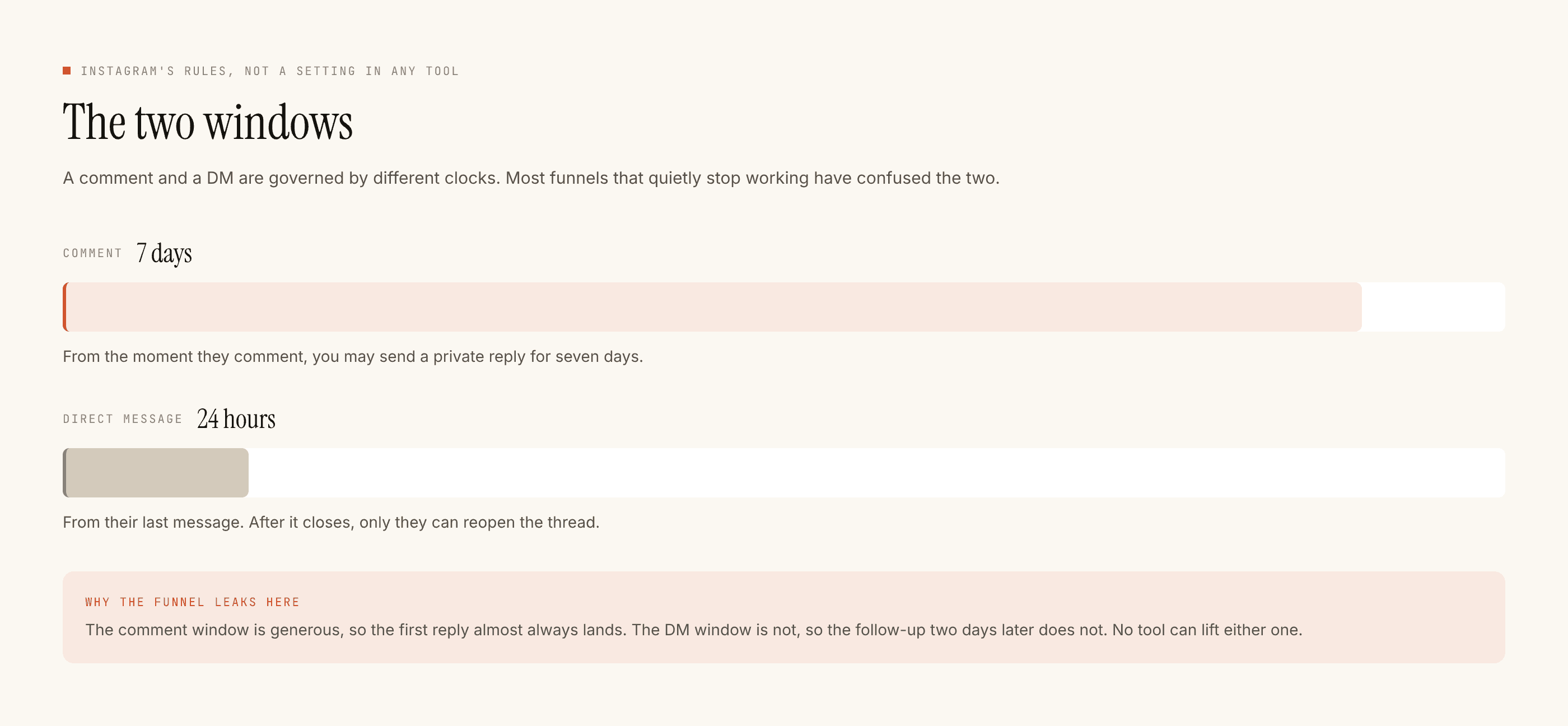
You may send someone a direct message within twenty-four hours of their last message to you. That is the whole rule. The clock is started by them and restarted only by them. Silence closes it, and once it is closed no tool, plan, or pricing tier reopens it.
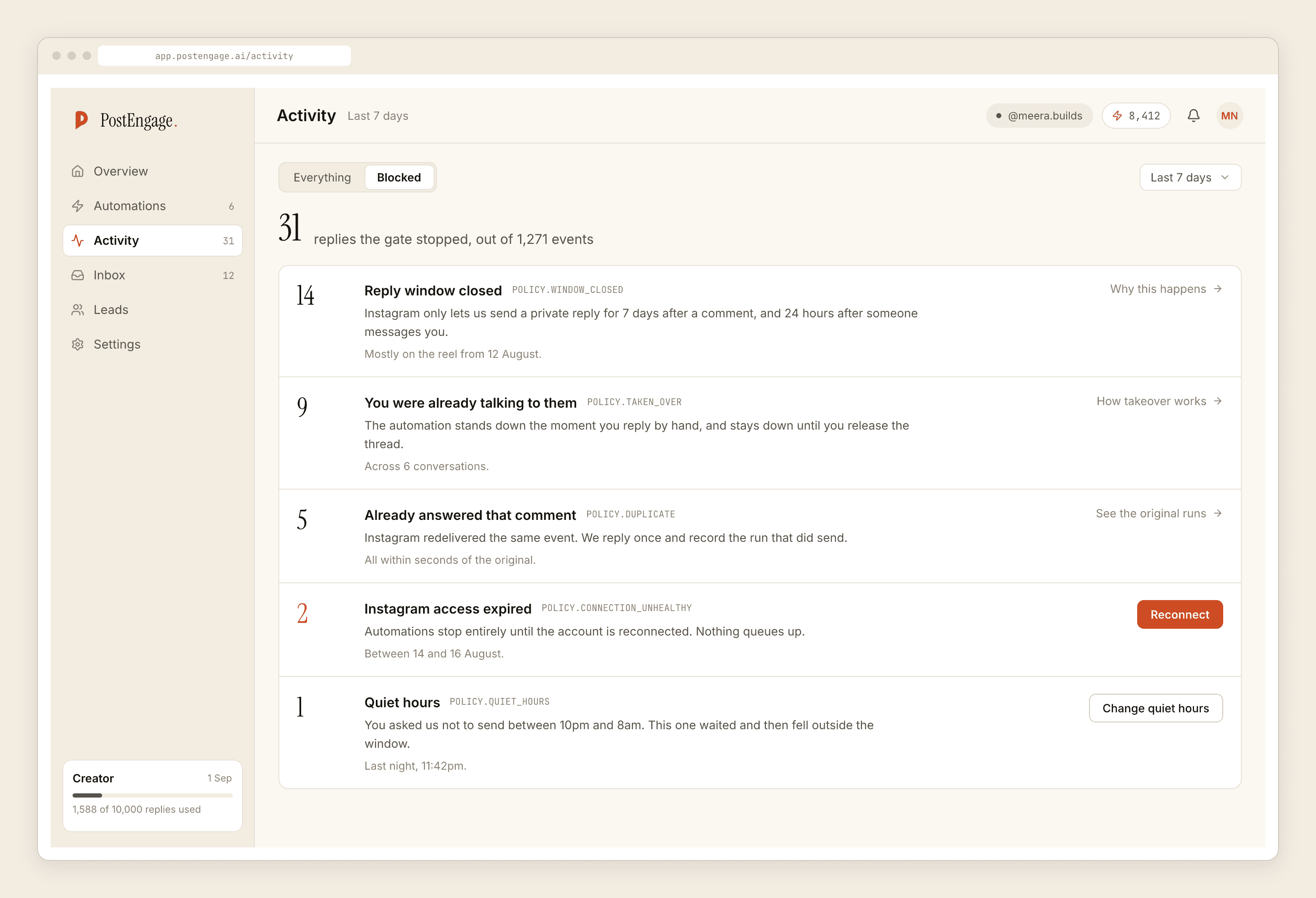
A person who abandoned a cart on your website has not messaged you on Instagram. There is no window. There was never a window. Sending them a message is not something we decline to do — it is something the API refuses, and the request is rejected before it reaches anyone.
So what are the tools promising this actually doing?
Fair question, and worth asking whichever tool you are evaluating rather than taking anyone's word for it. In practice, a "cart recovery" feature on Instagram resolves into one of a few things:
- It is email or SMS with an Instagram-themed screenshot. Your ESP recovers the cart. The Instagram part of the diagram is decoration.
- It is a comment-triggered flow renamed. Somebody commented on a product post and went quiet, and following up inside a window they opened is called cart recovery. That one is real. It is just not what the phrase means.
- It is on-site retargeting. A pop-up, a browser push, a retargeted ad. All legitimate, all a different tool from this one.
If a demo shows a message going to a stranger who abandoned a cart, the question to ask is which of the three walls above it cleared, and how. There is no polite answer that also passes review.
Ask a vendor how their cart recovery obtains permission to message someone who never messaged the store. The answer is the whole evaluation.
What is actually left, and it is not nothing
Two real openings, both of which start with the customer:
They commented
They messaged
Both of those are worth building properly, and neither is a drip sequence — a five-message nurture over a week assumes a window nobody has.
Everything outside them is email, on-site retargeting, or paid remarketing, which are different tools solving the same problem better than a DM could. Where DMs genuinely beat email and where they do not is a more useful comparison than most, because the answer is not the same in both directions.
For the build itself — the triggers, the timing, the wording of the one follow-up you get — the companion post walks through it. And for the wider picture of what Instagram automation does for a store once the fantasy version is off the table, start here.
The honest summary is short. You cannot recover a cart on Instagram. You can recover a conversation, and for a store with a busy product inbox, that is the larger pile anyway.