Playbooks · 5 min read
Working Out the ROI of Instagram Automation, by Hand

The product will not calculate this for you.
There is no analytics screen. No conversion tracking, no revenue attribution, no UTM handling, no pixel, no funnel report, no dashboard with a rupee figure on it. We do not know whether anybody who received a reply went on to buy anything, and we have no mechanism by which we could find out.
That sounds like a bad opening for a post about ROI. It is actually the useful part, because it forces the calculation to be done with numbers that exist rather than numbers a tool invented. And the cost side of this particular equation is unusually knowable.
The cost side, which you can get exact
Start here because it takes ten minutes and it is genuinely precise.
A templated reply is free and unlimited. Not free on a trial, not free up to a cap — free. A credit is spent only when the AI writes a new reply, and it is one credit for one reply.
So for an account whose inbox is mostly four repeated questions, the running cost of answering them is zero, forever. The free tier gives you 100 credits with no card, and credit packs start at ₹499 when you want the AI writing replies rather than templates.
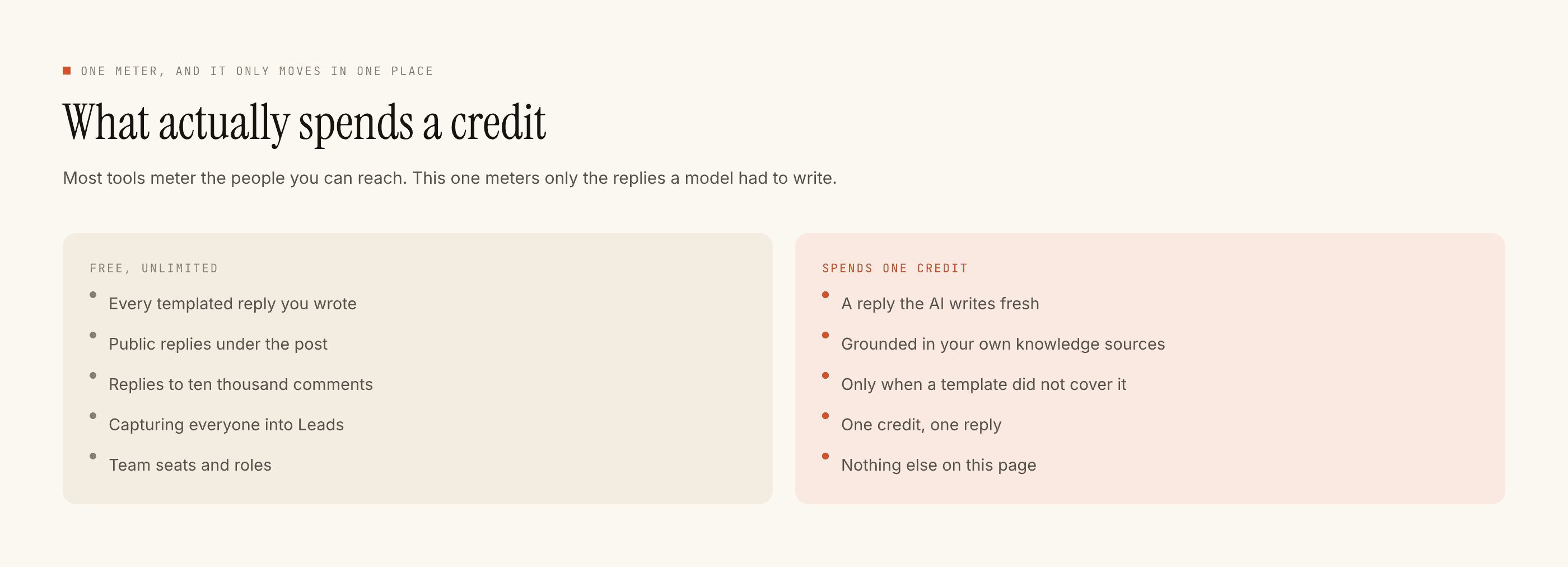
Which means the honest cost line has two entries, and the second one is bigger:
- Credits. Zero if you run templates. Otherwise a number you can read off your usage before you spend it.
- Setup and upkeep. Half a day to build and test the first automations. Then something like an hour a month rereading them so they do not go stale. This is the real cost and nobody puts it in the spreadsheet.
The four numbers you can actually count
None of these are computed for you. All of them are countable by a person in under half an hour.
Replies sent. Activity shows what went out. This is the volume of typing your team did not do.
Replies blocked, and why. Also in Activity, with the reason recorded against each one. A pile of window refusals on old posts is normal. A pile of connection failures means you have been paying for nothing.
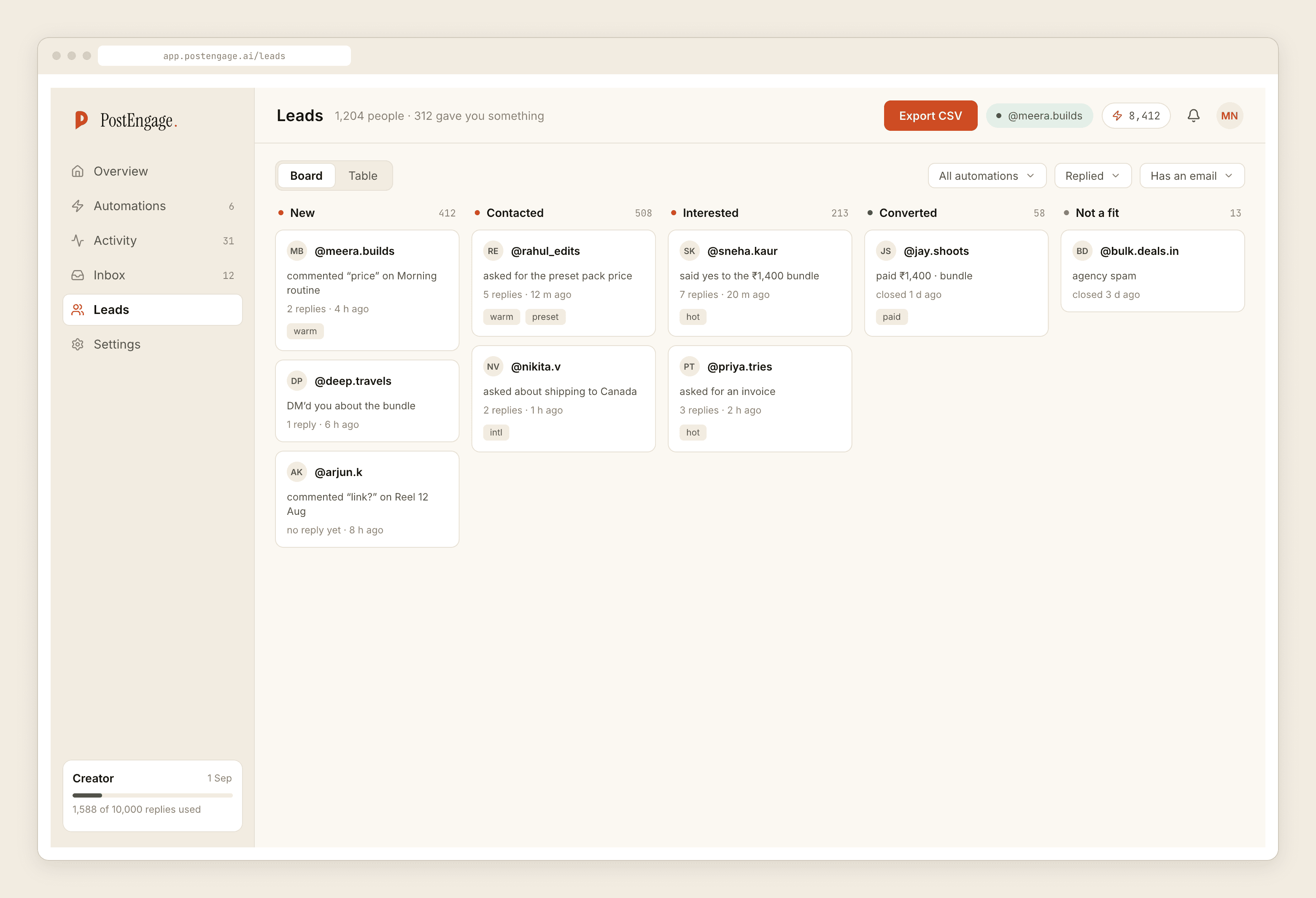
Leads captured. Rows in the Leads list. Export as CSV whenever you want the whole thing.
Leads that became customers. This one is not in the product. It comes from your own sales record — your order book, your billing software, your diary. You match by hand.
The by-hand method, in full
Pick a month that has already finished. Then:
Export the leads for that month. Open your own record of who bought. Go down the lead list and mark the ones that appear in both. It is tedious and it takes an hour for a normal month, and at the end you have a real number of customers who first appeared in an automated conversation.
Multiply by what a customer is worth to you, which is a number you already know and we never will. Subtract the credits, which is probably zero, and the hours.
That is the calculation. It has no methodology to speak of and it is more trustworthy than anything a dashboard would have shown you, because every input came from something you can point at.
An attribution model you cannot inspect is not more accurate than counting. It is just harder to argue with.
The number you cannot have
Here is the one nobody selling automation will tell you: you do not know the counterfactual.
Some proportion of those customers would have messaged you anyway, waited for a slower reply, and bought regardless. The automation did not create them. It answered them faster. There is no experiment available to you that separates the two groups, and any tool that reports "revenue generated by automation" is quietly assuming the entire counterfactual away.
So do not claim a figure you cannot defend. If you are reporting to a client or a boss, the defensible version is conditional and stated as such: if even a modest share of these conversations would otherwise have gone unanswered, the setup cost was recovered in the first month. That sentence survives being asked for a source. "Automation drove three lakh in revenue" does not.
The cost of getting it wrong, which belongs in the same sum
ROI conversations always leave this out. Automation has a downside case and it is not money.
A template quoting a price that changed, sitting in public under a post that is still being found. A cheerful reply landing in a thread where somebody is complaining. A greeting sent to a customer of three years. None of those show up in a benefit calculation and all of them cost something real.
This is why the maintenance hour is not optional and why reading the blocked list is the closest thing to a health metric this product has. The refusals are the system telling you what it stopped, which is the only place you will see the near-misses.
What to track if you want a rhythm rather than a number
Three things, monthly, in a spreadsheet you own: leads captured, leads that converted, and one sentence on anything you had to fix. Six months of that is a real picture of whether this is working, and it takes fifteen minutes a month.
For the metrics that are worth watching beyond ROI, there is a separate list, and the wider argument about measuring this at all approaches the same problem from the reporting side.