Playbooks · 5 min read
The Wedding Inbox: One Sale, Booked a Year Ahead
On this page
- Three properties, and everything follows from them
- The date is the first word, and nothing here can read it
- The windows are absurdly short against the cycle
- The person writing is often not the person paying
- Season is a spike, and a spike looks like spam
- What is genuinely safe across every wedding vendor
- What it will not do

A photographer, a planner, a decorator, a caterer and a lehenga label are five unrelated businesses. Open their Instagram inboxes in October and the messages rhyme so closely you could swap them.
"14 December available ho?"
"Hi, getting married in Jaipur next Nov, do you travel?"
"Budget kitna aata hai roughly for something like this?"
This post is the shape shared by all of them. The vendor-specific posts sit underneath it and go deeper: the date-and-portfolio problem for wedding photographers, budget qualification for planners, and the date refusal in full.
Three properties, and everything follows from them
A wedding purchase is date-bound, long-lead and singular. Almost every automation decision in this industry is downstream of one of those three.
Date-bound. The enquiry leads with a day, because the day is the only thing the customer has actually fixed. Venue, guest count, budget and theme are all still moving.
Long-lead. The message arrives eight to fourteen months before any money changes hands, and often before the venue is booked.
Singular. Nobody buys twice. There is no repeat purchase, no subscription, no win-back campaign. The customer is a one-off and the referral is the business.
Most automation advice assumes a customer you will sell to again. In this trade you get one sale and then you get their cousin's wedding, or you do not.
The date is the first word, and nothing here can read it
There is no calendar in this product. No booking, no availability, no sync with the diary you actually keep. An automated reply has no idea whether the fourteenth is free, half-held, or already committed.
That matters more here than in other date-led trades because auspicious dates cluster. The same four days in November are being asked about by twenty different families in the same fortnight. A template that reads as a yes, sent twenty times, does not produce twenty leads — it produces several families who each believe they have you.
So the rule across the whole industry: capture the date, never confirm it. "Checking that date now and coming back to you today" is honest, fast, and gives exactly the impression a wedding vendor wants to give in the first thirty seconds, which is that a person is involved.
The windows are absurdly short against the cycle
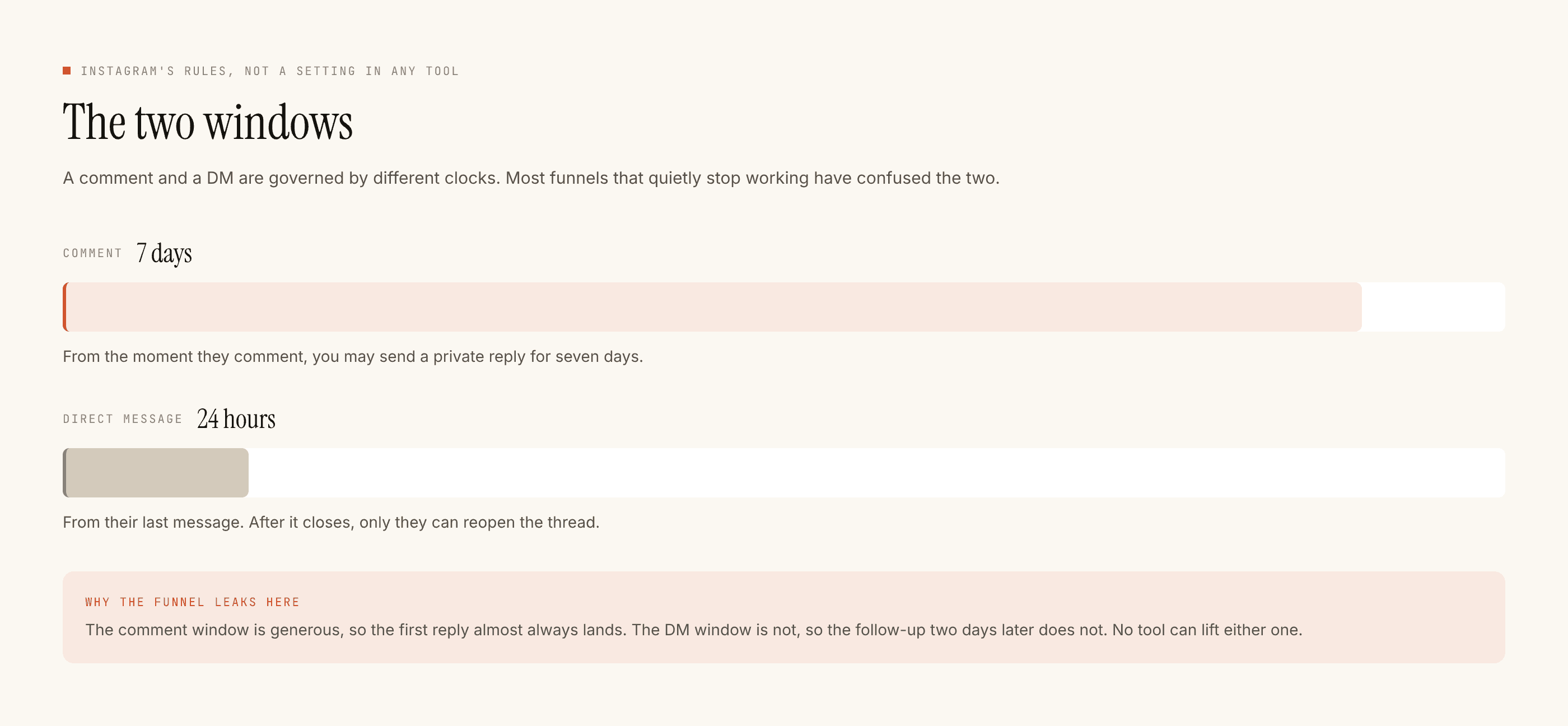
Official Graph API only. Seven days to reply to a comment, twenty-four hours inside a DM thread, and that DM clock restarts only when they message you again — not when you do.
Set that against a decision that takes eleven months. Somebody writes in January, compares six vendors, disappears for five weeks, and comes back after their mother has seen your feed. By then your side of the thread has been shut for a month.
The practical consequence is blunt: whatever you want them to have, put it in the first reply. A portfolio link, a page that explains how you price, a form, a phone number. Not a step one of five. There is no sequence feature here, no drip, no broadcast, and even if there were, the window would not let it run.
The person writing is often not the person paying
The account messaging you is frequently the bride's friend collecting options, a cousin who was told to "check Instagram", or a mother who has never used a DM before and will send four separate messages.
This is why hard qualification in the first automated reply misfires. A budget question fired at a cousin gets an invented number. A "how many guests" question fired at a friend gets a guess. Both then sit in your leads export as if they were facts.
Ask for the three things that are true regardless of who is typing: the date, the city, and what kind of function it is. Stop there and let a human ask the rest.
Season is a spike, and a spike looks like spam
Wedding content travels in bursts. One decor reel from a Udaipur function gets picked up and you have four hundred comments by lunch.
An uncapped automation answering four hundred comments in an hour is how an ordinary good day starts looking, from the outside, like an account behaving badly. Set a rate budget. It turns the spike into a queue, which is what you wanted anyway, because you cannot follow up four hundred people today either.
What is genuinely safe across every wedding vendor
- Where you work. Cities, whether you travel, whether destination work is something you take on at all. Fixed, asked constantly, free to answer.
- What you do and do not cover. The scope of the service in plain words, including the parts people assume are included and are not.
- How to enquire properly. The form, the number, the email, the fact that a DM will be read but a call gets a faster answer in season.
- Where the real portfolio is. Not four grid posts — the full body of work, wherever it lives publicly.
- How you price, structurally. Not a number. Whether it is a package, a percentage, a per-day rate, whether travel is extra, whether there is a minimum. The shape survives a rate revision; a figure does not.
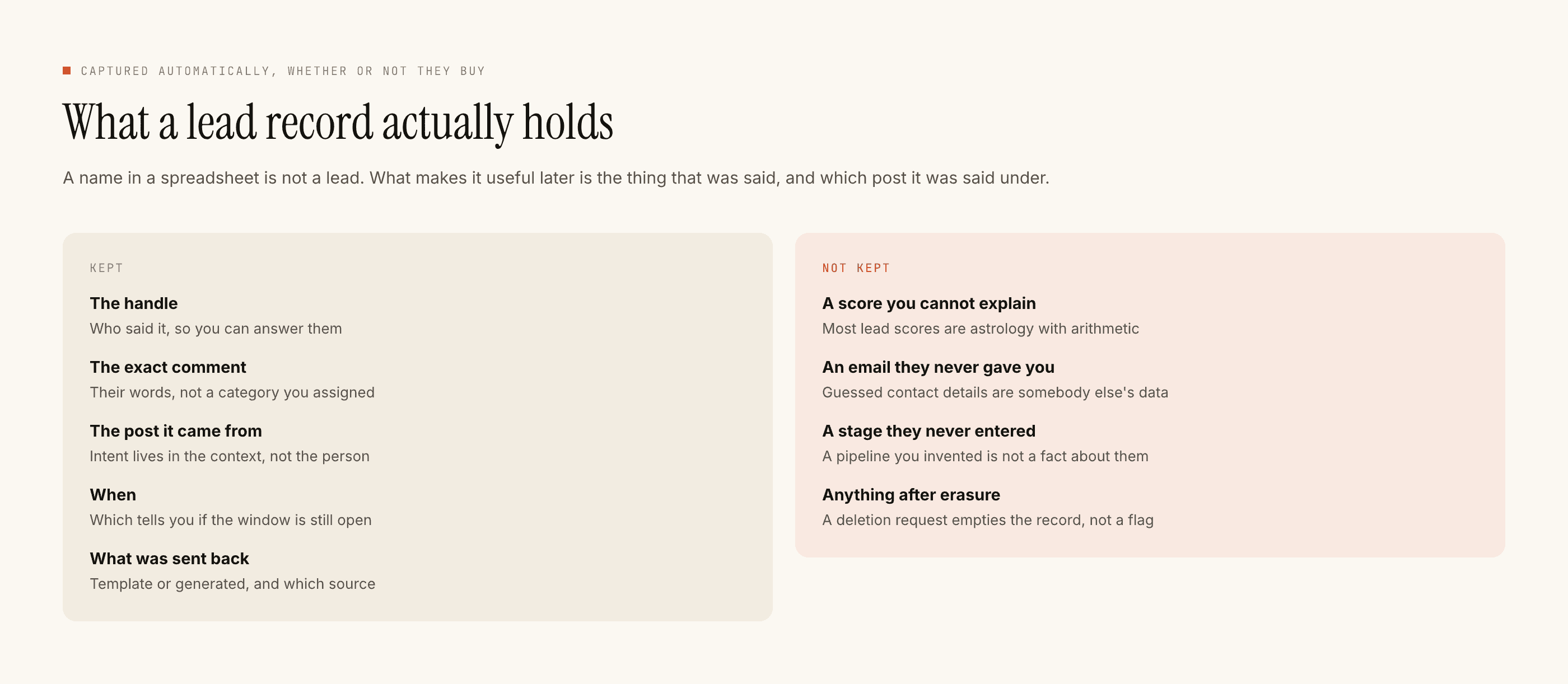
Those are templates. Templated replies are free and unlimited, and a credit is spent only when the AI writes a new reply — so the repetitive half of a wedding inbox costs nothing regardless of how heavy the season gets. Free tier is 100 credits, no card, and packs start at ₹499.
What it will not do
No calendar, so nothing can hold or confirm a date. No contracts, no payments, no advances. No CRM sync — leads leave as CSV. No WhatsApp. No scheduling or posting. It cannot message anyone who has not written to you first, and it cannot see a photograph, which matters in a trade where half the enquiries open with a screenshot of somebody else's mandap.
Build the date-capture automation first, then the coverage-area template, then read what got blocked in your first week. If flowers are your side of it, the florist post covers the stock problem this one does not.