Playbooks · 5 min read
From Automated Reply to Sale: Where the Handoff Happens

Let us take the air out of the phrase first, because a pipeline implies stages and automation moving people between them, and that is not what happens.
There are no multi-step nurture sequences here. No broadcasts, no drip messages, no flow-builder canvas, no lead scoring pushed into a CRM, no attribution connecting a conversation to a payment. What exists is one automated exchange at the front, a person at the other end, and a moment in between where the software stops and you start.
That moment is where deals are won and lost, it gets almost no attention compared to the copywriting, and it is the subject of this post.
Three segments, and only one of them is software
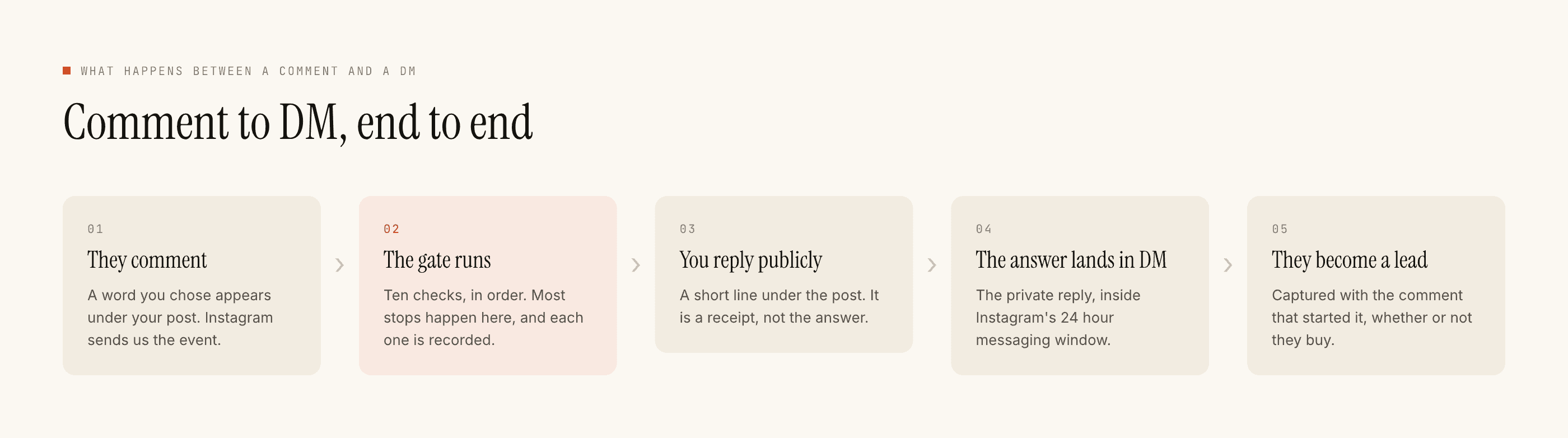
Segment one: the opening. Somebody comments, the keyword matches, they get a public reply and a private message. The job of that message is to answer the question accurately and to leave the door open. It is not to sell. A machine attempting a close in its first sentence is the most reliable way to make a warm person cold.
Segment two: the handoff. The thread now has a real person in it who is interested enough to have typed twice. Something has to bring a human in.
Segment three: the human conversation. This is where money is decided, and no feature on any comparison table participates in it.
What triggers the handoff
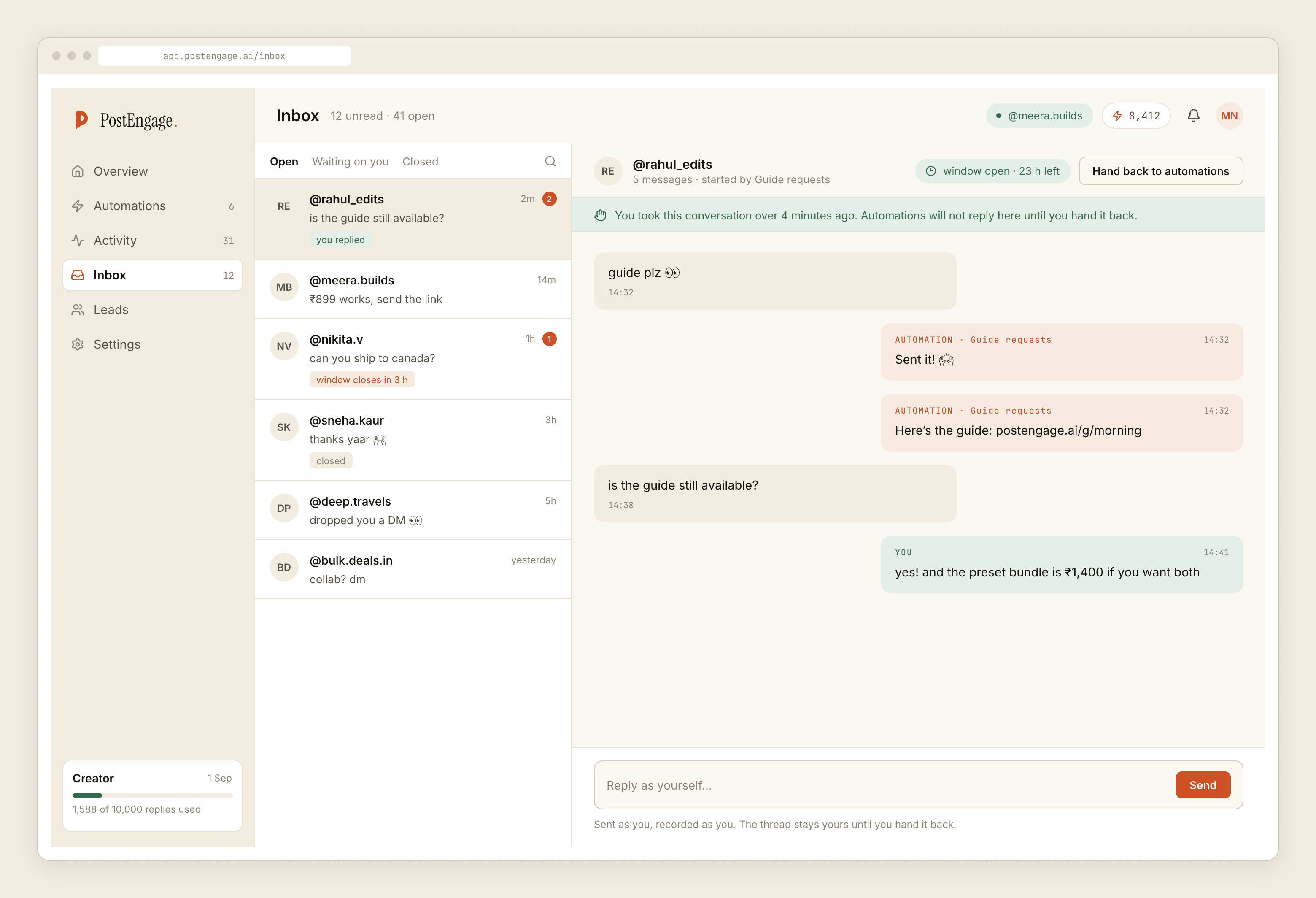
There is no escalation rule to configure, which people find either alarming or refreshing. The mechanism is blunt: takeover. The moment you reply by hand in a thread, automation is out of that thread for good. Nothing to pause, no state to set.
Which means your instinct — see something interesting, jump in — is also the correct operational move. What you need is a habit for noticing, and three things support it.
- Negative keywords keep automation out of the wrong threads before they start. Anything about a complaint, a refund, a custom order, or a price objection should never receive a templated answer. Add the words your audience actually uses for those.
- The review queue holds what the system was not confident about. Skim it in a batch. The held replies are frequently the most interesting conversations of the day, precisely because they did not fit a pattern.
- Leads capture writes down who triggered and what they said. Read that list looking for sentences that do not sound like everyone else's. Somebody who typed a paragraph is not the same lead as somebody who typed one word.
The clock belongs to the human too
This is the part most people miss, and it changes how you should staff the inbox.
Inside a DM thread you have twenty-four hours to reply, and that clock is restarted only by their message. So the automated opening does not buy you unlimited time — it buys you a reply within the window, and then the window keeps running against you.
If someone asks a real question at 9pm and the automation answers it, and you get to the thread on Thursday, you may find the window closed and no way to reopen it. You cannot send a nudge. You cannot follow up tomorrow "just checking in", because that is a message and the permission to send it expired. There are no follow-up sequences here and the window is the reason, not a missing feature.
Automation does not give you more time to reply. It replies once, and then the deadline is yours.
What actually moves a conversation towards money
No percentages, because we cannot measure this and neither can anybody selling you a number for it. What is left is what experienced operators do consistently.
Answer the question that was asked. Before anything else. A person who asked the price and received a paragraph about your brand story has learned something about you, and it is not good.
Be specific about the thing. "The blue one in the reel, size M, ready to ship" beats "our products". Specificity is the cheapest credibility available.
Give exactly one next step. A link, a call, a form, a visit. Two options is a decision; three is a delay.
Move to where the money is. Instagram is where the conversation starts. Payment happens in your store, on a call, or in person. The transition should be one sentence and should feel like a service rather than an ejection.
Ask a question back if you need time. Their message restarts the twenty-four hour clock. A genuine question — what size, which city, when do you need it — keeps the thread alive and gets you information. A hollow "does that help?" does not.
What breaks it
Too many automated messages before a person arrives. One accurate reply reads as service. Three read as a funnel, and people recognise a funnel.
A generated message attempting the close. Ask for money in a sentence the model wrote and you have made the least personal moment of the exchange the one where trust is required. Write that sentence yourself, or better, say it as a human in segment three.
Treating the leads list as a mailing list. You cannot message people who have not messaged you, and you cannot broadcast. The list is a record of conversations, and it leaves as a CSV — nothing pushes it anywhere.
The honest summary
The automated part is a short, accurate opening under a clock. It removes the answers you were losing at 1am and the ones you were typing for the two hundredth time. That is genuinely worth money if you were losing them.
It does not sell anything. The selling happens when somebody notices a good conversation and takes over it, quickly, while the window is still open. How the comment-to-DM flow is built covers segment one properly, and what a lead worth interrupting your day for looks like is about noticing segment two before it expires.