Playbooks · 5 min read
Salon Bookings: Design the Handoff, Not the Booking
The argument that a salon automation cannot see your appointment book is already made, and made properly, in the hair salon post. It owns that case, along with the economics of running this on a small appointment business. Read it first if the idea that a bot must never confirm a slot is new to you.
This post starts one step later. You have accepted that the automation cannot book. So what exactly is it doing instead, and why do so many of these end up going nowhere?
The answer is that a booking automation does two jobs — qualify and route — and almost everybody builds the first one and neglects the second. The handoff is where bookings die.
Qualify means: collect what the desk needs to make an offer
A salon conversation that starts in a DM and ends in an appointment usually takes five or six messages. Service. Have you been before. Which stylist. When roughly. How long have you got. Okay, Thursday at four?
Most of those messages exist only because the desk is starting from nothing. Somebody wrote "kal slot hai?" and the person holding the diary has to reconstruct the entire enquiry by hand, in gaps between clients, one question at a time.
A qualifying automation collapses that. It answers the fixed part immediately and it collects the four things the desk needs before it can make a real offer:
- What service. Not a category. "Balayage" and "root touch-up" occupy different amounts of chair time, and the desk cannot offer a time without knowing which.
- First visit or returning. A returning client's history is in the book. A new one needs a consultation slot, and sometimes a patch test, which changes the offer completely.
- Roughly when. Weekday or weekend, morning or evening. Not a specific slot, because you cannot verify one — just enough to narrow the search.
- Anything that changes the length. Hair length, previous colour, whether it was boxed at home. The desk knows what to ask about; the automation just has to make sure it gets asked.
What comes out of that is not a booking. It is a callback that closes in one message instead of five, which for a salon running two chairs is the whole difference between a lead that converts and one that goes cold overnight.
The automation is not trying to be the receptionist. It is trying to hand the receptionist a conversation that is already three-quarters done.
Route means: one destination, named, and staffed
This is the half that gets neglected, and the failures are boringly consistent.
Two destinations is zero destinations. "Book here, or reply to this message and we'll sort it." That reads as helpful and it splits the person's attention at exactly the moment they were about to act. Pick one route and commit to it.
A route nobody staffs. The number in the template rings at the desk. The desk closes at eight. The enquiry arrives at eleven. Nothing is wrong with routing to a phone line, but the template has to say when someone picks up, or the customer concludes you are ignoring them.
A link that does not survive the tap. Instagram opens links in its in-app browser. A booking page that needs a login, an app install, or a payment page that behaves badly there will lose people who fully intended to book. Open your own link from inside a DM on a phone, on mobile data, and go all the way through. Most salons have never done this.
A stale link. Booking pages get migrated and templates do not. Put a re-check in the calendar quarterly, alongside re-reading the templates themselves.
The twenty-four-hour window makes the handoff self-sufficient
This is the constraint that decides how the routing has to be written, and it is specific to the platform rather than to salons.
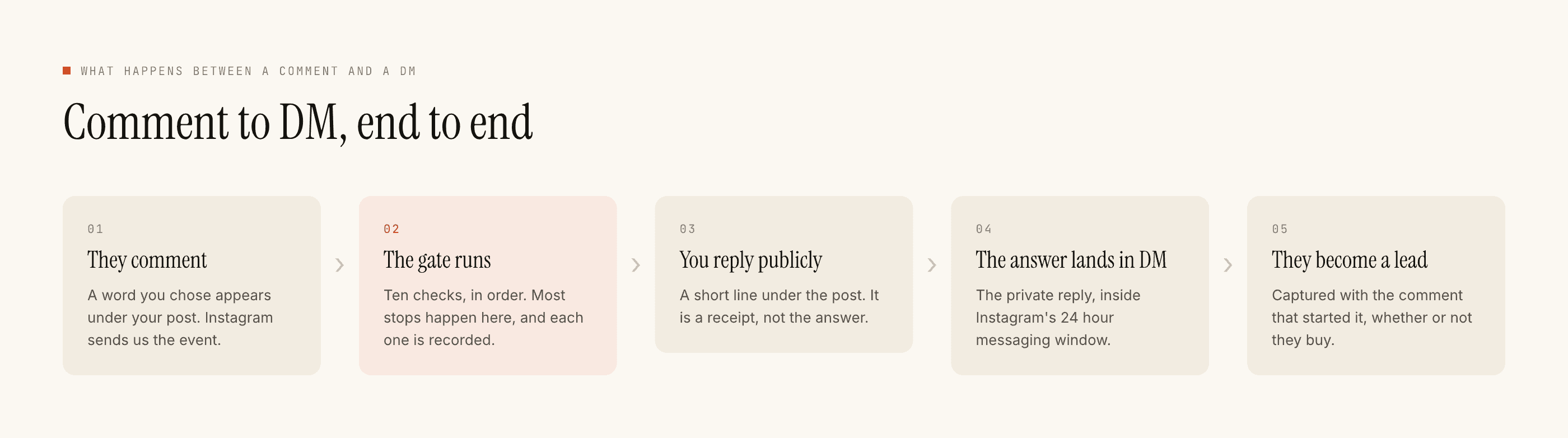
A DM thread stays open to you for twenty-four hours, and that clock restarts only when the customer messages again — not when you do. So the sentence "we'll message you with some times" is a promise that expires. If the desk works its list on Monday morning and the enquiry came in on Saturday night, the thread is closed and the reply cannot be sent at all.
The consequence is that a routing reply has to be self-sufficient. The person must be able to act on it without needing you to write again: the link, the number, the hours somebody answers, all in the one message they already have. Anything that depends on a follow-up inside the window is a plan, not a route.
If a human genuinely will reply inside the window — the desk works the inbox every evening — then say that, and mean it. What you cannot do is write it as a template and hope.
What you can and cannot measure
Be realistic about this, because the tools that promise otherwise are describing something we do not build.
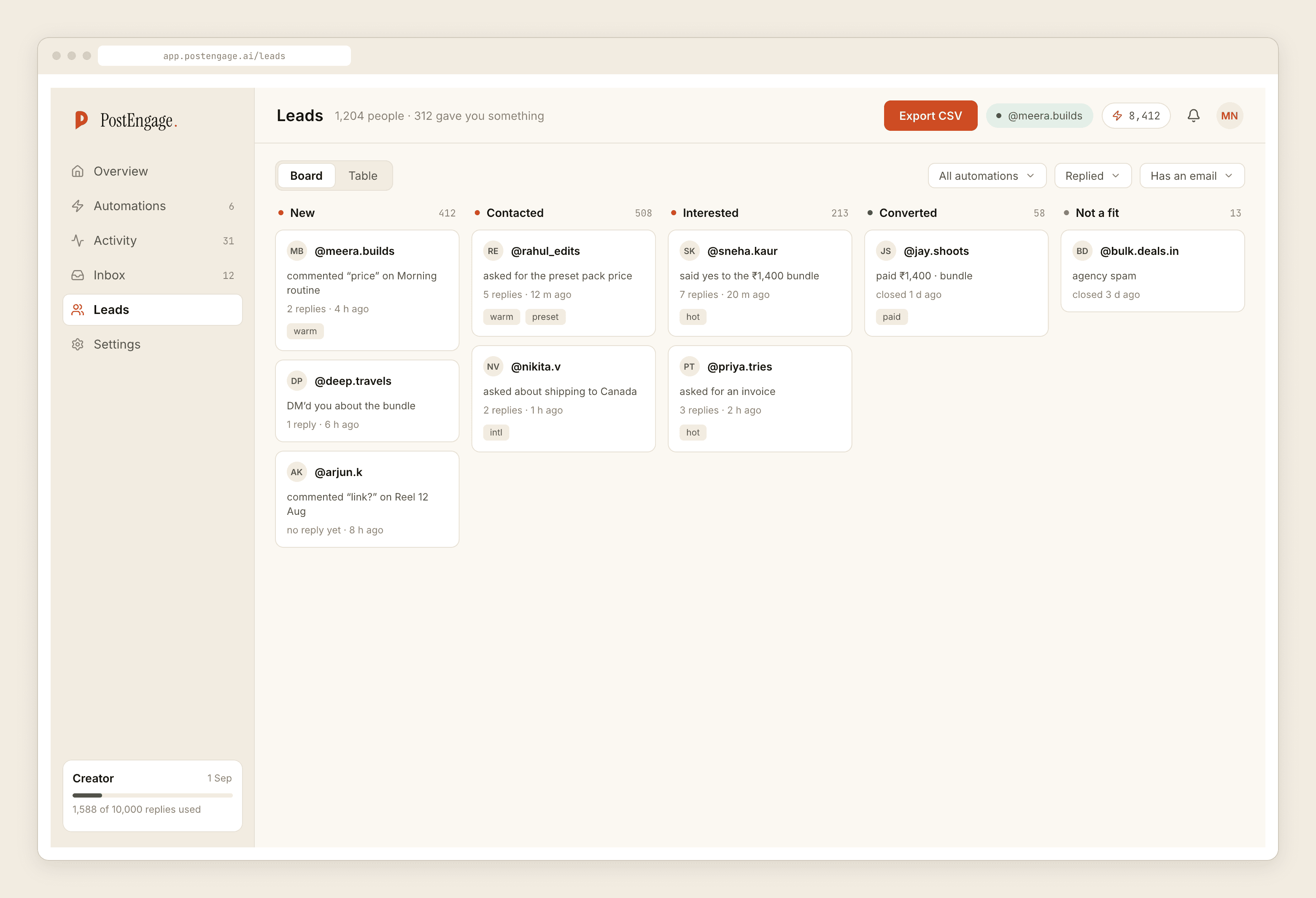
You can see what went out, what got blocked and why, and which enquiries were captured with what they asked about. You cannot see whether somebody tapped the link, and there is no attribution back from your booking system, because there is no integration with one. Leads leave as a CSV.
So the honest measurement is manual and it takes ten minutes a week: take the captured enquiries, hand them to whoever holds the diary, and ask which names they recognise from the book. That is a crude conversion check and it is a real one, which is more than a dashboard number nobody can trace would be.
The one automation to build first
The comment-to-DM flow on your most-commented service post. A four-word public reply, the qualifying questions and the route in the private one, capture switched on.
Everything else — story replies, second and third automations, a wider keyword net — can wait until you have watched that one run for a week and read what came through. If the salon also offers treatments rather than only hair, the wellness rules apply on top of everything here, because a question about a skin condition is not a booking question.
Templated replies are free and unlimited; a credit is spent only when the AI writes a new reply. Free tier is 100 credits with no card, packs from ₹499. And nothing here books, holds, or cancels anything, takes a deposit, syncs to a calendar, or does WhatsApp — the point of designing the handoff carefully is that it does not have to.