Lead generation · 5 min read
A Hot Lead on Instagram Is a Person With a Deadline

The phrase gets used to mean "someone we have a good feeling about". That is fine in conversation and useless in a system, because a term that cannot be wrong cannot be improved.
So it is worth doing the boring thing and defining it, and the definition that holds up on Instagram is stranger than the one you inherit from CRM software.
The version that is astrology
You have seen this scoring model, in some tool, in some blog post. Followed you: five points. Liked three posts: ten points. Watched a story: two points. Commented: fifteen. Score above sixty: hot.
Every number in that model was invented by whoever built the screen. None of them were derived from anything. And the thing that makes it astrology rather than merely rough is that nobody ever goes back and checks it: no one takes last quarter's sales, looks up what those people scored the week before they bought, and discovers the model was backwards.
It also flatters. A scoring model built on engagement will always tell you that your most engaged followers are your best prospects, which is the same as saying your fans are your fans. Sometimes true. Not information.
A score you never check against an outcome is a horoscope with a database behind it.
The definition that survives contact
Two clauses, and both are required.
One: they asked for something specific, in their own words. Not a like, not a follow, not a fire emoji under a reel. A sentence they composed, naming a thing. "Kitna hai" is an opening. "Blue wala kitna hai, Pune deliver hoga kya" is a hot lead — it names an object, a constraint, and an assumption that they are going to buy it.
Two: you are currently permitted to reply. This is the clause CRM vocabulary has no equivalent for, and on Instagram it dominates everything else.
Heat expires, and it expires on a clock you can read
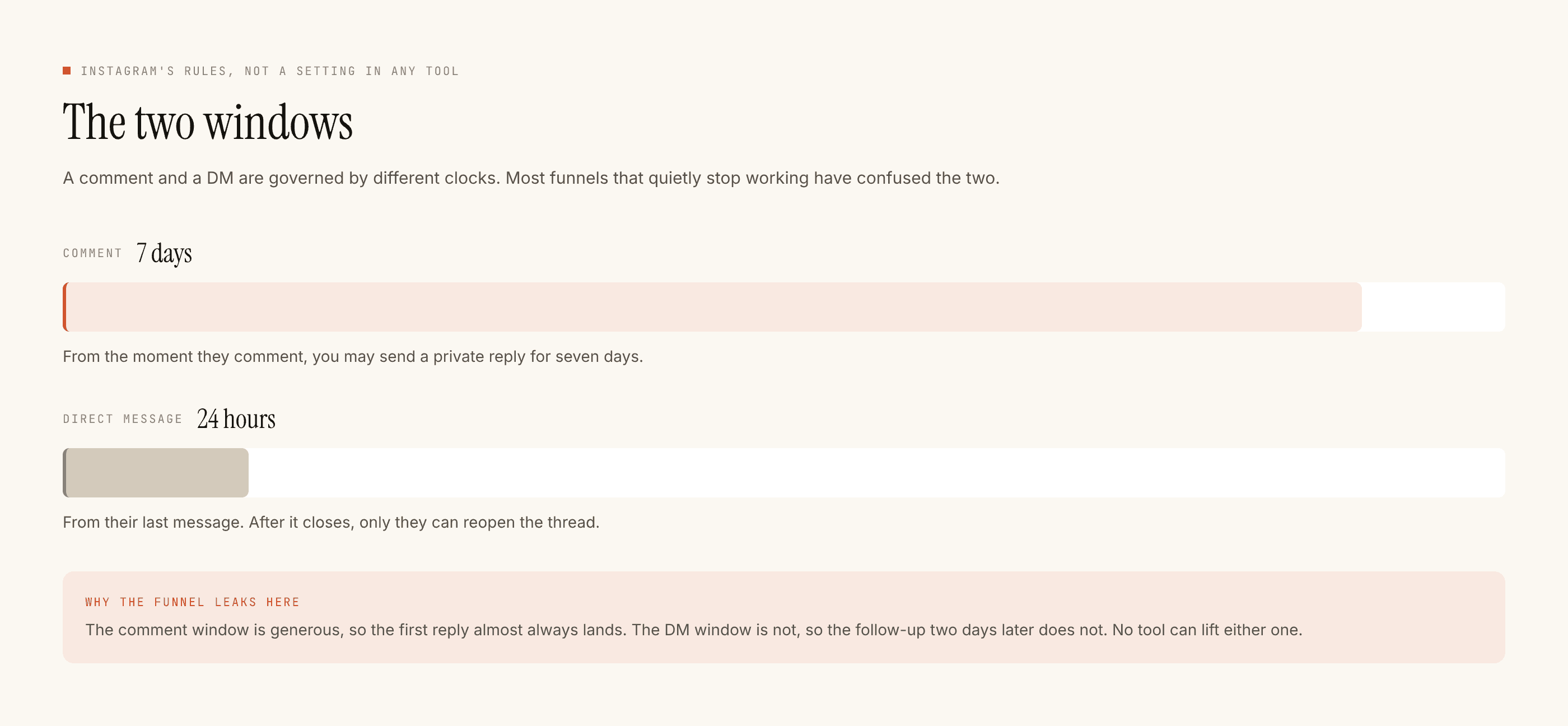
On an email list, a hot lead stays warm for a week while you get around to them. Here, permission itself decays. Somebody who sent you a detailed buying question 25 hours ago is not a warm lead you can follow up on Monday — they are a person you may no longer message at all until they speak again.
Which produces a definition with an odd shape: heat on Instagram is a property of a moment, not a property of a person. The same human is hot at 9pm and unreachable at 10pm the next day, and nothing about their interest changed.
What to do with a two-clause definition
It changes what you sort by. Not a score. Two questions, in this order: whose window closes soonest, and which of them asked something specific.
That ordering is unglamorous and it beats every points system for a simple reason — it is about what you are allowed to do, and points are about what you think of somebody. Answering a specific question in hour two is a conversation. Answering it in hour twenty-six is not possible.
Reads as hot, usually is not
Actually hot
The left column is not worthless — some of those people buy eventually. They are just not the ones with a deadline attached, and a deadline is the only thing that makes prioritising worth doing at all.
Making it falsifiable, cheaply
You do not need analytics for this. You need one habit: when a conversation ends, mark the lead. Converted, or not a fit. It takes a second and it is the only thing that turns your instincts into something checkable.
A month of that gives you a small, real dataset — the people who bought, and what their first message looked like. Read fifteen of them in a row and you will find your own definition of specific, in your own category, which will be sharper than anything generic. For some accounts it is a city. For others it is asking about delivery time. That pattern is worth more than any scoring model somebody else designed.
Where the definition meets the software
The gap between "they asked something specific" and a thing your inbox can act on is a real gap, and it is mostly a reading problem — the signal is unstructured text, in three languages, written on a phone. What can actually be extracted from a thread, and what a model gets right and wrong when it tries, is a separate and more practical question.
And if you are wondering whether to build any of this into a system with rules and buckets, the honest answer depends almost entirely on volume — below a certain inbox size, a scoring system costs more than it returns, because you can simply read everything.
Until then the working definition is short enough to keep in your head. Someone who asked you a real question, while the clock is still running. Everything else is a follower.