Playbooks · 4 min read
A Coaching Sale Happens in a Conversation, Not a Funnel

Somebody comments PRICE under your carousel. Thirty seconds later they get a DM that opens with "Great question! Our transformational 12-week container is designed for ambitious professionals who…" and by the third line they have left the thread.
The reply was fast, on-brand, and completely wrong, because it tried to do the thing that only a conversation can do.
The automation is not the salesperson. It is the door.
Coaching gets bought after somebody has decided they trust you. That decision does not happen inside a first automated message, no matter how well written, because the person is not evaluating your offer yet — they are evaluating whether there is a real human at the other end who understands their situation.
So the first reply has exactly three jobs, and a fourth job is where accounts go wrong.
- Acknowledge that a person wrote. One line, in your actual register. Not "Hi there!" — the thing you would type.
- Answer the literal question. They asked something. Answer it, plainly, including the awkward one.
- Name the next step and who it is with. "I'll come back on this myself this evening" is a next step. So is a link to the page that explains the programme.
- Do not pitch. The fourth job is the one to leave undone. Every sentence of selling in an automated first reply is a sentence spent before the person asked you to sell.
Getting a qualified person into a conversation is the whole win. The conversation is where the money is, and you have to be in it.
Answer the price question. Do not dodge it.
The most common mistake in coaching automation is the pricing dodge: somebody DMs asking what it costs and the automated reply says "DM me for details". They just did. That reply reads as a negotiation tactic before a conversation has started.
If you have a public price, put it in the template. If your pricing genuinely depends on scope — most one-on-one coaching does — say that in one sentence and give the range's shape without inventing a number: what it depends on, and how quickly you can tell them. "Depends on whether it is weekly or fortnightly, I'll give you the exact figure once I know which — usually within the hour."
That is not a sales sequence. It is a fact and an appointment to continue, which is all the automation was ever able to give you.
The corollary: anything money-adjacent should be a template you wrote, not a reply the AI composes. Put discount, offer, EMI, refund, guarantee on the negative-keyword list and route them to yourself. A generated reply will negotiate on your behalf with enormous confidence.
The handoff is the design problem
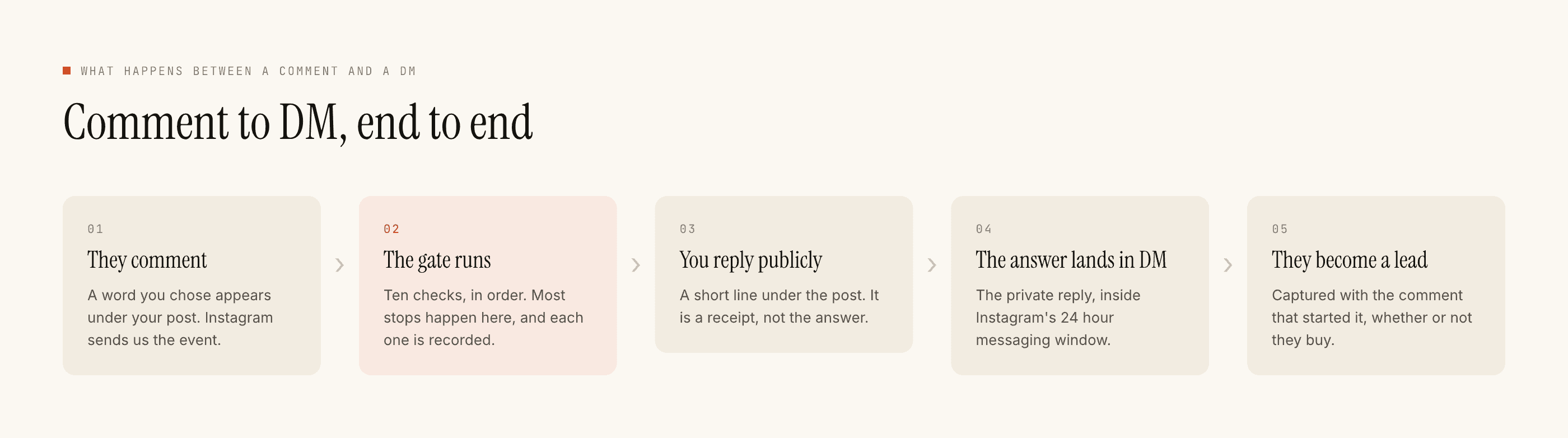
The moment you reply by hand, the automation stands down for that conversation. No follow-up template lands on top of your considered answer, no cheerful nudge two days later contradicting what you just said. Takeover is not a setting you enable; it is how the thing behaves.
Which means the handoff can happen whenever you want. Mid-thread, from a phone, between sessions. The practical version for most coaches: automation covers the first response at all hours, you arrive at the two or three times a day you actually do inbox.
The twenty-four hours is the real constraint on a sales conversation
Official Instagram API, so: seven days to reply to a comment, twenty-four hours to reply inside a DM thread — and only their next message restarts that second clock. You cannot reopen it from your side.
Deciding to hire a coach takes longer than a day. Somebody writes on Sunday night, thinks it over, comes back Thursday. That Thursday message restarts the window; your Wednesday follow-up does not exist as an option.
The consequence is structural, not tactical. Do not design a sales process that depends on you following up on your schedule. Whatever the person needs in order to keep deciding — the page that explains the method, the testimonials, the way to reach you — has to be in the reply they got while the window was open. There is no drip sequence here to catch them; we do not build those and Instagram would not carry them the way people imagine.
What this costs
Templated replies are free and unlimited, and for a sales inbox that covers most of it: the acknowledgement, the logistics, the link. A credit is spent only when the AI writes a new reply. Free tier is 100 credits with no card and packs start at ₹499.
Captured people land in Leads and leave as a CSV. There is no CRM sync, no booking calendar, no payment link, no WhatsApp. If your process needs a call booked, the booking has to be a link in your reply, going somewhere we have nothing to do with.
The one metric worth watching
Not replies sent. Conversations you personally ended up in. An automation that sends four hundred polished DMs and produces two real conversations is doing worse than one that sends forty and produces twelve, and only the second number tells you which.
If you want the scope question first — what belongs to software and what belongs to you — that ledger is here. For the qualification side, what a hot lead actually looks like is more useful than any scoring model, and speed of first response is the one thing the automation genuinely does better than you do.