Playbooks · 5 min read
You Have a Five-Step Sequence. Here Is How to Port It

There are no follow-up sequences in this product. No drip, no day-three nudge, no flow canvas, no broadcast, no scheduled second message.
That is settled ground on this site and I am not going to argue it a fourth time. The sequence-design post explains why the window makes it impossible and what the one reply should contain. The follow-up post separates the three different things people mean by the word and shows how to pre-position a reply for a turn you invited. The nurturing post covers what to do with the people who go quiet.
Read whichever of those matches your question. This post exists for one specific reader: the person who is arriving from a tool where they had built a sequence, who has it written down, and who wants to know what happens to it. That is a mechanical exercise and nobody has written it out.
Why the port is not a redesign
The instinct is to throw the old sequence away and start from a blank page. Do not. Your sequence encodes real knowledge — the objections you learnt to handle in order, the questions people actually asked. That knowledge survives. Only the delivery mechanism dies.
So take the document, and go through it step by step with one question each.
The sorting question
For every step in the sequence, ask: was this step answering something, or pushing something?
Answering steps survive. Pushing steps do not, and cannot be made to.
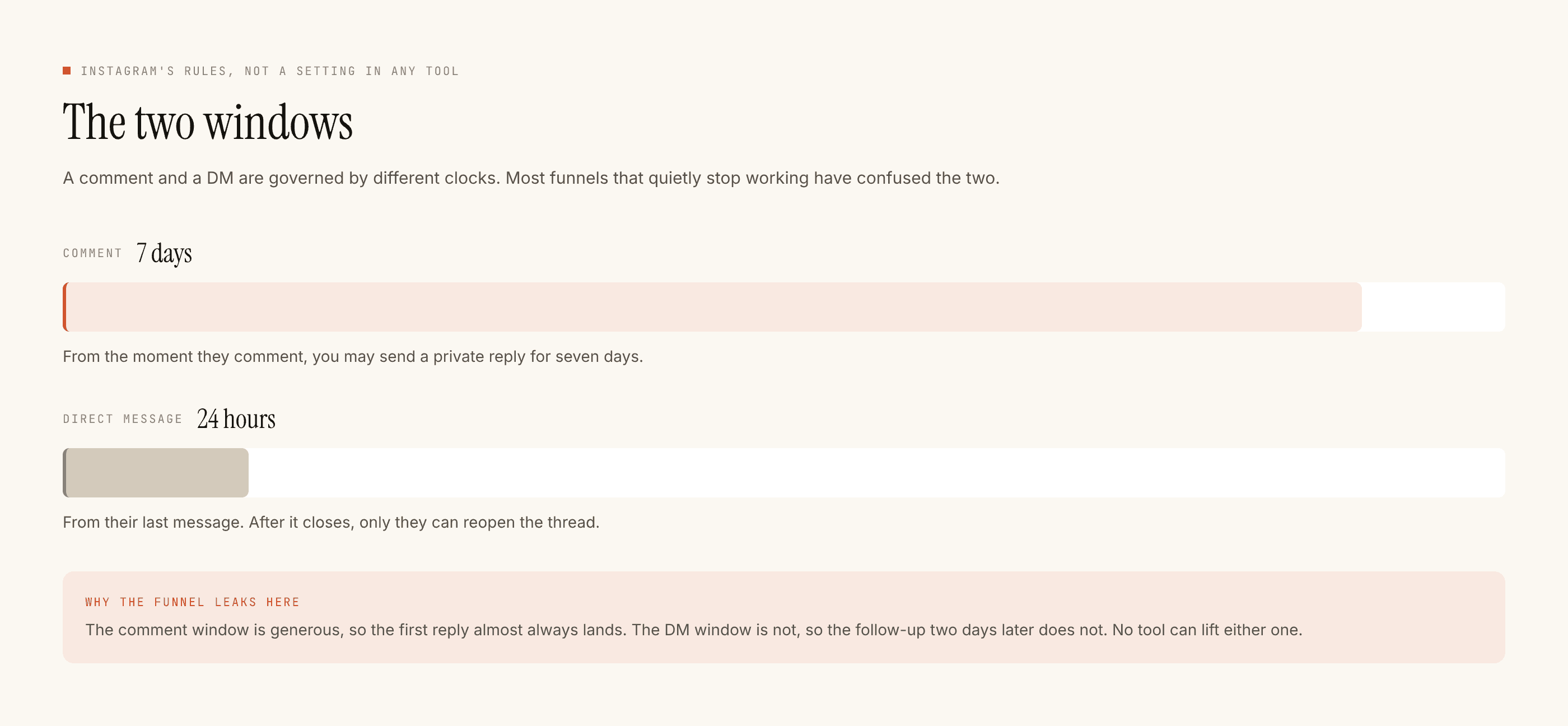
That sounds like a value judgement and it is not. It is a description of the mechanic. The DM window is twenty-four hours and is restarted only by their message. A step that answers a question is triggered by a message — the question — so the window is open by definition. A step that pushes is triggered by a timer, and there is no timer that can open a window.
Run a typical five-step lead sequence through it:
- Welcome / deliver the lead magnet. Answering. Triggered by them typing the keyword. This survives intact and is your main automation.
- Day two: the objection handler. Split it. If it answers a question people genuinely ask, it becomes a template on a message trigger for those words. If it fires on a timer regardless, it dies.
- Day four: the case study. Almost always pushing. Dies. The content is still good — it belongs in a post, which is the only outbound channel you have here.
- Day six: the offer. Pushing. Dies as a scheduled message. Survives as the ending of step one, which is where it should have been.
- Day nine: the last-chance message. Pushing, and the one people fight hardest to keep. It cannot be sent. There is no re-open, no paid override, no template that revives a closed thread.
Most five-step sequences come out of this as one automation, one or two message-triggered templates, and two pieces of content that need to become posts.
Where the dead steps go
They are not wasted, they are misfiled. Three destinations.
Into the first reply. The offer that was step four usually belongs at the end of step one. You have one guaranteed turn, so anything you were saving for later either goes in now or goes nowhere.
Into a post. Your case study, your testimonial, your "here is what happens after you join". These were always content. Putting them in a scheduled DM was a way of guaranteeing they got seen, and that guarantee is gone. Your posting schedule is now your nurture schedule, which is not a slogan, it is a description of the mechanism.
Into another channel. If you need genuine scheduled sending, it has to happen somewhere that permits it. Leads export as a CSV — there is no CRM sync, no webhook, no email tool and no WhatsApp here. The file is the entire handoff, and this product's honest role in that plan is to hand you the list.
The one thing that is genuinely better here
Worth ending on, because the port is otherwise a subtraction.
In a sequence, step two arrives on day two whether or not the person is thinking about you. Here, the equivalent reply arrives the second they ask, at whatever hour, because you pre-positioned a template for the answers to your own closing question. Reply one ends "Weekend batch ya weekday?" and there is an automation waiting on weekend, weekday, saturday, sunday.
That is not scheduling into the future. It is a reply parked on a turn you invited, and it lands faster than any drip step ever did.
A sequence sends on your calendar. What replaces it sends on theirs, which is the calendar that was always deciding the outcome.
What to keep from the old document
The objection list. The order you learnt to handle things in. The sentences that worked. All of that is writing, and writing is the part of a sequence that had value.
Templated replies are free and unlimited, so every one of those salvaged sentences costs nothing to run at any volume. A credit is spent only when the AI has to write something new. Free tier is 100 credits with no card; packs from ₹499.
Then delete the timer column, because that was the part the platform was never going to allow.