Playbooks · 5 min read
Answering "Kitna Hai" Without Losing the Conversation

This post is not about what our software costs. It is about the single line you write once and then send several hundred times: your answer to the most repeated question on your account.
Open your comments. On most Indian creator and small business accounts the top question, by a distance, is some form of "kitna hai". Price, rate, cost, keemat, DM me the rate. Whatever automation you build will spend most of its life answering that question, so the wording of that answer is a more consequential decision than any setting in the builder.
"DM for price" is an obstacle, not a strategy
The reasoning behind hiding the price is that a conversation converts better than a number. Sometimes true. The cost is rarely counted.
A person asking the price has already decided they are interested enough to type. That is the moment of maximum willingness, and answering it with a request for more effort spends that willingness on nothing. Half of them do not DM. The ones who do arrive slightly annoyed, and the first thing they say is the same question again.
There is a second cost that is easy to miss. Comments are public. When you reply to one person with the number, you have answered the forty people reading the comments who were never going to ask.
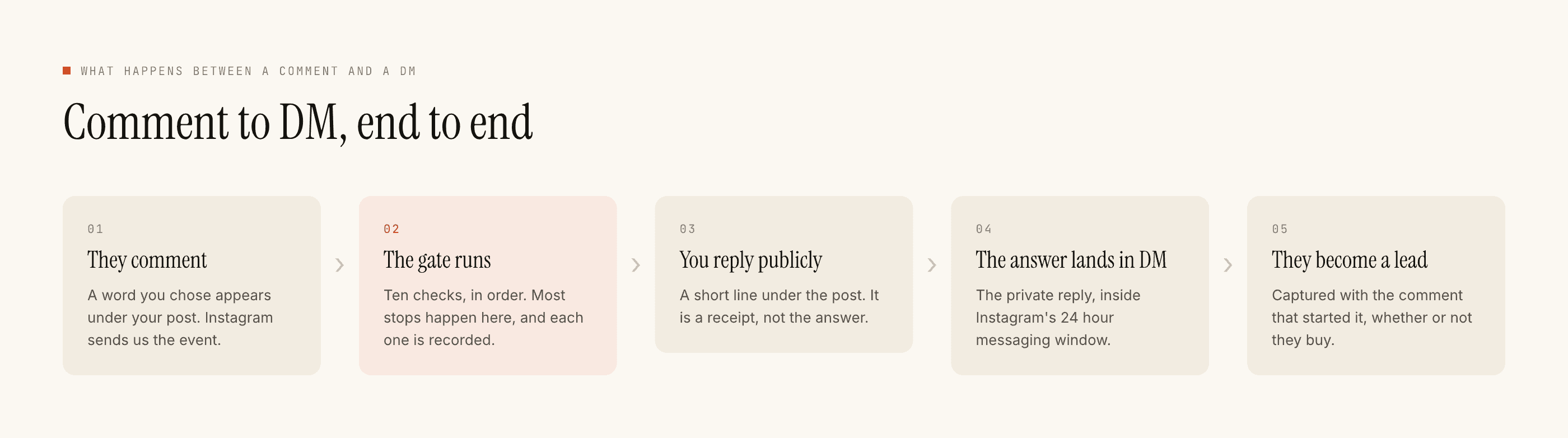
Four ways to answer, and what each costs
- The number. "₹2,499." Fastest, most trusted, filters hardest. Costs: it is public if you say it publicly, competitors read it, and if your price genuinely varies you have just made a promise you cannot keep.
- The range. "2,499 se start, size ke hisaab se." The best default for most businesses. Costs: everyone anchors on the bottom of the range, so the bottom number had better be one you are willing to sell at.
- The rule. "₹85 per square foot", "per head", "per hour", "per day of shoot". Right when the total is genuinely a function of something. Costs: it needs one more piece of information from them before it means anything, which is fine because the rule itself already told them the order of magnitude.
- The counter-question. Only honest when you truly cannot quote — a bespoke build, a wedding, a renovation. Costs: a round trip, and a round trip depends on them writing back to you, which is a real chance of losing them. If you take this route, ask everything you need in one message.
The one option not on this list is silence, because silence is not neutral. It reads as expensive, which is a positioning choice you have made without deciding to.
Splitting it across the two replies
You have two surfaces per automation and they behave differently.
The public reply sits under the post permanently, visible to everyone including people who find the post six months later. The private reply reaches one person and disappears into a thread.
A defensible split: put the honest shape in public — "starts at 2,499, sending details" — and the specifics in the DM. The public line does the filtering at scale and demonstrates that you answer the question, which is itself a signal. The DM does the work.
If your price is genuinely sensitive, keep the public reply free of numbers and accept that you are trading reach for control. Just make the trade knowingly.
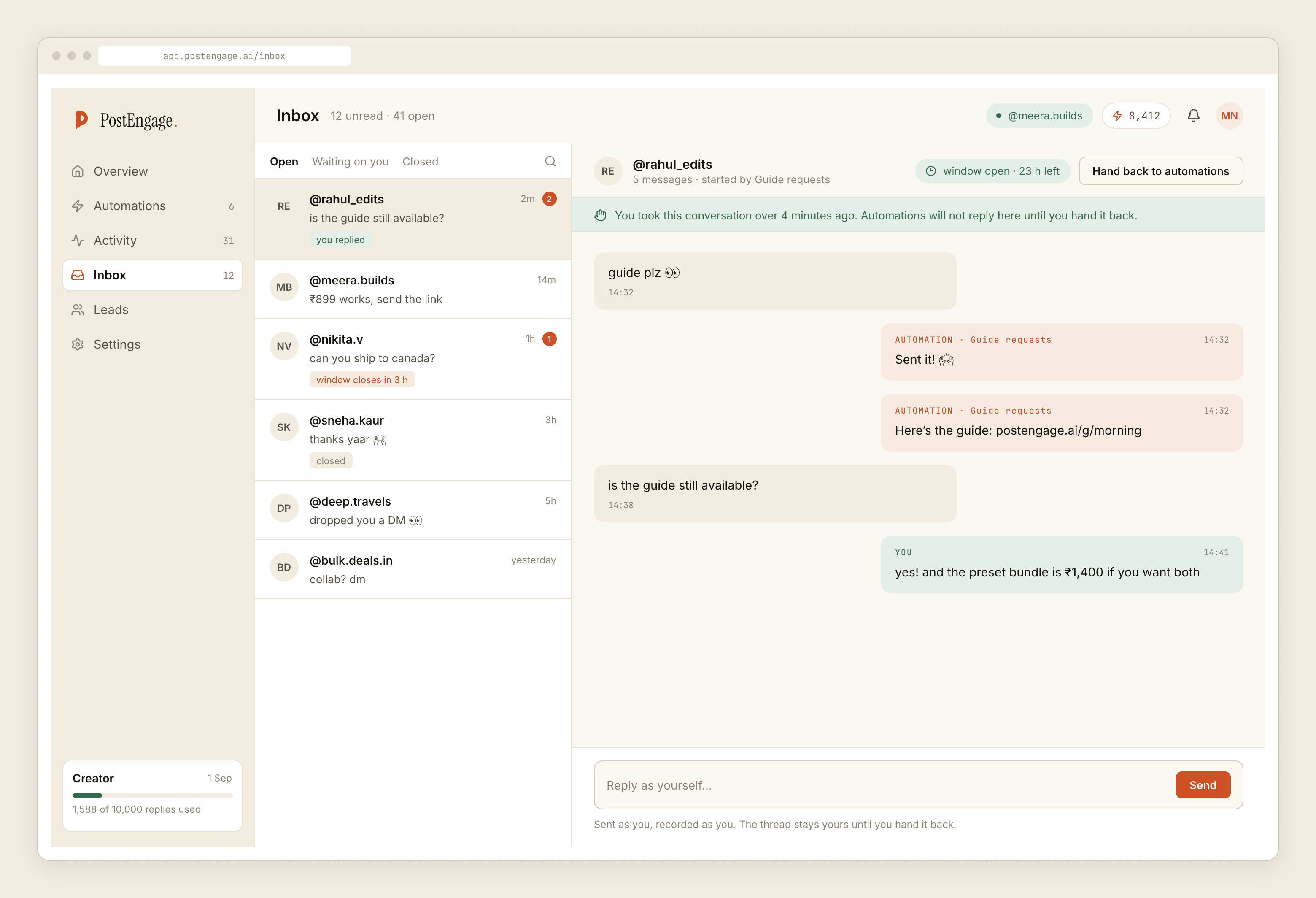
Where negotiation begins, automation stops
discount, best price, last price, kam karo, EMI, installment, offer, student price. Put every one of them in negative keywords so nothing automated goes out and the message lands in your inbox.
A template cannot negotiate. It can only concede or refuse, and it will do whichever you wrote three months ago regardless of who is asking or what they are buying. Negotiation is a judgement, it is where your margin lives, and it should cost you thirty seconds of attention rather than a stored sentence.
The maintenance nobody mentions
Your price is text inside your templates. There is no price field, no catalogue, no product feed, no sync with your store. When you raise prices in April, every automation that mentions a number is wrong until you edit it by hand.
This bites hardest in a mature setup with several automations built over a year — which is an argument for keeping a list of them. Put a price change on the same checklist as updating your website, and check the public replies too, since those are the ones a stranger reads first.
An automation quoting last year's price is not a small bug. It is a public promise you have to honour or explain.
Two things not to do
Do not put a fake deadline on the price. "Only till Sunday" that is still there next month is a false statement repeated at volume by a machine, and in a channel this personal people notice — the longer argument about pressure in DMs is here.
Do not let the AI invent a number. Templated replies are free and unlimited, which means there is no cost reason to have a model composing anything near your pricing. Write the line yourself, in your own register, and let the generation earn its keep on the messages you could not have anticipated.