
"Close deals from your DMs without lifting a finger" is the phrase this category is sold on. It is worth taking apart step by step rather than agreeing or disagreeing with it, because the truthful answer is uneven: some of a sale automates completely, most of it cannot be touched, and the boundary is sharp enough to draw.
There are also no revenue benchmarks in this post. We have no attribution, no conversion tracking and no view of anybody's orders, so any figure would be invented, and an invented figure is the thing that makes the rest of a document unusable.
The sale, step by step
Getting attention. Not automatable, not by us and not by anyone on the official API. Reach is decided by the post and the algorithm. We have no publishing, no scheduling, no hashtag tool, no caption generator, and nothing that influences how many people see anything.
Being asked. Not automatable, because it is their action. You can make it likelier — a specific ask in the caption, a keyword short enough to type with one thumb — but the message itself is theirs to send and no permission exists to skip it.
Answering the question you have answered a hundred times. Fully automatable, and free. This is the whole product. A trigger matches the word, ten checks run, and a templated reply goes out. Templated replies are unlimited and cost nothing, so an inbox that is mostly four repeated questions costs nothing to answer forever.
Answering the second question. Automatable if you predicted it. Their reply restarts the window and is its own trigger event, so a set of small independent automations — one for size, one for cod and upi, one for delivery — handles most of what comes back.
Answering something nobody predicted. Partly. This is what a credit is for: one credit, one reply, and only when the model writes something new. It writes in a voice built from replies you actually wrote, and if it cannot ground what it would say, your template goes out instead.
Negotiating. Not automatable, and it should not be attempted. A discount conceded by a template is a discount conceded to everybody who typed the word.
Taking the payment. Not automatable, because it does not exist here. No checkout, no cart, no payment link generation, no order object. The message ends with a link, an address, or a UPI handle, and the transaction happens somewhere else.
Confirming, and everything after the sale. Only if they message you. There is no post-purchase sequence and no way to reach a past customer who has gone quiet, because the window is theirs to open.
One step out of eight automates completely. It also happens to be the step you were doing four hundred times a month.
The ceiling, and where it comes from
Everything above sits under a permission you granted once, on Meta's own consent screen, and the token you came back with is the ceiling on everything a compliant tool can do.
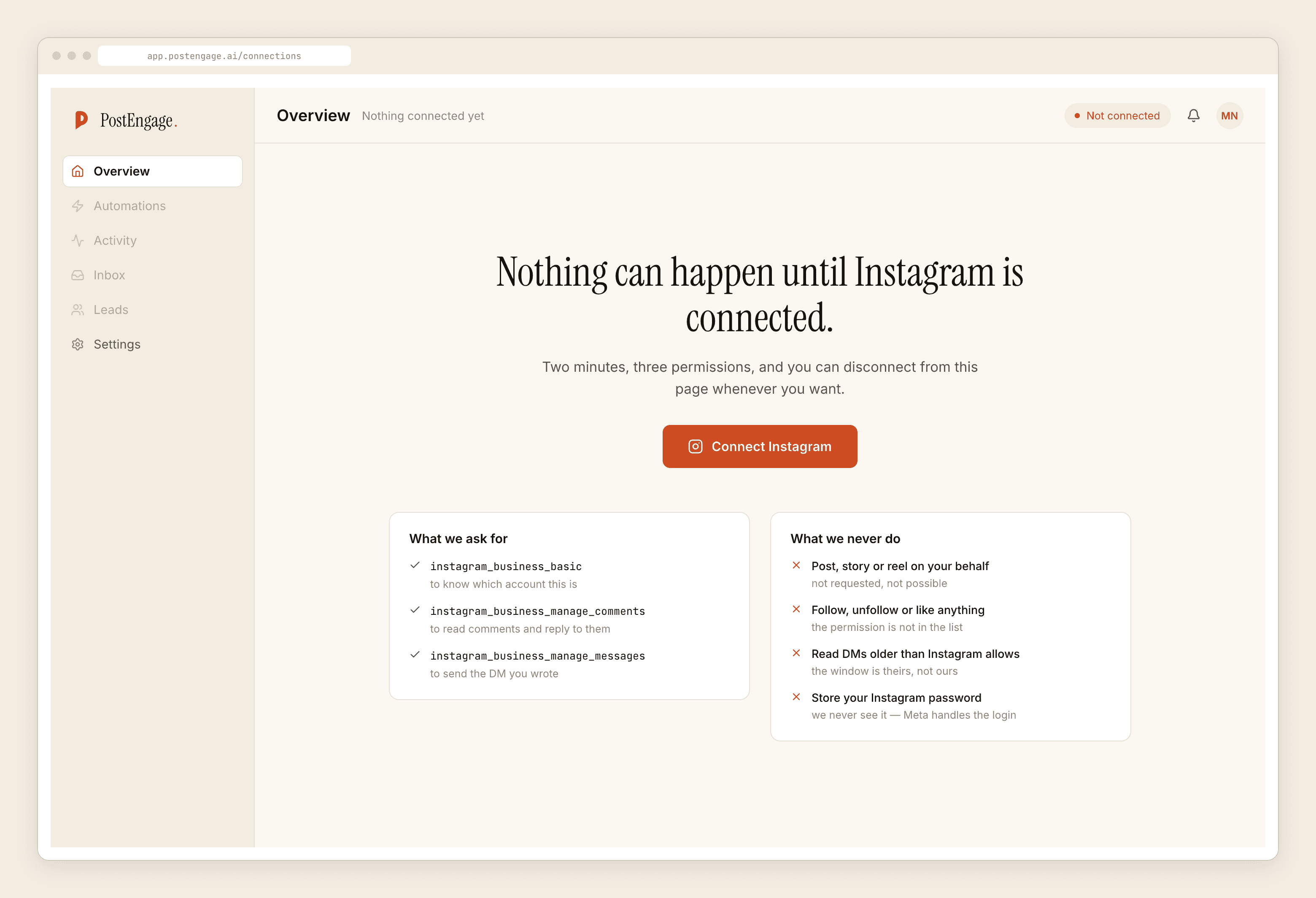
Which is why "sales automation" in the sense of a machine that finds buyers and closes them is not a product that exists on this API. There is no permission to message somebody who has not messaged you, at any price, on any plan. The refusal in full, including what the tools advertising it are actually doing.
What runs between the match and the send
Before any reply goes out it passes ten checks, in a fixed order: kill switch, connection, takeover, window, dedupe, cooldown, quiet hours, rate budget, credits, content safety. The first failure stops the send and records the reason against the run.
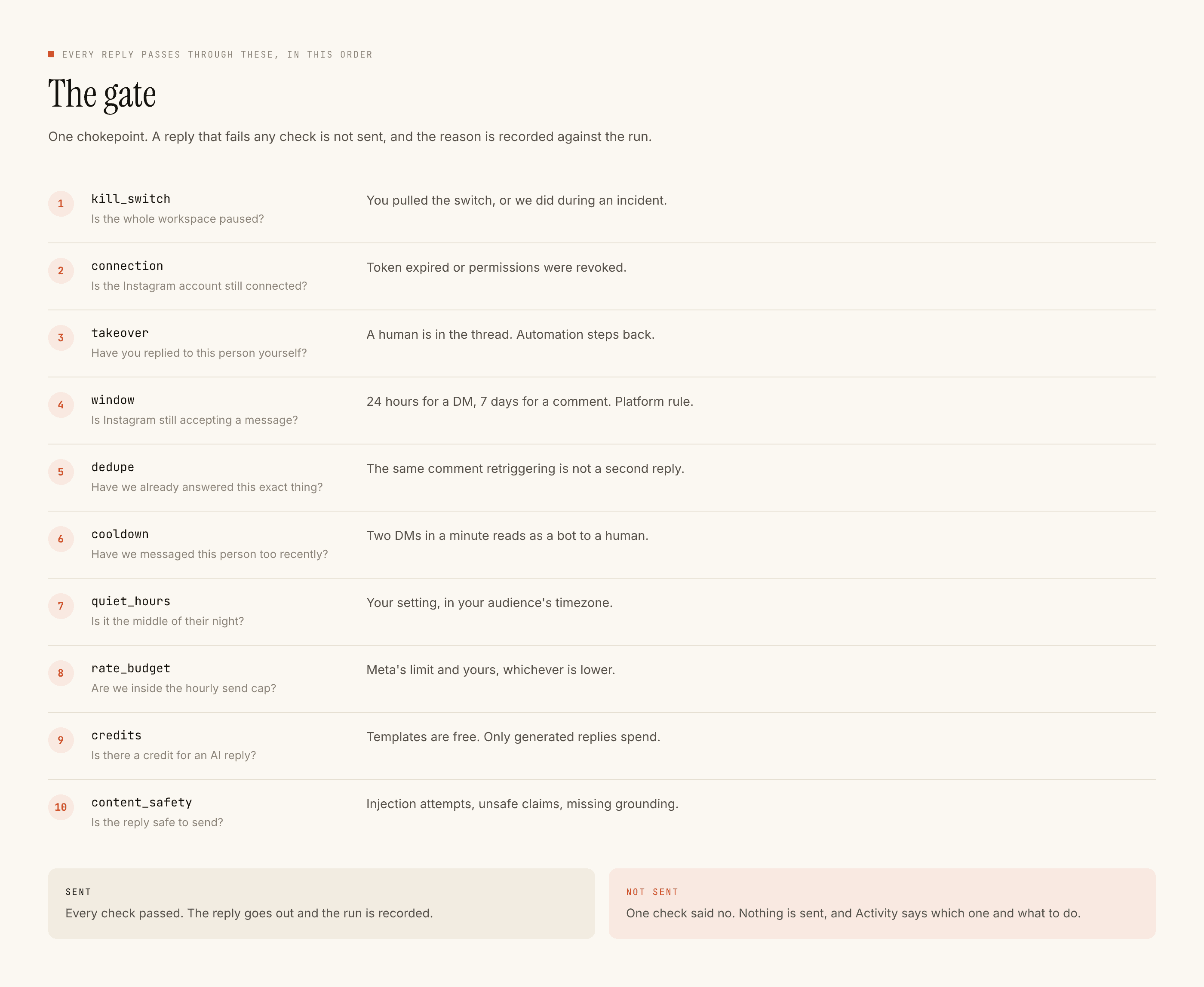
Two of them are worth knowing by name if sales is the use case. Takeover stands the automation down the moment you reply by hand, which is exactly what you want on a large order. Rate budget caps how many replies leave in an hour, which on a post that travels turns two thousand simultaneous messages into a queue that drains over the afternoon — still comfortably inside the seven day comment window, and without the spam reports that would otherwise follow your account around.
So what is it actually worth
Not a revenue multiple, because nobody can honestly produce one. The defensible claim is narrower and easier to check: every question that used to wait until Monday now gets answered, including the ones that arrive at two in the morning, and the ones on posts from four months ago that you had stopped looking at.
Whether that converts is a question about your offer and your answer, not about the automation. Working the ROI out by hand is the version that survives being asked where the number came from, and what a single reply has to contain is where the actual selling happens.