Guide · 6 min read
How to automate Instagram DMs inside the twenty-four hour window
The clock is the whole subject. A DM automation is a rule that has to answer a person before a twenty-four hour window shuts, and most of what looks like a broken setup is a window that closed while you were asleep.
Instagram DM automation gets described as though the hard part is writing the message. It is not. The hard part is that you are allowed to send it for a limited time, that the limit is different depending on where the conversation started, and that almost every "why did nothing send" question turns out to be a clock question.
So start with the clocks.
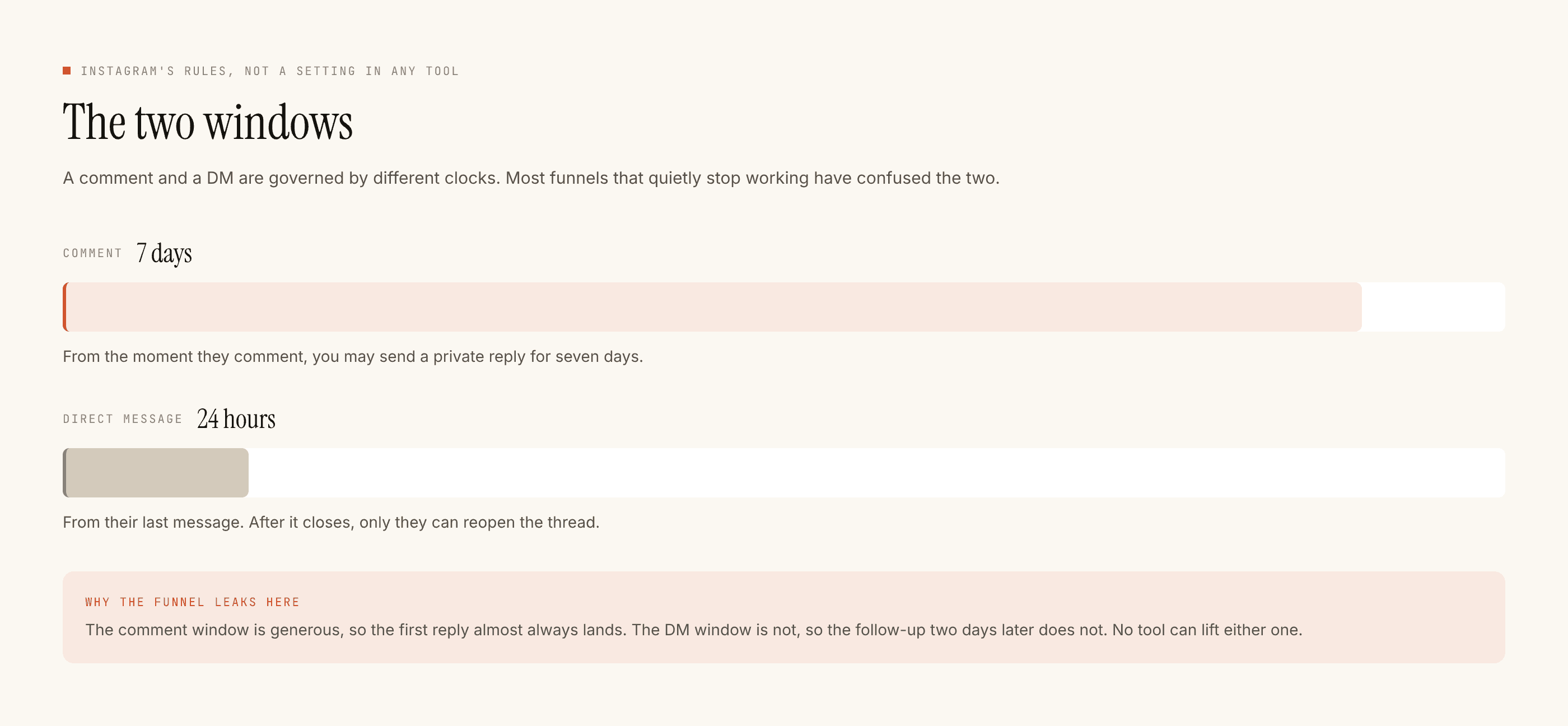
Comments: 7 days. You can reply to a comment for a week after it was posted.
DMs: 24 hours. You can reply to a direct message for a day after the person's most recent message to you, and the clock restarts whenever they write again.
That second sentence is the useful one. A conversation stays open as long as it is a conversation. It closes when the person stops talking, which is exactly when a reply would have been unwelcome anyway.
What you are actually allowed to automate
Three entry points, all of them started by the other person:
- A comment on your post or Reel. They comment a keyword, you reply publicly and privately. This is the comment-to-DM flow and it is the most common reason people set any of this up.
- A story reply or a story mention. Someone answers your story and lands in your inbox. Same 24-hour clock as any other DM.
- An inbound DM. They message you first, containing a word you have a rule for.
What is not on the list is the thing DM automation is usually marketed as: messaging people who have never messaged you. Blasting a follower list is not a permission you can apply for. It is the reason the enforcement exists in the first place. If a tool advertises it, it is not on the official API, and the difference between those two kinds of tool is worth thirty seconds of your time.
Building one
The builder is the same one comment automations use, because a comment-to-DM flow is a comment automation with the private reply filled in. If you have not built one yet, the comment guide walks every field and this page assumes it.
The fields that matter differently for DMs:
- The trigger. For an inbound DM rule, the keywords are matched against the message they sent. Matching ignores case and punctuation, so
Price?andpriceare one thing. It still does not guess —pricingis a separate entry. - Negative keywords. More important in DMs than in comments, because a DM is longer and has more room to contain a word you did not mean.
not interested,cancel, and anything that means the opposite of what your rule assumes. - The private reply. The whole payload. There is no second message coming, so this one has to answer the question and say what happens next.
- Capture to Leads. On. A person who DMs you is a person worth having a record of.
- Advanced: first-time senders only. Genuinely useful here. It stops the same follower being greeted every time they reply to a story.
- Advanced: quiet hours. In your audience's timezone. A DM at 3am reads as a bot even when the words are perfect.
Two settings people leave alone and should not. Cooldown stops the same person being answered again and again in a short stretch, which matters most on the accounts where one enthusiastic follower replies to every story. Rate budget caps how many replies can go out in an hour, so a post that goes unexpectedly wide does not turn into several hundred identical messages arriving in the same minute. Both appear in the blocked list when they fire, which is how you find out they were doing something.
Write it like a person who is busy, not like a brochure
The register that works in an Instagram inbox is the register you use in an Instagram inbox. Short. Lowercase is fine. "haan, ye size mein available hai — kal tak dispatch ho jayega" is a better reply than three sentences of customer-service English, because it is what the person expected to receive.
Templated replies are free and unlimited, so write a specific one per trigger instead of one general one you reuse. A credit is spent only when the AI writes something new for a specific message, one credit per reply. If you want AI-written replies rather than templates, that is its own guide.
Test on myself, then go live
Test on myself runs the real pipeline — match, all ten checks, generation, send — and delivers the result to your own account. Nothing is simulated. Then Go live, on one rule, and leave it alone for a day.
The ten checks run in this fixed order on every reply: kill_switch, connection, takeover, window, dedupe, cooldown, quiet_hours, rate_budget, credits, content_safety. The first failure stops the send and its name is recorded against the run in Activity.
A blocked list full of closed windows is not a broken automation. It is the platform saying no, on schedule.
Reading the inbox, and knowing when to take over
Automation answers the questions you already know the answers to. The rest lands in the inbox, where a person handles it.
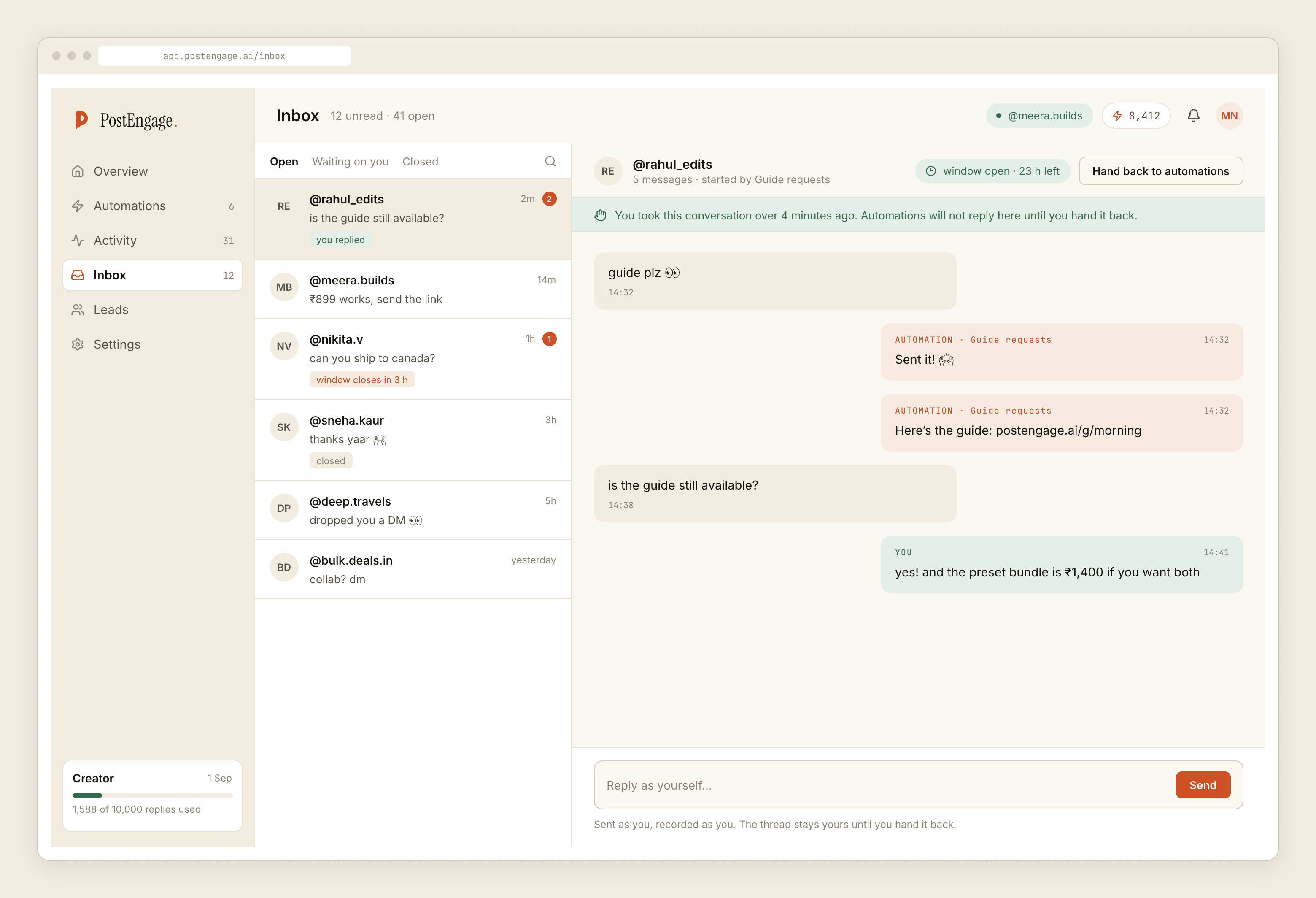
Two habits make this work. First, check the threads where the automation replied and the person answered back — that second message is where real conversations start, and no rule is going to handle it. Second, watch how often takeover fires. A lot of takeovers means the rule is answering things you would rather answer yourself, and it should be narrower.
What to look at after a week
Healthy
Worth fixing
Leads leave as CSV — there are no one-click integrations here, so if the list needs to reach a CRM, export is the route. Sorting which of those leads is worth answering first is a separate job with its own guide.
What to do next
If the automation is live and the blocked list is boring, that is the finished state. Widen slowly: one more rule, tested on yourself, live on one post.
Two things worth reading afterwards. The overview of what the API permits across the whole category, which is the honest shape of every tool in this space and not only ours. And where a comment-to-DM funnel leaks, which explains the drop between people who commented and people who replied to the DM, most of which is not fixable and is worth not chasing.
What we hold, how long, and what leaves the system is written down on the security page, because a tool that reads your inbox owes you that in plain language.
Questions people ask
Can I send automated DMs to people who have never messaged me?
No, and no compliant tool can. The official API only lets you reply inside a conversation the other person started, whether that was a comment on your post, a story reply, or a DM. Cold outreach to a follower list is not a permission Meta grants, and asking for it is the fastest way to lose an account.
What is the twenty-four hour window exactly?
It runs from the other person's most recent message to you, and it resets every time they send another one. Inside it you can reply freely. Once it closes, the send is refused and Activity records the reason as the window check, which is the single most common entry in a healthy blocked list.
Does automation stop if I reply to someone myself?
Yes. Takeover is the third of the ten checks, and it stands the automation down in that thread the moment a human replies by hand. It does not resume afterwards. That is deliberate: nothing is worse than a customer getting a template thirty seconds after you personally answered them.
Can I build a multi-step nurture sequence in DMs?
Not here. There is no sequence builder, no broadcast and no flow canvas in this product — an automation is one rule that produces one reply. If a drip campaign across days is the thing you need, this is not the tool, and it is better to know that now than after migrating.