Playbooks · 5 min read
A WhatsApp Funnel Is a Chain of Permissions, Not Boxes

We do not have a funnel builder. No canvas, no drag-and-drop journey, no branching flowchart, no step counter attached to a contact. Not on Instagram, not on any channel, not behind a flag.
That is a real absence and worth stating before anything else. But the more useful thing to say is that the canvas — the thing people are shopping for when they search this — is a picture of a mechanism that does not exist on a messaging channel, and building against it produces designs that break in ways the diagram cannot show.
What a flowchart quietly assumes
Draw a box, draw an arrow, draw the next box. That picture assumes one thing: that after box one completes, you get to run box two.
On a website, you do. On an email list, you do. On a messaging channel you do not, and the reason is that the next move belongs to the other person or to a permission you hold. Every arrow in the diagram is really a question — am I allowed to speak now? — and the diagram has no way of drawing that question, so it draws certainty instead.
A flowchart drawn for this channel is a picture of what you would like to happen, with the permissions painted out.
The three states you can be in
There are only three, and every "stage" of a funnel here reduces to one of them.
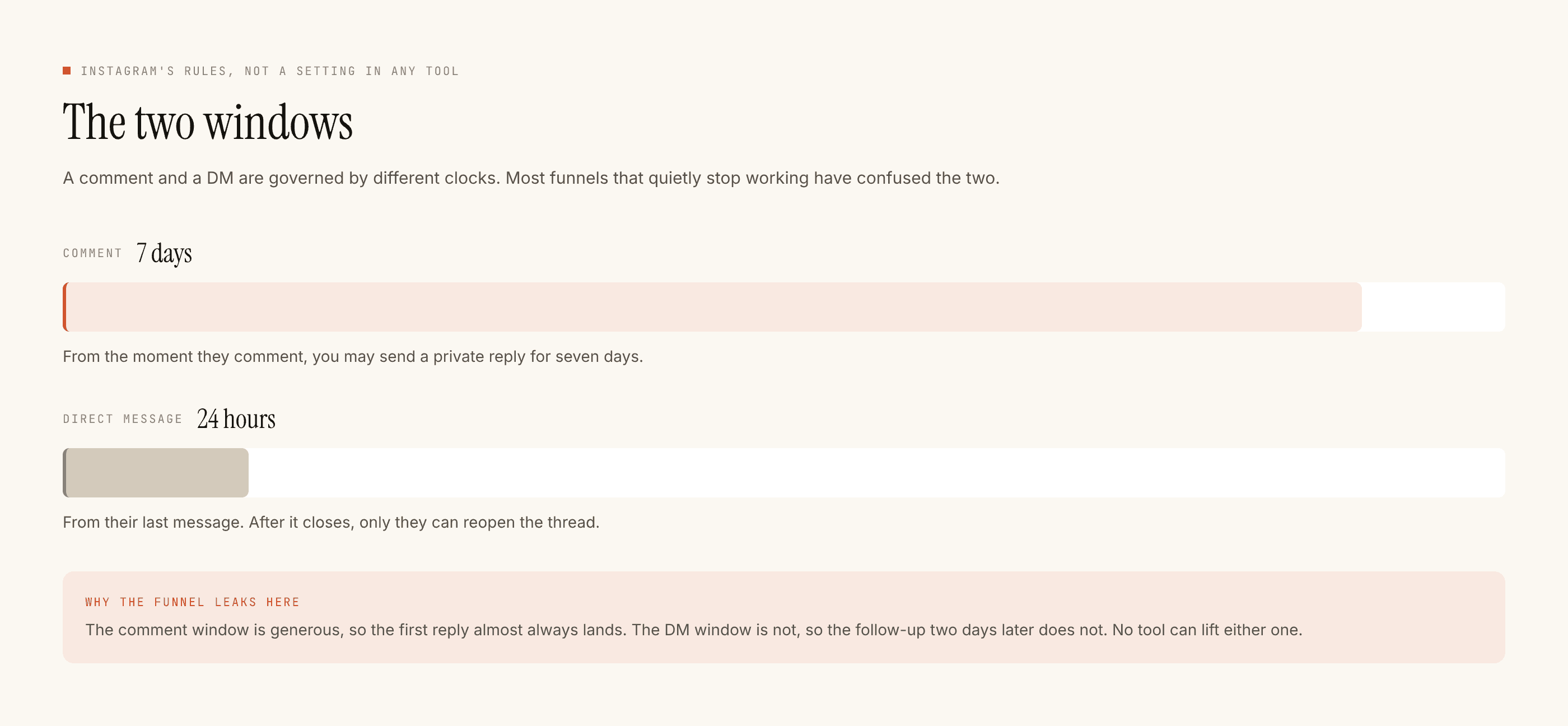
They wrote to you recently. This is the good state. Within a window that Meta defines for the platform, you can reply in free-form text, ask a question, send a link, be a human. Nothing needs approval. This state is created only by them, and it expires.
You hold consent and an approved template. You may open a conversation. What you may say is constrained to a template that was reviewed in advance, the template belongs to a category, and the category determines both what is permitted and what it costs.
Neither. You may not message. There is no clever workaround, and a vendor offering one is describing either a rule they do not control or a route that will cost you the number.
So the funnel, drawn honestly
It has four parts, and only two of them are messages.
A door, somewhere else. Nobody discovers a business by browsing this channel. Somebody taps a link, scans a code, clicks an ad, or reads a number off an invoice. The door is on a website, a shelf, a poster or a feed — where the lead actually comes from is its own subject.
The conversation they opened. State one. This is where almost all of the value is, and it is short. The design question is not what five messages to send; it is what one reply earns another turn.
A permission, asked for out loud. If anything is to happen after the conversation cools, you need consent that is specific and recorded. This is the only stage transition in the whole funnel that you actually control, and it is a sentence in a message: here is what we would send you, is that all right.
An exit. Most people will not buy in the thread. What happens to them next belongs to a channel built for unprompted repeated contact. Pretending this one is that channel is the mistake the flowchart encourages.
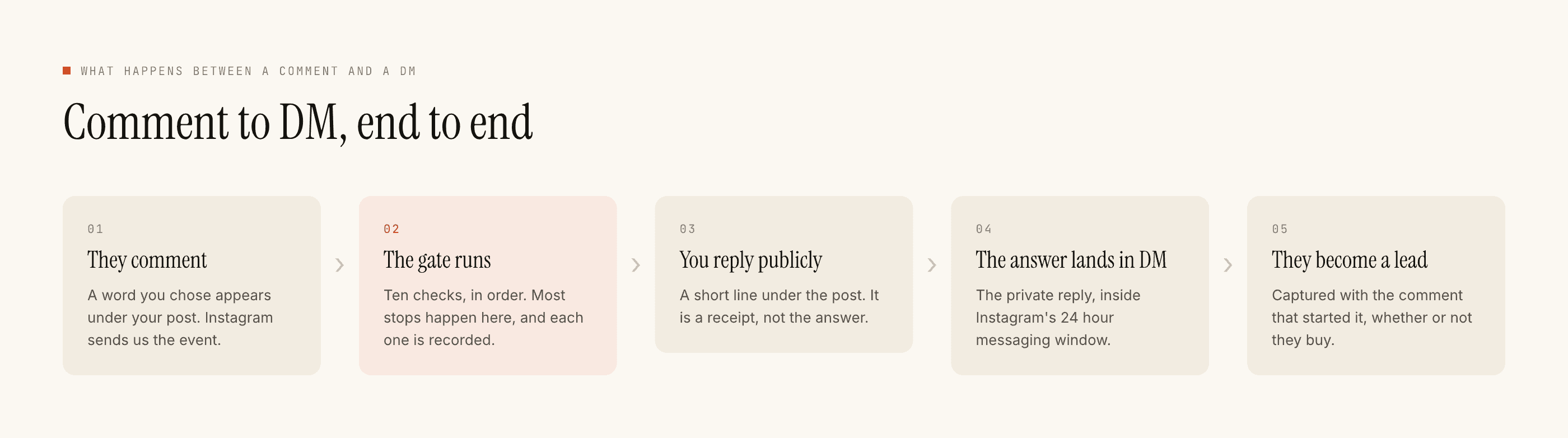
Why independent rules beat a flow
A canvas implies per-person state: this contact is on step three, that one is on step five. State has to be stored, kept correct, and reasoned about when reality does not cooperate — and reality does not cooperate constantly. Somebody replies to step two four days later. Somebody asks a question from step five while sitting at step one. Somebody's colleague answers by hand.
The design that survives is a set of small independent rules, each watching for something and answering the message in front of it. One handles the sizing question. One handles delivery areas. One handles the price. None of them knows the others exist.
From the customer's side it still reads as a conversation, because they asked three things in order and got three good answers. From your side it is far easier to fix, because a wrong answer is one rule rather than a branch buried in a diagram.
What to build instead of a canvas
- Name the doors. List every place the number appears and what a person arriving through each one already knows.
- Write the first reply per door. Not one universal greeting. Somebody who scanned a QR at your counter needs a different sentence from somebody forwarded the number by a cousin.
- End replies with one easy question. A question is what earns the next turn, and the next turn is the only currency this channel has.
- Ask for consent explicitly, once, in plain language, and record what the person was shown when they said yes.
- Route anything that is not a question to a person. No branch is going to handle a complaint well.
- Export and hand off. The people who went quiet belong in a channel that is allowed to contact them again.
Where this stands today
PostEngage does not ship WhatsApp. On Instagram it answers comments and DMs using independent rules exactly as described above — a trigger, keywords, a public reply, a private reply, and a capture to Leads. There is no builder canvas, no sequence, and no broadcast in it.
For the sending-later half of this, nurturing has rules of its own on this channel. For the same argument made against Instagram's flow-builder pitch, the Instagram version is here.