Playbooks · 4 min read
Automating WhatsApp Without Writing Code: What That Actually Means

We do not ship WhatsApp, so this is not a walkthrough of our product. It is what "no-code" turns out to mean on this channel, written because the phrase does a lot of quiet work in vendor marketing.
The honest version: no-code removes the typing. It does not remove the four decisions that determine whether the thing works, and every one of those is still yours.
What no-code genuinely removes
Real, and worth having. You are not writing a webhook handler, not managing an access token, not deciding what happens when Meta returns a rate-limit error at two in the morning, and not maintaining any of it when the API changes.
That is a substantial amount of work, and a tool absorbing it is the actual product. The mistake is assuming it also absorbed the thinking.
A canvas with no boxes on it is not easier to use than an empty file. It is just prettier while you decide what to put in it.
The four decisions nobody makes for you
- What each message is for. Not "a welcome flow" — the specific question it answers. Most businesses need fewer than five messages and start by building twenty.
- Who agreed to receive it. On a channel this personal, the difference between a welcome message and a complaint is whether the person asked. That is a decision about your sign-up, not about your tool.
- What must never be automated. Anything about their money, their order, their account, or anything a complaint arrives in. Writing this list before the send list is the single best predictor of whether the setup survives.
- Who takes over, and when. The handover rule. A tool can route; it cannot decide when a person is needed.
None of those is technical. All four are harder than the configuration, and all four are skipped in exactly the setups that go wrong.
The part that is genuinely technical anyway
Two things stay awkward no matter how good the interface is, because they are platform facts rather than product limitations.
Business-initiated messages need pre-approved templates. You cannot improvise a message to somebody who has not written to you recently. That is how the platform is built, and it means a "no-code campaign" still involves a submission and a wait.
The categories a message falls into affect what Meta charges. The specifics change and vary by country, so take them from Meta's own documentation on the day you plan — not from a blog post, including this one.
The shape that works
Start with the message you send most, written properly, once. Not a flow — a message. Get it right, watch what people reply to it with, and let the second message be an answer to something real rather than something you imagined.
Businesses that build a twenty-node flow in week one almost always discover in week three that fifteen of the nodes are never reached, and that the two questions people actually ask were not in the diagram at all.
What this looks like on the channel we do run
PostEngage answers Instagram comments and DMs. There is no flow-builder canvas in it, deliberately — an automation is a trigger, a reply, and an optional capture, and the complexity that would go into a diagram goes into the checks instead.
Ten of those run before anything is sent, in a fixed order, and the one that stopped a send is recorded with the sentence explaining why.
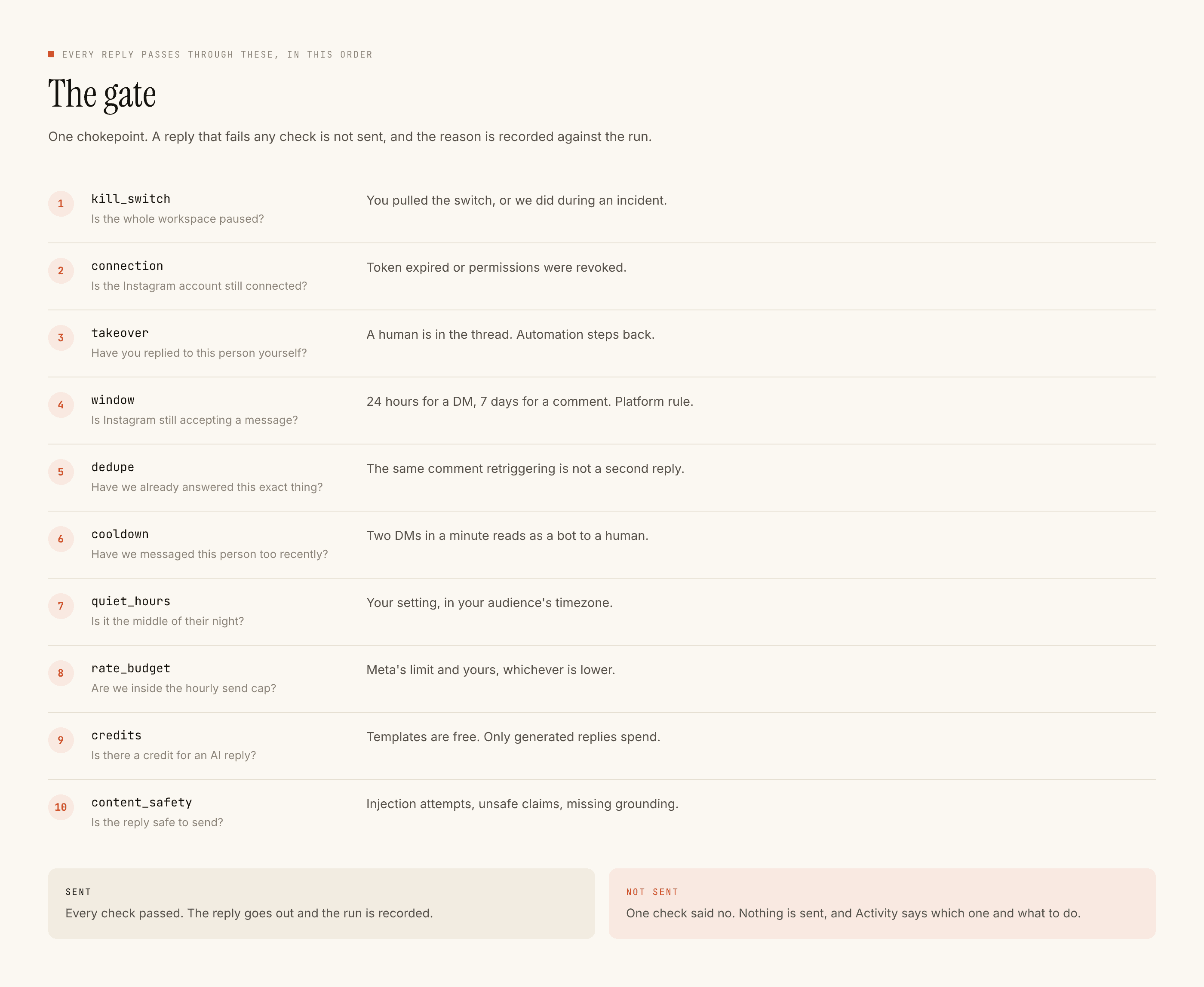
Building one takes a few minutes and the fields are all plain language: trigger and keywords, what to reply publicly, what to send privately, and whether to capture the person to Leads. Test on myself sends it to your own account first, which is the closest thing to a compiler this kind of work has.
When a person should still write it
Every time the answer depends on something about that specific person that the tool does not know. Where their order is, why they were charged twice, whether their booking moved.
A no-code tool will happily let you automate all three, and the resulting message will be confident and wrong. That is the failure mode worth designing against, and no interface prevents it — only the never-automate list does.
Where to read more
For the strategy side of the same argument on WhatsApp, the strategy post goes deeper, and the no-code chatbot post covers what these builders can and cannot express. For the Instagram version, where there is no flow canvas at all, start here.