Lead generation · 5 min read
Where a WhatsApp Lead Comes From Is Not WhatsApp

There is no discovery surface here. No search that finds businesses, no feed, no explore page, no recommendations, no public profile that ranks for anything. Nobody has ever opened this app and found a shop they did not already know about.
Which means the phrase "lead generation on WhatsApp" is describing the wrong half of the process. The channel does not generate leads. It receives them, from doors placed somewhere else, and everything worth optimising is either the door or the first four sentences after somebody comes through it.
Name your doors
Every business has a handful, and most have never written them down. The exercise takes ten minutes and it is the highest-leverage thing in this post.
A click-to-chat link. In a bio, on a website button, in an email signature, in a payment confirmation page. It can carry a prefilled first message, which means the link itself can tell you why they came.
A click-to-chat ad. Paid placement on a feed that opens a thread instead of a landing page. This is the one that behaves most like conventional lead generation, and it is also the one where cost per conversation gets away from people fastest.
A QR code. On the counter, on packaging, on an invoice, on a poster at an event, on the back of a visiting card. Underrated, because a person scanning a QR is physically present and already interested.
A printed or spoken number. On a signboard, on a bill, said aloud by a staff member. Untrackable and often the largest source.
A forward. Somebody's cousin sent them the number. No attribution, no context, and frequently the best lead in the file.
The door is the campaign. The conversation is just what happens after it opens.
What each door tells you before anyone types
This is why listing them matters. A lead's usefulness at the moment of arrival is almost entirely determined by which door they used.
Arrives with context
Arrives with nothing
The right-hand column is not worse. It is just uninformed, and it needs a different first reply — one that finds out what the person wants rather than assuming.
Qualification costs a turn, so ask one question
Lead scoring on this channel gets sold as though a model can read a message and assign a temperature. Be sceptical. What you can genuinely know at the start is what they typed, which door they used, and nothing else. There is no browsing history, no page views, no company data, no enrichment.
So qualification here is not scoring. It is asking, and every question you ask spends a turn that the person may not grant you another of.
That argues for exactly one qualifying question, chosen carefully:
- Pick the one fact that changes what you would do. For a builder, it is the locality. For a coaching class, the exam. For a boutique, the size. Not all three.
- Make it a choice, not an open field. "Ghar ke liye ya office?" gets an answer. "Please share your requirements" gets silence.
- Answer something before you ask it. A question that arrives before any value has been given reads as a form.
- Record the answer where a human can see it later, with the door it came through, so next month you can tell which door produces customers rather than which produces messages.
The consent moment, and where people get it wrong
Somebody messaging you is not somebody agreeing to hear from you later. Those are different things and the gap between them is where most compliance trouble on this channel begins.
Their message gives you a period to reply freely. It does not give you permission to send them an offer next month. If you want that, ask for it, in a sentence they can understand, and keep a record of what they were shown when they said yes — the date, the wording, the door. A number in a spreadsheet with no provenance is not a lead you can market to; it is a risk sitting in a file.
What data protection law requires of your specific business is a question for someone qualified. The mechanics — collect it explicitly, record it, honour a withdrawal immediately — are the same everywhere and are worth doing regardless.
The number worth watching
Not lead volume. Volume responds to spending and tells you almost nothing about whether the thing works.
Watch the share of opened conversations that got a reply back after your first message. A reply is proof that the first message did its job and it is the only asset the whole design produces. If that share is low, the problem is the first reply or the door mismatch behind it, and no amount of extra traffic fixes either.
Where this stands today
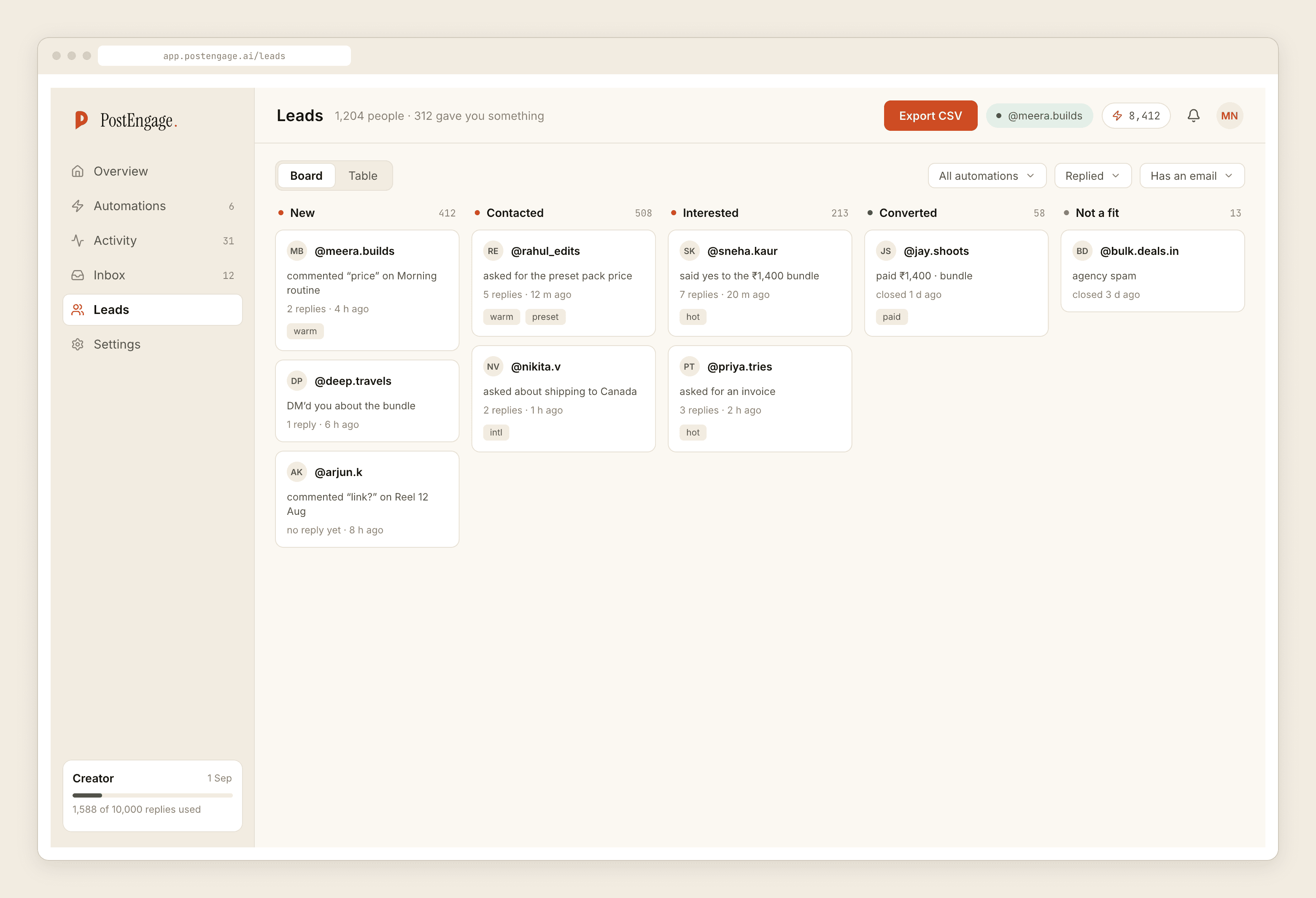
PostEngage does not ship WhatsApp. On Instagram it captures leads from comment and DM automations into a Leads list with the keyword that caught each one, and that list exports as a CSV. There is no scoring model, no enrichment, and no integration that pushes a lead anywhere by itself.
For what happens after capture, the honest account of nurturing on this channel is here. For how the handoff to another tool actually works, it is a file, and that has consequences.