Playbooks · 5 min read
WhatsApp Cart Recovery: The Mechanic and Its Rules

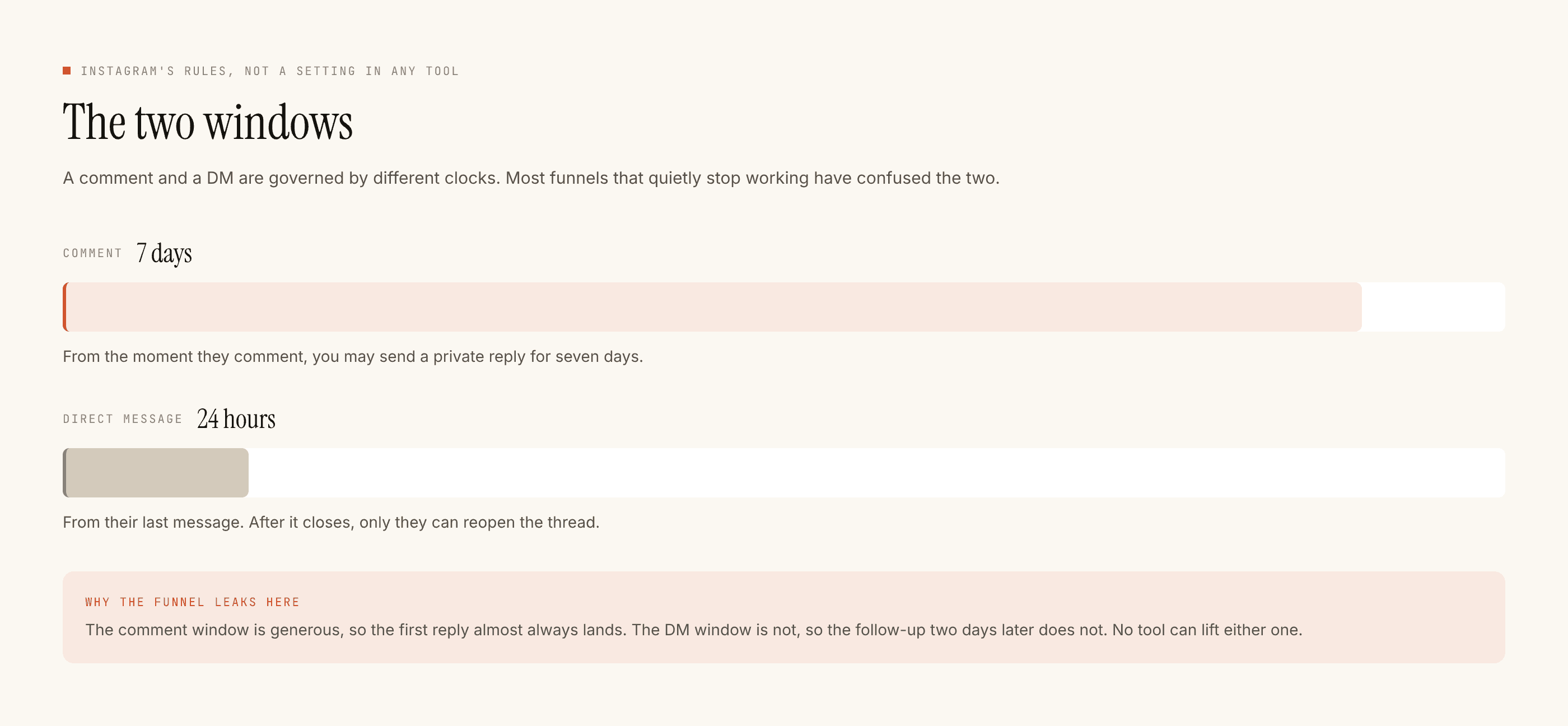
Most channels do not let you chase an abandoned cart. Instagram certainly does not: the DM window is 24 hours from the customer's last message to you, and if someone browsed your store without ever messaging your account, there is no permission to reach them at all. No amount of tooling changes that, ours included.
WhatsApp is the exception, and it is worth being precise about why. The permission is real, but it is granted by a specific mechanism with specific conditions, and businesses that skip the conditions lose the permission.
This post covers the mechanic and its rules. The companion post covers what the message should say.
Why it is allowed here at all
Two features of the WhatsApp Business Platform combine to make it possible.
Templates. Outside the 24-hour customer service window, you may only send a message Meta has pre-approved. A cart reminder is a template: fixed text with placeholders for the things that change.
Opt-in. Meta requires businesses to obtain permission before sending template messages. Someone who abandoned a cart is, by definition, outside any window — they never messaged you. So the entire legitimacy of the send rests on having captured a real opt-in.
The template is the format. The opt-in is the permission. You need both, and only one of them is a technical problem.
The five conditions, in order
- A verified business on the Platform. Meta Business account, business verification, a WhatsApp Business Account, a registered number. Nothing sends before this exists.
- A recorded opt-in. Captured at checkout or before it, with clear language about what you will send. Store when and where it was given. A phone number in your database is not an opt-in.
- An approved template, in the right category. A cart reminder that promotes a purchase is marketing. Submit it as such. Filing it as utility to change the economics is the thing Meta reclassifies.
- A trigger from your store. Checkout started, payment not completed, some delay. This is your side of the wiring, not Meta's.
- A way to reply, and a way to stop. The reply reopens the window, which is where the value is. The stop is an obligation and a quality signal.
What "opt-in" actually has to look like
This is where most programmes are quietly non-compliant, so it is worth being concrete.
An opt-in is a person actively agreeing to receive WhatsApp messages from your business, with enough context to know what that means. A pre-ticked box does not clear that bar in spirit and increasingly does not clear it in law. A phone number entered to receive an OTP is not consent to receive promotions.
Category, and being honest about it
Meta prices conversations by category and reviews templates against the category you claim. A cart reminder sits awkwardly for people because it feels transactional — the customer started it, after all — but it is promoting a purchase that has not happened. That is marketing in Meta's terms.
The consequence is a cost consequence, and it is the correct one: chasing people costs more than serving people, which is a reasonable thing for a messaging platform to price in. The cost model in full.
The window reopens, and that is the actual prize
Here is the part most cart-recovery advice misses entirely.
The template send is a billable, approved, one-shot message. But if the customer replies to it — even with "kitna time lagega" — a 24-hour window opens, and inside that window you can write freely. No approval, no fixed text, a real conversation.
So the template is not the pitch. It is the door. A template designed to get a reply is worth more than one designed to close a sale, and it is a different piece of copy entirely.
Where this gets abused, and what it costs
The failure pattern is always the same. A business discovers the mechanic works, sends more, widens the list, shortens the delay, adds a second and third reminder. Then blocks and reports climb, the quality rating falls, messaging limits tighten, and the channel that was working stops working.
The recovery from that is slow and mostly consists of sending less. It is far cheaper to never get there.
Programmes that keep working
Programmes that degrade
The Instagram contrast, honestly
On Instagram, our answer to cart recovery is that we cannot do it and neither can anyone else on the official API — there is no permission to message a browser who never talked to you. What is possible there is the reverse direction: make the conversation happen first, publicly, and then the window exists. That is the comment-to-DM pattern, and it is a genuinely different play.
WhatsApp's advantage on this specific job is real. It is also conditional, metered, and easy to burn. Treat the permission as the scarce resource, because it is.