
Most DM funnels are assembled forwards. Pick a post, pick a keyword, write a friendly reply, turn it on, hope. It works well enough to produce conversations and badly enough that nobody can say what the conversations were for.
Designing backwards fixes that, and it takes about twenty minutes. You start at the end — the one thing you want to have happened — and work back through the DM, the public reply, and the ask in the post, checking that each stage can plausibly produce the next.
Name the destination first, in one sentence
Write down what a successful run looks like, concretely enough that you would know it when you saw it. "They book a call." "They tell me their size and I quote them." "They reply with their city so I can say whether we deliver."
Notice that all three end in something the person does, not something you send. A funnel whose destination is "they receive the link" has no destination. It has an outbox.
Work back to the DM, which is the only stage that has to persuade
The private reply is where the funnel actually happens. Everything before it exists to get a person into that thread, and everything after it depends on whether they answer.
Two rules cover most of it. Answer the question they asked before you do anything else, because a message that opens with a pitch reads as a broadcast and gets treated like one. And end with a question, because a question is the only thing that reliably produces a reply, and a reply is the thing that keeps the conversation alive.
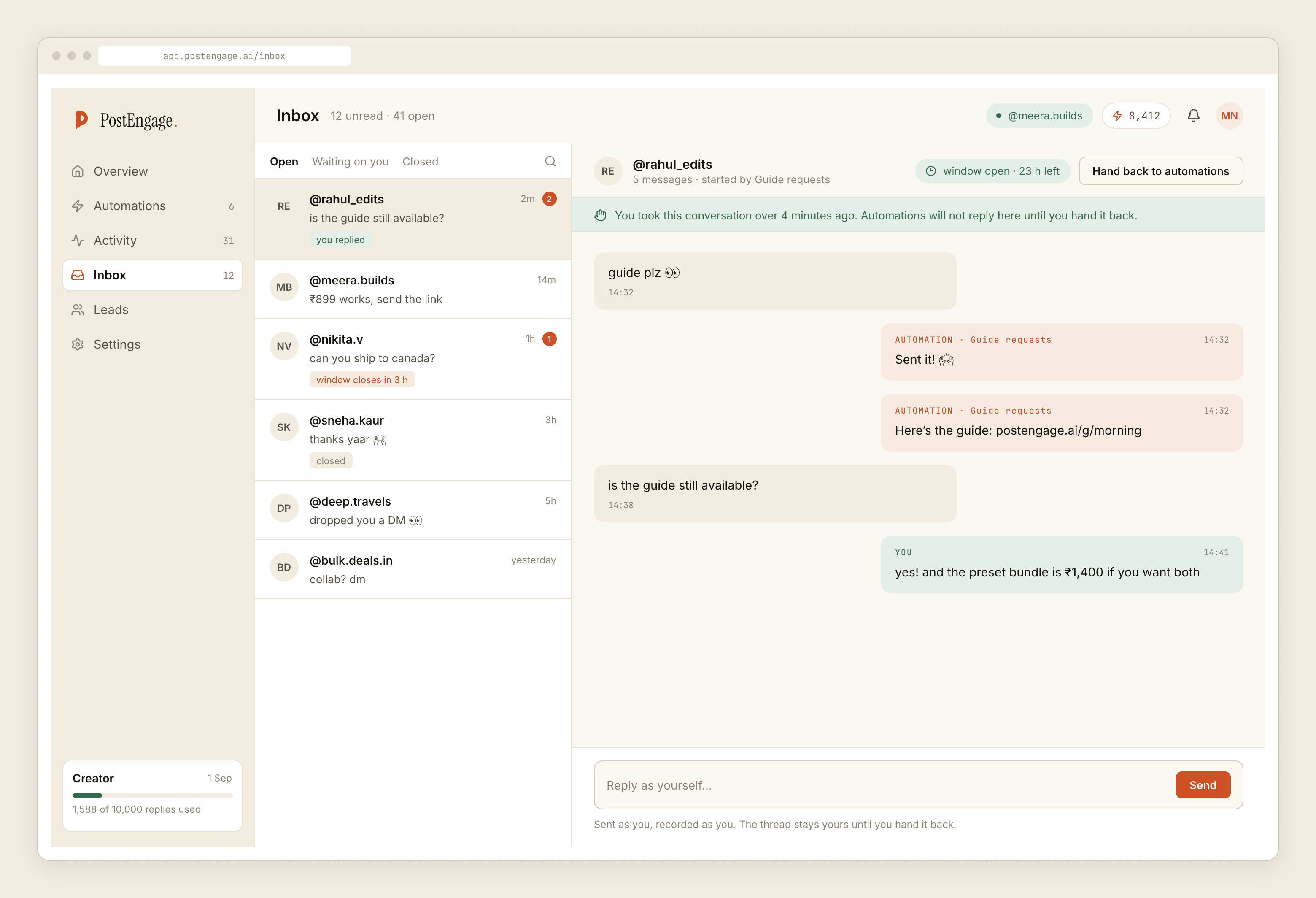
You are not building a machine that runs to completion. You are building an opening move good enough that a human being wants to take the second one, and the automation gets out of the way as soon as one does.
Work back to the public reply, which is a receipt
The public reply is the most misused field in the builder. People try to make it do the selling, and it cannot, because it is a comment under a post being read by strangers.
Public reply
Private reply
A private reply to a comment is the mechanism that turns a public comment into a DM at all. The public reply is the receipt for it, nothing more. Keep it under about eight words and resist every instinct to add detail.
Work back to the ask, which is content, not software
The first stage is the caption or the voiceover telling people what to comment and what they get in return. No tool improves this stage and no tool can rescue it.
The ask has to name the word and name the reward in the same breath. "Comment PRICE and I will send the full rate card" is an ask. "Link in bio" is not, and neither is "comment below". Whether the word you chose is one your audience would type unprompted is a separate decision worth making deliberately — keyword choice deserves its own pass, because it determines what the DM is even allowed to say.
The two windows, which are the real constraints
Everything above is shaped by two deadlines that are not yours to negotiate.
- Comments give you 7 days. Counted from the comment. Generous — a post from last Tuesday still converts on Sunday, which is why leaving comment triggers running on recent posts costs you nothing.
- DMs give you 24 hours. Counted from their most recent message to you. Every reply they send restarts it. Silence closes it, and there is no route around a closed window.
The design consequence is blunt: multi-day nurture sequences do not exist here. A five-message drip assumes a window nobody has. What you get instead is one strong message and however many turns the person chooses to give you, each reply buying another 24 hours.
Do not design a sequence. Design a first message worth answering, then be ready to answer back.
This is also why the destination you wrote at the start has to be reachable in one or two turns. If it genuinely needs five exchanges, the fifth will be a human doing it in the inbox, and the design should say so rather than pretend otherwise.
What runs between the design and the send
Between deciding what to send and it actually going out sit ten checks, in a fixed order: kill_switch, connection, takeover, window, dedupe, cooldown, quiet_hours, rate_budget, credits, content_safety. The first failure stops the send and records its reason in Activity.
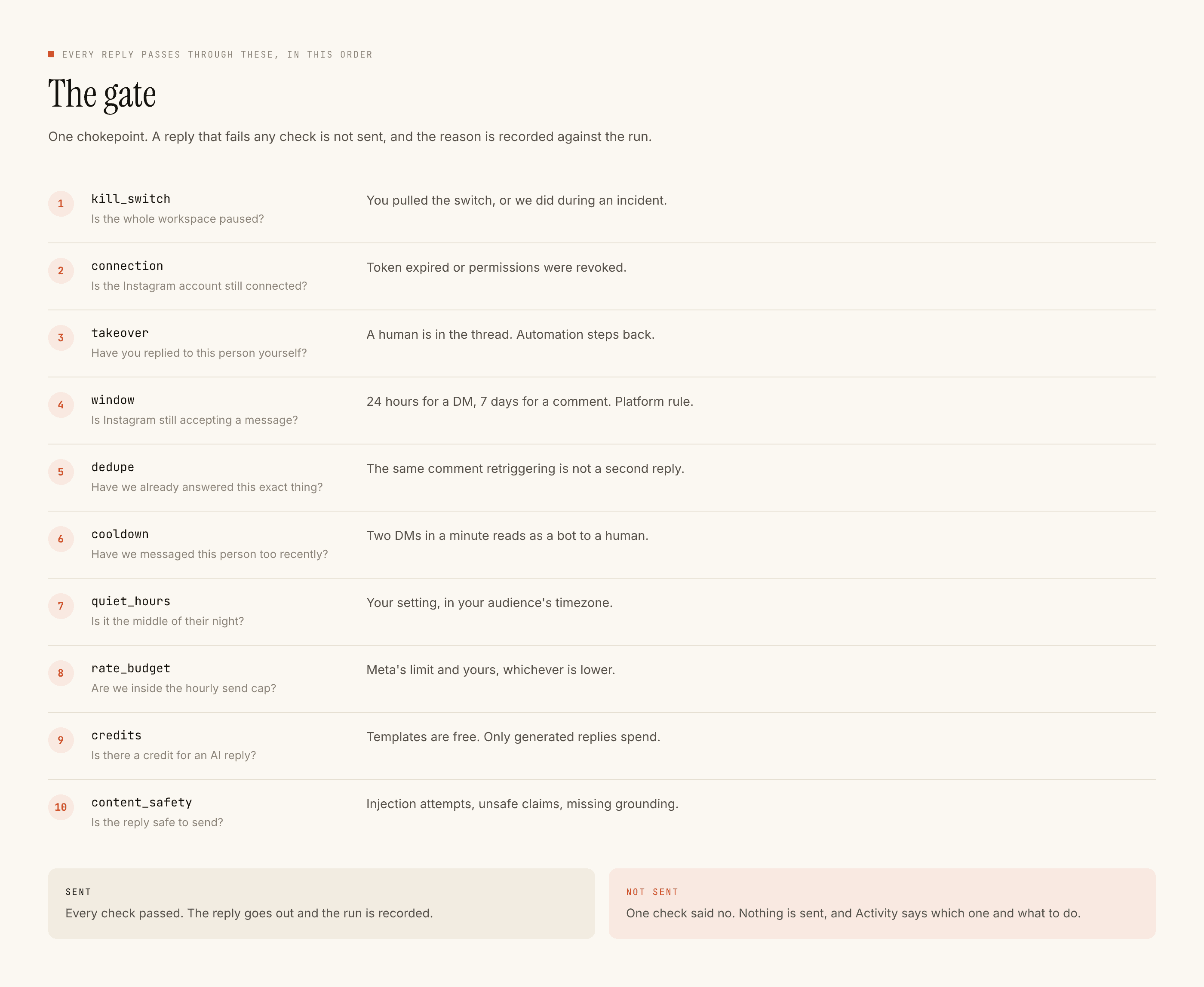
For design purposes the ones that change your choices are window, quiet_hours and rate_budget. Window is why the funnel is short. Quiet hours are why the reply somebody earns at 2am arrives at 8am instead. Rate budget is why a Reel that travels overnight produces a queue rather than a thousand simultaneous DMs and a delivery problem that outlasts the post.
If you want the stage-by-stage account of where a live funnel loses people and how to read the loss, that is a diagnostic question rather than a design one, and it is covered in detail here.
Keep the people, not just the conversations
Turn on capture to Leads. A funnel that produces conversations and no record produces nothing you can act on next month.
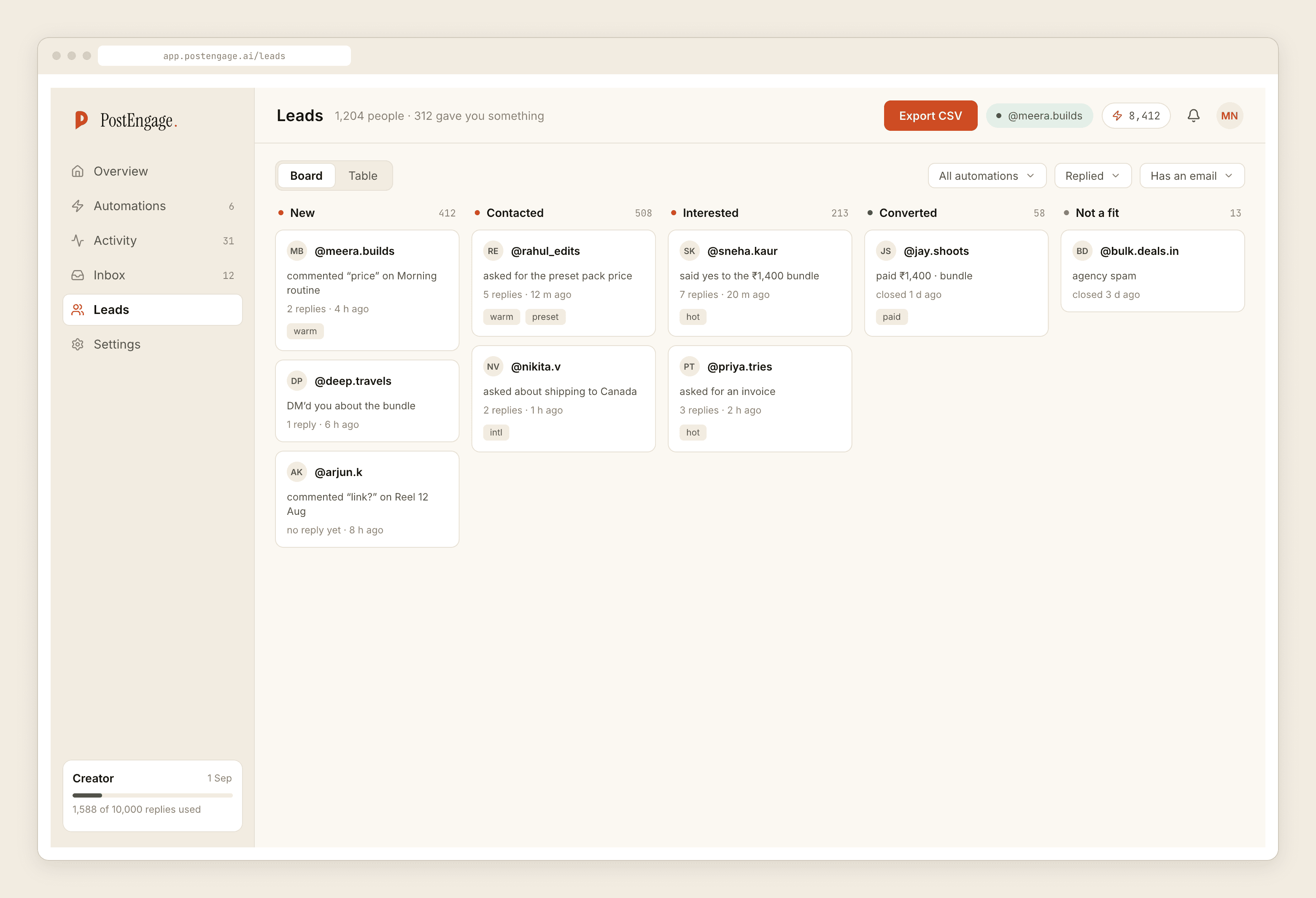
Cost shapes one last design choice. Templated replies are free and unlimited, and credits are spent only when the AI writes something new. For this flow that lines up neatly: the first DM should almost always be a template, because the person typed one word and you know exactly what they meant. The model earns its keep on the second turn, when they say something specific that no template anticipated.
Then test it on yourself
Build the whole flow, press Test on myself, and receive it as a stranger would. Read it for tone rather than correctness — you can check correctness by rereading the template, but whether the message sounds like a person who runs this account is something you can only judge by having it land in your own inbox. Once it does, go live on one post, and let the first evening's replies tell you which stage to rewrite. Better DM copy is the usual answer.