Product · 4 min read
One Tool for WhatsApp and Instagram: What That Should Mean

The pitch for a single tool across both channels is obvious enough: one login, one set of templates, one bill, one place to look when something goes wrong. Worth wanting. Also worth being precise about, because the two channels differ in ways that make "the same automation, everywhere" a promise nobody can keep.
What genuinely does transfer
Three things, and they are the useful three.
Your answers. The reply to "how much is delivery" is the same sentence regardless of which app somebody typed the question into. Writing it once and using it in both places is real work saved, and it is most of the work.
Your voice. A record of how you write does not change per channel. If it was built from replies you actually wrote, it applies wherever you are replying.
Your refusal list. The things you never want answered automatically — refunds, complaints, anything about money that has already moved, anything medical — are the same list on every channel. Maintaining one of those rather than two is a genuine reduction in how much you have to remember.
What transfers is the writing. What does not is almost everything about delivery.
What does not transfer, and why
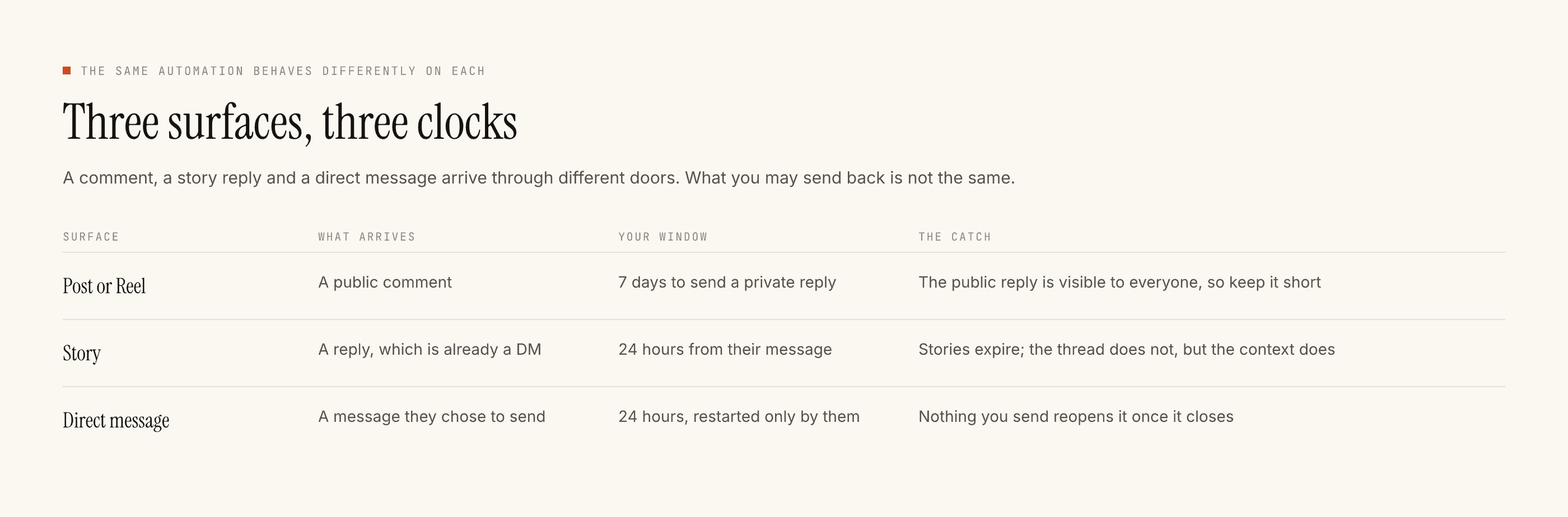
The trigger. On Instagram, an automation starts because somebody commented publicly on a post, and that comment gives you seven days to open a private conversation. WhatsApp has no comment surface at all — nothing is public, so there is no equivalent of the ask in a caption, and no public reply that other readers see and learn from.
The clock. Instagram's messaging window is twenty-four hours from their last message, restarted only by them. WhatsApp's rules are its own, set by Meta for that platform, and they are not the same rules. Any tool that treats one window as the other will get the timing wrong on at least one channel.
The opening move. On Instagram you cannot message anybody first, ever. WhatsApp's model is different in kind, with its own approvals and its own constraints on what may be sent to whom. A product that "just works the same" on both is describing one of them incorrectly.
The honest test for any tool claiming both
Three questions worth asking, and they apply to any vendor, not only to us.
- Does it use one window model or two? If the settings screen has a single "reply window" field, one of the two channels is being handled with the other's rules.
- What happens when a channel is unhealthy? Instagram tokens expire and connections break. If a broken Instagram connection quietly stops WhatsApp too, the channels are more coupled than the marketing suggests.
- Can you see, per channel, what was refused and why? A shared inbox with no per-channel record of refusals is a shared inbox you cannot debug.
The part that should be shared, and often is not
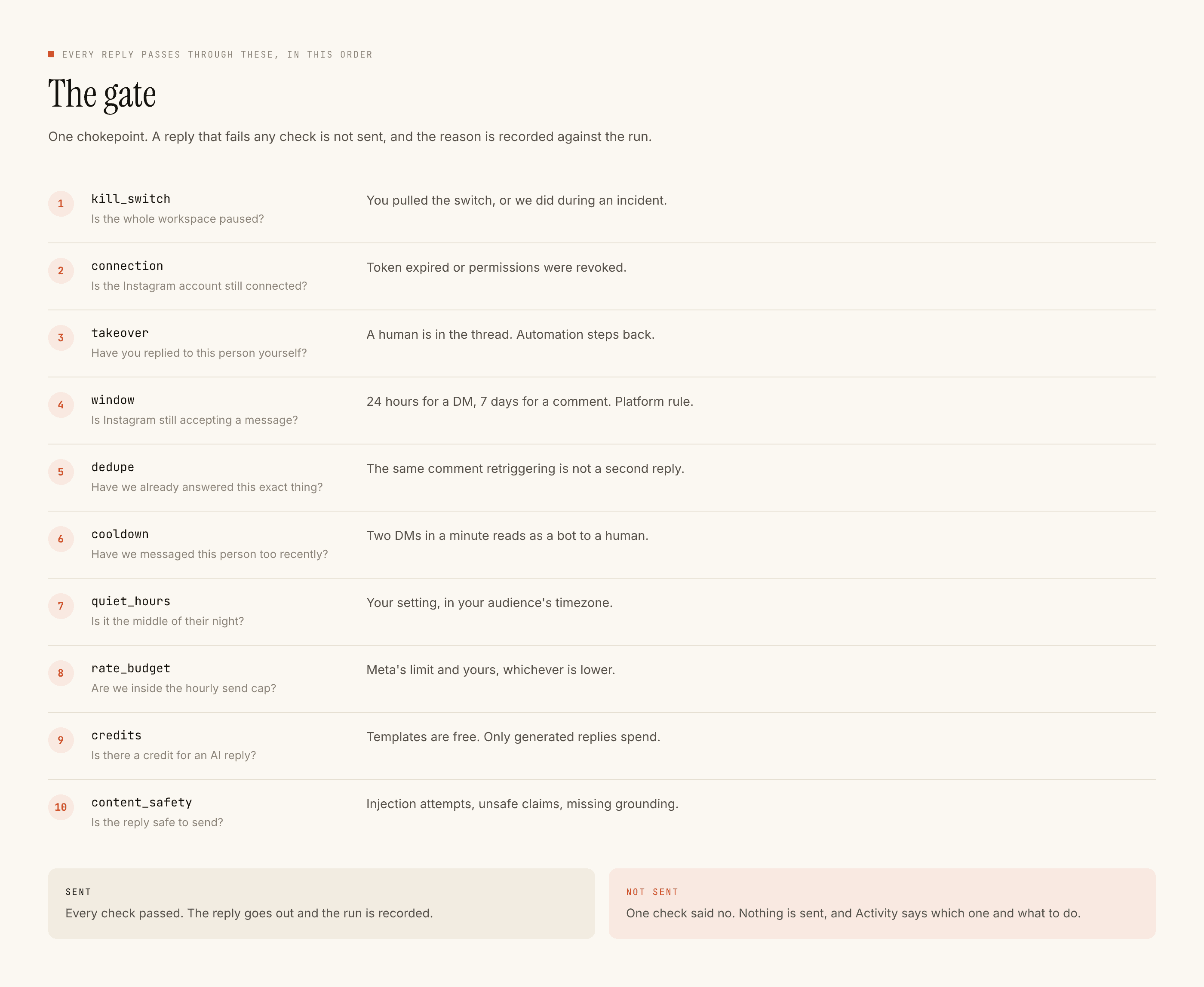
Refusals. Whatever else differs, the decision not to send should be made in one place and recorded in one place.
Two channels with two independent gates means two lists to read, two sets of reasons to learn, and a real chance that a person who is upset gets a template on one channel because you only put them on the blocklist for the other.
That is the argument for a single tool that actually holds: not that the sending is shared, but that the judgement is.
What you can do today, on one channel
If Instagram is where your questions arrive, the setup is the same as it would be for any account: one automation on the post that gets the most repeated question, a negative keyword list written before the second automation, and a test to yourself before anything goes live.
If WhatsApp is where your revenue actually is, then the honest recommendation is to buy a WhatsApp tool for it. That is a real answer, and it is better than waiting for us.
If you want the Instagram side in full, the setup guide walks through it. If the multi-channel question is really about whether to run two at all, the honest version of that argument is here.