Playbooks · 5 min read
The Stages a DM Conversation Moves Through, and Who Owns Each

A customer journey drawn in a slide deck has arrows going one way and a purchase at the end. A DM conversation is not shaped like that. It has two clocks running, one point where control changes hands, and an ending that is usually silence rather than a decision.
Here are the stages that actually occur, in order, with the honest answer to who owns each one.
Stage one: the public action
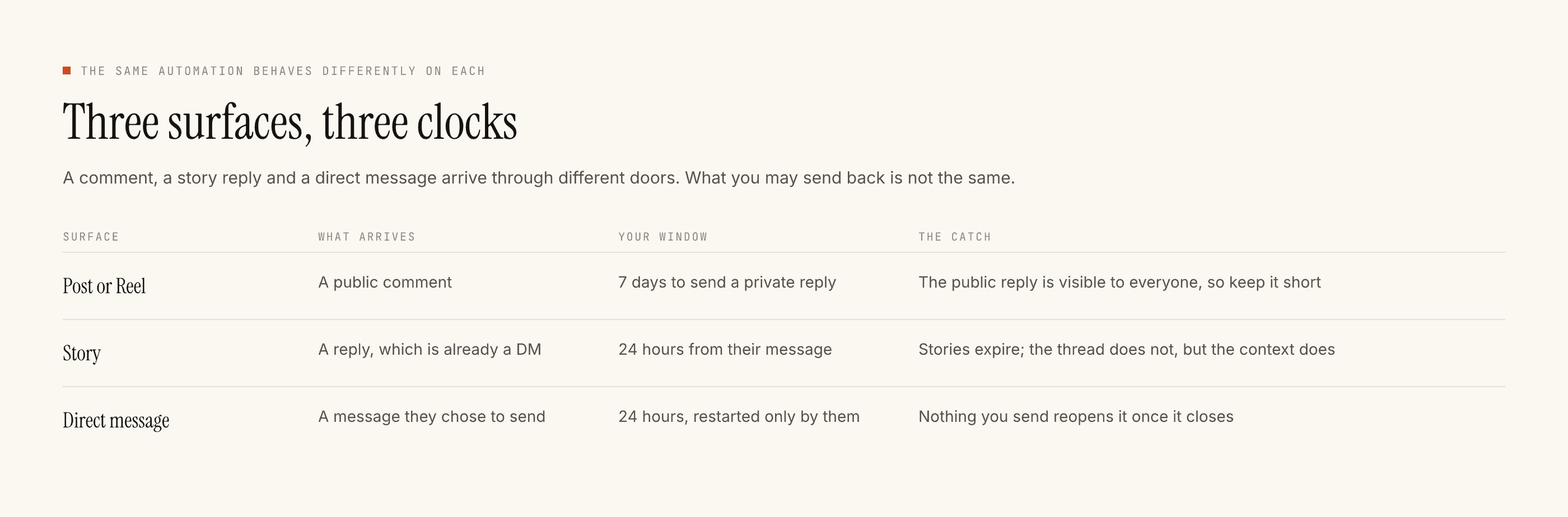
Nothing begins in the DMs. Something happens in the open first — a comment under a reel, a story reply, a tap on an ad. The person has done something visible, and that action is what gives you permission to say anything at all.
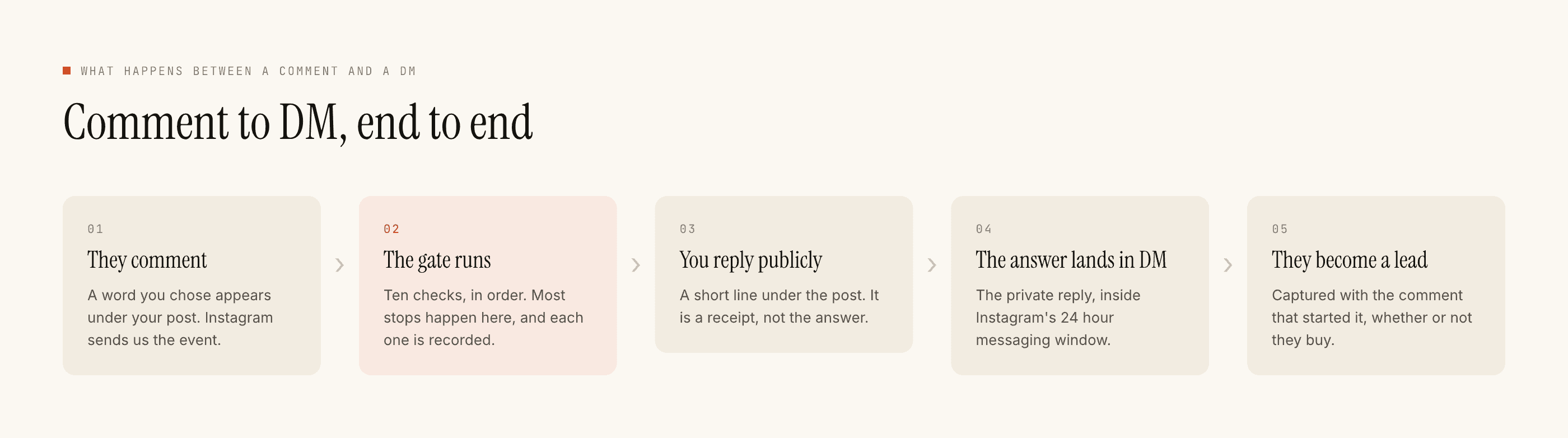
Automation owns this fully. Keyword matching, negative keywords, the public reply under the post. Matching ignores case and punctuation, so Price? and price are the same event.
The clock: a comment gives you 7 days. A story reply lands as a DM and gives you 24 hours. Same intent, very different amount of room, which is why it is worth knowing which door somebody came through.
What goes wrong here: the public reply written as an answer rather than a receipt. It should be a few words pointing at the DM, not the information itself. If the public reply answers the question, nobody opens the DM and the rest of the journey does not happen.
Stage two: the opening message
The private reply. The first thing that arrives in their inbox from you.
Automation owns this fully, and it should be a template. Same question, same answer, every time — free and unlimited, instant, and in your own words by construction. This is the single highest-leverage sentence in the whole sequence and it deserves to be written by hand rather than generated.
Stage three: their reply, and the clock reset
They write back. This is the stage that matters most and the one nobody diagrams, because it is where the conversation stops being a flow and becomes a conversation.
Two things happen at once. Their message restarts the 24 hour window — the clock is driven by their message, never by yours. And the question they ask is unpredictable in a way stage one never is.
Automation owns a slice of this, not the stage. It should answer the stable, same-for-everybody questions and nothing else — the ones covered in what a support bot can truthfully answer. Anything specific to their order, their money, or their mood is out of scope, because the automation has no record to read and no judgement to apply.
What goes wrong here: an automation that treats stage three like stage two and sends another scripted line. The person asked something real and got a leaflet.
Stage four: the handover
At some point a human takes the thread. This is a stage, not an exception, and designing for it is what separates a setup that survives from one that gets switched off in month two.
takeover runs third in the ten checks, before the window check, because if you are already in a thread nothing else about it is relevant. From your first hand-typed reply, automation is out of that conversation permanently.
The human owns everything from here. No clever re-entry, no "the bot resumes after 24 hours". The customer has been talking to a person; going back to a machine mid-thread is the most legible insult in this medium.
Handover is not the automation failing. It is the automation finishing.
Three triggers for a handover, worth setting explicitly:
- A message with heat in it. Something went wrong, or they have asked twice. Negative keywords —
refund,broken,still waiting,cancel— should mean do not reply, so that the first response they get is from somebody who read the thread. - A question about their specific situation. Their order, their booking, their payment. No amount of prompt engineering gives an automation access to a record it cannot see.
- Anything where being wrong would be expensive. Health, legal, large amounts of money, a promise about a date.
Stage five: the silence
Most conversations end here and no diagram admits it.
They stop replying. The 24 hours run out. And then there is nothing you can do, because you cannot open a conversation — not a nudge, not a "still interested?", not a scheduled follow-up. This is a platform rule and it is identical for every tool on the official API.
Nobody owns this stage. The honest response is to have front-loaded the conversation: put the price in stage two rather than saving it, ask for the one thing you need while they are still typing, capture the lead so you have a record even if the thread dies.
If they come back a week later, their new message restarts everything. That happens more often than the funnel model predicts, and cooldown and dedupe exist so that the return does not get greeted with the same opening message they received the first time.
The shape, once you stop drawing it as a funnel
Public action, opening message, their real question, handover, silence. Automation owns the first two completely, part of the third, and none of the last two.
That is a smaller territory than most flow builders imply and it is the territory where automation is genuinely better than a person — instant, consistent, awake, never bored of the same question. The rest is yours, and the design work is making the boundary clean rather than pushing it outward.
If you want to see where people drop out between these stages and which losses are fixable, the comment-to-DM funnel and its leaks is the numbers-flavoured version of this post. And if the useful next step is drawing this for your own account rather than reading someone else's, the mapping exercise is a spreadsheet and an afternoon.