Playbooks · 4 min read
How Many DMs Before the Ask? You Get One, Then They Decide

The question arrives in a specific shape: how many messages should I send before I pitch? Three? Five? Is there a right number?
There is, and it is one, and the reason is not a matter of taste.
We do not have sequences, and nor does the platform
No drip. No day-three follow-up. No multi-step nurture track, no flow-builder canvas, no broadcast, no scheduling of any kind. If you arrived from a tool where you drew a five-message journey on a canvas, that thing is not here.
More importantly, it is not really there either. On the official Instagram API you may reply inside a DM thread for twenty-four hours, and that clock is restarted only by the other person's message. Not by yours. Sending does not extend it, waiting does not extend it, and there is no mechanism that buys you another day on your own initiative.
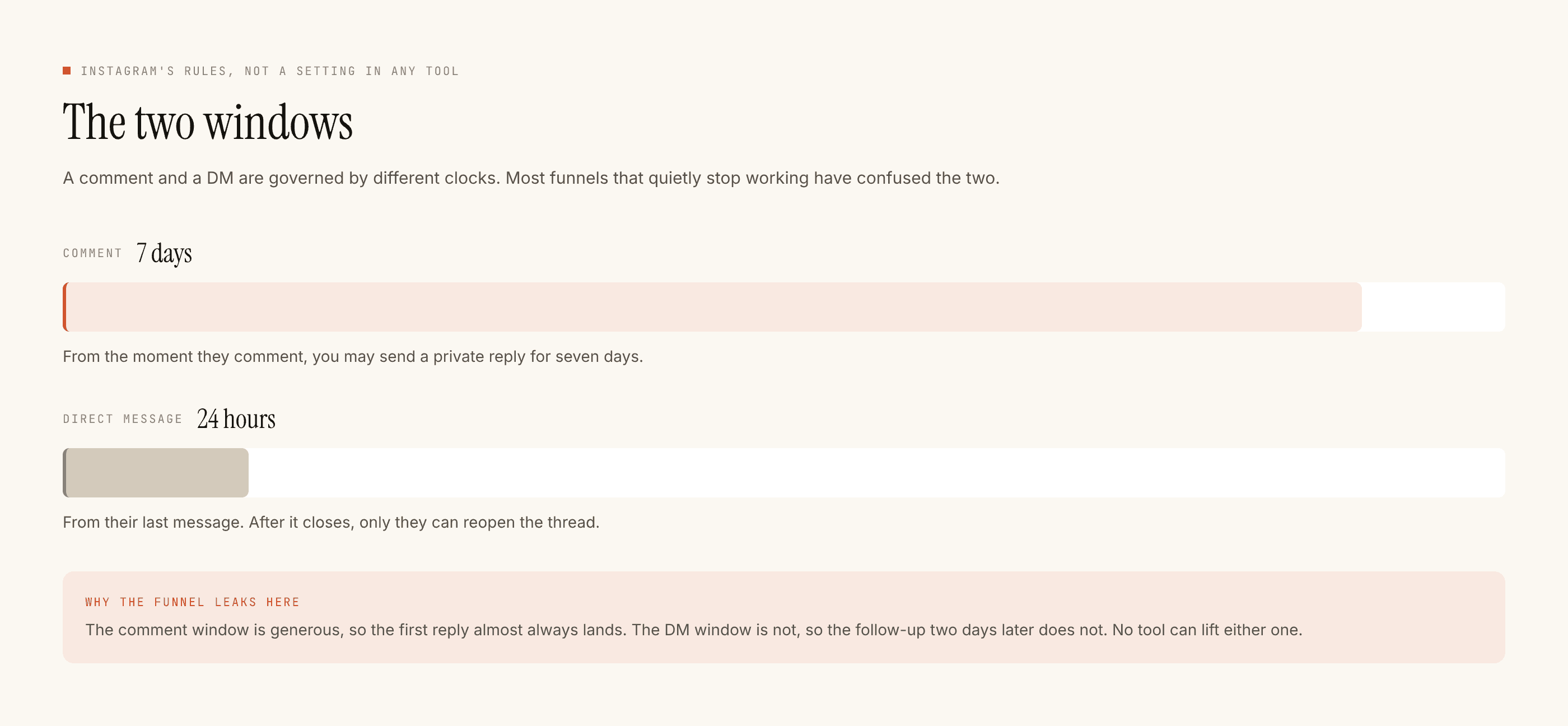
So "message three, sent on day four" is not a feature we declined to build. It is a message that cannot be delivered. Any tool appearing to offer one is either sending inside a window that is still open — in which case it is not really a schedule, it is a reply — or it is doing something that puts your account on a staircase of enforcement that starts with silent throttling.
What the question was really asking
Underneath "how many before the ask" is a good instinct: pitching too early feels pushy, and people who feel pushed do not buy.
That instinct is right and the fix is not spacing. It is what goes in the single message you are guaranteed. Spreading a pitch across five sends was always a way of buying time to earn attention. Here you have no time to buy, so the earning has to happen inside one paragraph.
You do not own the cadence. They do, one message at a time, and every turn you get is one they granted.
Which changes what "the ask" should be. If you only get one message, the ask cannot be "buy now" — that is a request for a decision from somebody who has had four seconds of contact. It also cannot be "let us know your requirements", which asks them to do work.
The ask that fits is the smallest next step that is genuinely worth a reply. A choice between two things. A confirmation. M ya L? A person can answer that with one thumb, and their answer restarts the twenty-four hours, which is the only way a second message ever exists.
Can you not just send two messages inside the open window?
You can, and it buys you nothing. Nothing about the clock changes, so a second message sent forty minutes after the first is arriving into the same window with the same remaining time. What it does change is how the thread reads: two unanswered messages in a row from a business is the texture of a broadcast, and it is the texture people report.
The exception is when their reply asked for something the first message did not cover, which is not a sequence — it is a reply.
Where the multi-message habit came from
It is imported from channels where sending is permitted. Email lets you send whenever you like, subject only to whether people keep opening. In a channel like that a sequence is a real object, and the discipline is about restraint.
Instagram is the opposite. Restraint is enforced; the discipline is about density. You are writing the one message, not the first of five, and the most common failure in it is deferral — "our team will get back to you shortly" spends the guaranteed turn saying nothing at all, and the window closes on it.
What honestly looks like a sequence
Once they reply, you have another window, and an automation can handle that turn too. It is built as several independent automations on the message trigger rather than one flow with steps: one watching for size, one for cod and upi, one for delivery and kitne din. None of them knows about the others, there is no step counter, and from the customer's side it still reads as a conversation because they asked three things and got three good answers.
Dedupe and cooldown keep that from turning into a pile-up, and takeover steps the whole thing aside the moment you type something yourself. The full design of that one message is the post to read next, because it is where the actual work is.
And when they go quiet
Most conversations end in silence and there is no automated recovery for it. Saying otherwise would be the lie. What exists is the record: the lead, what they asked, which post produced them, exported as a CSV whenever you want it. What nurturing honestly becomes without a send button covers what to do with that list.
The short version: stop counting messages. You get one, it should answer the thing they asked, and it should end with a question a tired person can answer in three characters.