Product · 4 min read
A Free Instagram Comment Bot That Does Not Sound Like One
Search "instagram comment bot" and the results split into tools for pretending to be interested in strangers and tools for answering the people already interested in you. The first kind dies on contact with Instagram's spam detection. The second kind is just customer service with the latency removed — and it is the one worth running.
The test for whether a comment bot is the good kind takes ten seconds: scroll the comments of an account that uses it. If you can spot the bot — same phrasing, same emoji, same cheerfulness pasted under every comment including the angry ones — so can every potential customer, and so can Instagram.
The two products sharing one search term
Outward: comments on strangers
Inward: answers on your posts
Almost every "is this safe" question in this category dissolves once you know which column a tool is in, and the connect screen tells you in about a minute. Anything asking for your Instagram password is in the left column whatever its marketing says.
Why bots sound like bots
Three failures, all of them cheap to avoid and almost never avoided:
One string, many recipients. The reply that reads fine once reads like a machine the third time it appears in the same thread. Any bot worth running varies its output — different words, same meaning — so two people asking the same question do not receive byte-identical enthusiasm.
Answering everything. A human skips the troll, the complaint, and the comment that is actually a question about something else. A bot that replies "Thanks so much! 🙌" to "this broke after two days" is not saving you time; it is manufacturing a screenshot.
The wrong register. Tools ship templates written in American marketing English. If your comments arrive in Hinglish, or your caption voice is dry and lowercase, "We appreciate you! Check your DMs 💖" under it is a costume change everyone notices.
A comment bot has one job harder than replying: knowing when not to.
What the good kind looks like
It connects through Meta's official API, never your password. It answers comments on your posts, triggered by words people actually type. It writes in your register — the honest tools learn it from your past replies rather than asking you to fill in a brand-voice form. And it holds anything it is not sure about: sentiment it cannot read, questions outside what you have told it, anything where a wrong public reply costs more than a slow one.
That hold is the feature to interrogate on any free tier. Sending is easy. Refusing is the product.
The four comments worth testing before you trust it
Feature lists will not tell you how a tool behaves when something is slightly wrong, and that is the only behaviour that matters in public. Test these deliberately from a second account rather than reading about them:
- The same comment twice. Does the person get two replies thirty seconds apart, or does the tool notice it already answered them?
- A comment at 2am. Does it fire immediately, and do you want it to? Quiet hours are a feature, not a limitation.
- A complaint. "this arrived broken" should not receive a cheerful acknowledgement. If it does, you have found the tool's ceiling.
- A reply you write by hand, mid-thread. A good tool notices a human took over and stands down. A bad one talks over you.
The fourth is the one nobody tests and the one that produces the worst screenshots, because it is the case where your own customer watches your account contradict itself.
Running it free
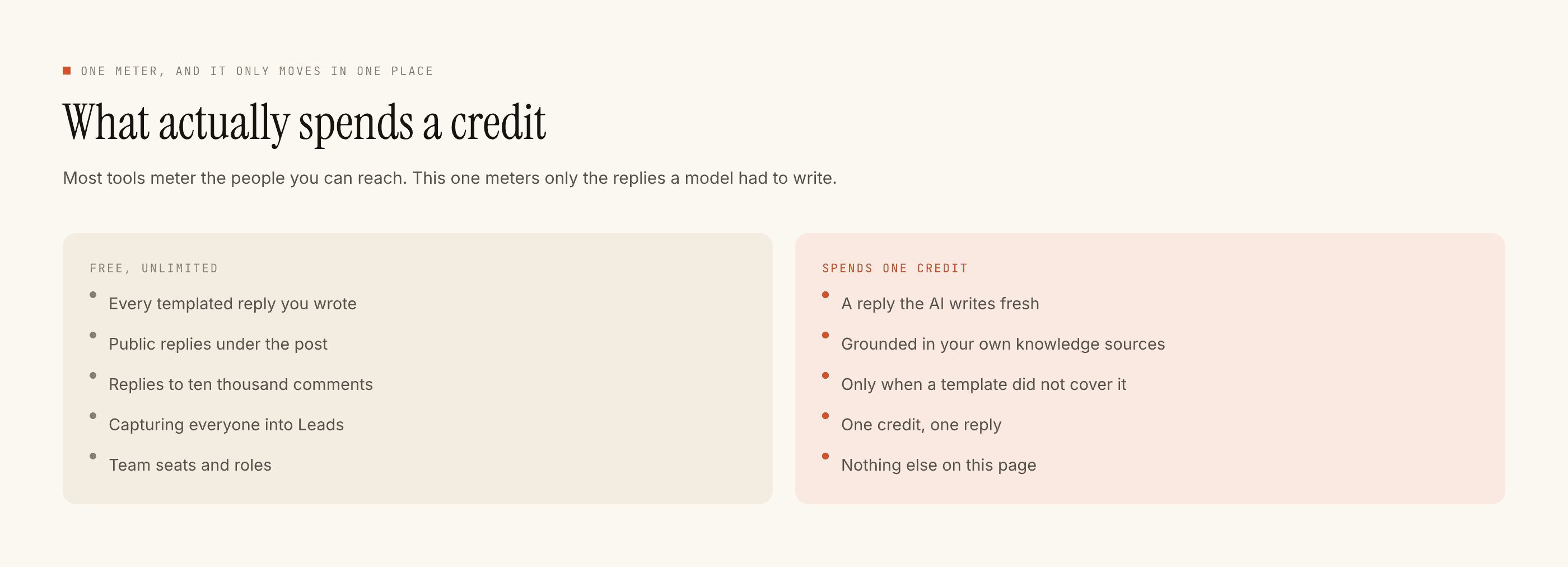
The free path that works: professional account, official-API tool, template replies for the predictable comments, and a few generated replies for the unpredictable ones. That is our free plan — 100 AI credits at signup, templates uncapped, no card — and the shape holds across the industry: templates cost nothing to send, generation costs someone real money per reply, so "unlimited free AI" is a claim to walk away from.
If you are comparing tools, the 2026 tool roundup covers the field, the ManyChat free-tier comparison covers the one everybody asks about, and what these tools actually charge you for explains why two plans at the same price can bill you very differently.
Set it up on one post. Read what it sends for a week, the way a stranger would. The bar is not "did it reply fast" — everything replies fast. The bar is whether anyone can tell.
Questions people ask
Will a comment bot get my Instagram account restricted?
It depends entirely on which kind you run. A bot that comments outward on strangers posts is doing something the official API has no endpoints for, which means it is logging in as you with your password — and that is the behaviour Instagram detection is built around. A bot that answers comments on your own posts through Meta official API is doing something the platform built the API to support.
What is the fastest way to tell if a tool is the risky kind?
Look at the connect screen. A username and password field on the vendor own site is the risky kind. A button that opens Meta permission screen is not. The second check is the feature list: following, liking, viewing stories and commenting on other people posts are all impossible through the official API, so a tool offering them is acting as you.
How do people spot a comment bot?
They scroll the comments. Identical phrasing repeated down a thread is the giveaway, closely followed by cheerful replies sitting under complaints. Neither is about speed — nobody minds a fast reply. They mind an obviously templated one appearing forty times under the same reel.
Should a bot reply to every comment?
No, and the ability to not reply is the feature worth testing hardest. Complaints, off-topic questions and anything the setup cannot actually answer should be held for a person. An automation that answers everything is not saving time, it is producing public mistakes at speed.
Is unlimited free AI replying realistic?
No. Sending a template you wrote costs a vendor nothing, so capping templates is charging rent. Generating a fresh reply costs real money on every single reply, so an unlimited free allowance of it means either the model is cheap enough that quality is the price, or the AI is a template with a name substituted in.