Tutorial · 5 min read
Auto-Comment on Instagram, Free: What Actually Works in 2026
"Auto comment" means two different products, and one of them will get your account restricted. Before anything else, be sure which one you are looking for.
The first kind posts comments outward — your account drops "Great post! 🔥" on strangers' photos to farm attention. Instagram treats that as spam, correctly, and tools that offer it work by holding your password and puppeting your account. Skip the whole category, free or not.
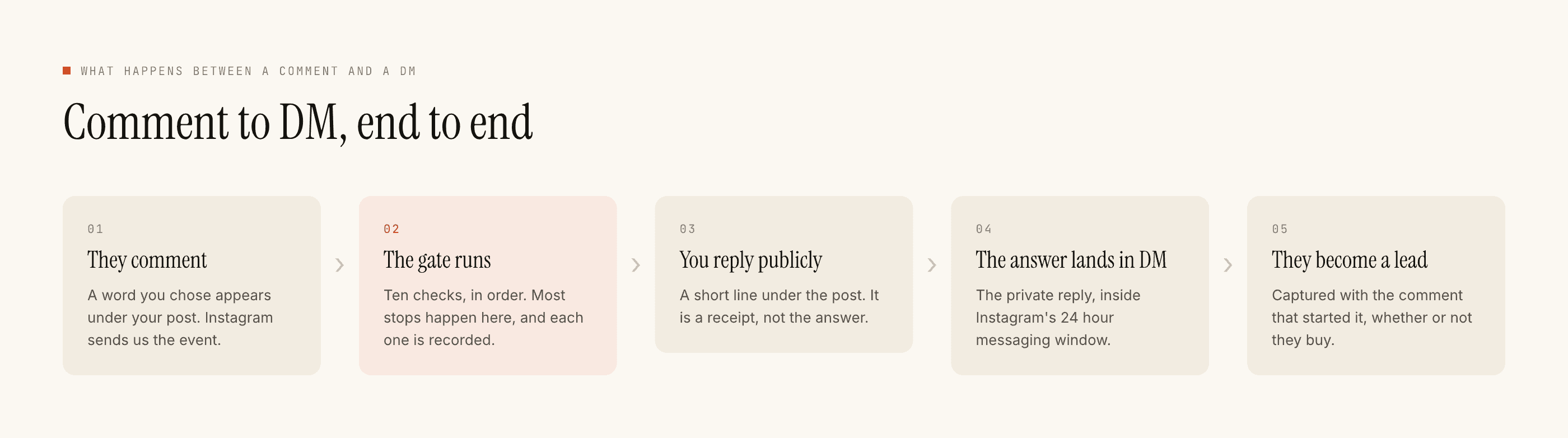
The second kind answers comments on your own posts: someone comments "price?", your account replies with the price, or replies publicly and sends the details in a DM. That is what Meta's official API exists for, it is allowed, and it is the thing you can genuinely run for free. This post is about that kind.
Seven days, not twenty-four hours
The comment window is the most useful and least known number in this category. A comment can be replied to for seven days after it is posted — seven times the room you get on a DM, where the limit is twenty-four hours from the person's last message.
That difference changes what comment automation is for. A DM automation is about being present in a conversation happening right now. A comment automation keeps working on posts that have stopped being pushed: someone finds a reel four days later, comments "link?", and the setup you wrote once still answers them. On accounts with a back catalogue that anyone still finds, this is where most of the quiet value sits.
It also means the pressure to reply instantly is mostly imagined. Nothing breaks if a held comment waits until you have read it, which makes the refusal behaviour below far cheaper to use than people assume.
What free gets you
A workable free setup needs four pieces, and all four exist without a card:
A trigger. A keyword in a comment — "price", "link", "want" — scoped to one post or to all of them. One-word triggers work best when the post itself asks for the word ("comment WANT and I'll DM you the guide"), because then the comment is unambiguous.
A reply in your own words. Not "Thanks for reaching out! 💕" — the sentence you would actually type. Write four or five variants, because the same string posted forty times under one reel is visible to everyone reading the comments, and it is what makes automation obvious.
A public reply plus a private one. The pattern that converts is a short public acknowledgement ("sent you a DM!") with the real content in the DM. The public half tells everyone else the comment section is alive; the private half does the selling.
A refusal. The piece almost nobody ships free: something that holds the reply when the comment is angry, off-topic, or a question your setup cannot actually answer. An automation that answers everything is worse than none, because the wrong reply is public.
The free tier you want is not the one with the most replies. It is the one that refuses to send the reply that would embarrass you.
Designing triggers that do not misfire
Most disappointing setups fail here rather than anywhere else, and every fix is free.
Copy the words, do not invent them. Open the post and read what people actually wrote. "kitna" and "price?" and "how much is this" are three triggers, not one, and a list written from imagination will miss all the ones that matter.
Write the negatives first. "price" fires on "no price anywhere", "worth every price" and "the price of not buying this". Negative keywords are the difference between a setup that looks clever and one that looks broken in public, and they take ten minutes.
Prefer an asked-for keyword on high-traffic posts. When the caption says "comment GUIDE", the word carries no ambiguity at all. On posts where you did not ask, expect to hold more and send less.
Scope narrowly at first. One post, not all posts. The blast radius of a bad trigger is every comment on everything you have ever published, and you will not notice for days.
Where free ends
Templates are free because they should be — you wrote them. What costs money anywhere honest is generation: a model reading the comment and writing a fresh reply in your voice. On our free plan you get 100 AI credits when you sign up, with templates and triggers uncapped, and that split is the industry's fairest shape: the marginal cost of a template is zero and the marginal cost of a generated reply is not.
If a tool advertises unlimited free AI replies, the model is cheap enough that you are the product, or the "AI" is a template with your first name substituted in. Read what free automation costs you anyway before you spend the afternoon on setup — the honest costs are time, not money — and what these tools actually charge you for if you are comparing paid plans later.
Setting it up in one afternoon
- Pick one post where comments already ask the same question repeatedly. Do not start with "all posts".
- Write the trigger list from the comments that actually exist — open the post and copy the words people used, including the misspellings.
- Write your reply variants by reading your own past replies. Steal from yourself, not from a template gallery.
- Add the negative cases: if "price" should not fire on "no price", say so.
- Test on yourself before going live, and read the result on a phone — that is where your audience reads it.
Run one post for a week, read every reply it sent, then widen. The creators who get burned are the ones who go from zero to everything in one evening.
What never to automate
Complaints, refund requests, and anything where the person is upset. A template cannot de-escalate, and a generated reply de-escalates in a voice that is not quite yours, which is worse. Every serious tool holds these for you to answer yourself; if the one you are trying does not, that is the tell it was built to send, not to represent you.
Related: the complete comment automation guide goes deeper on trigger design, and comment-to-DM funnels covers the conversion math.
Questions people ask
How long can I auto-reply to a comment?
Seven days from when the comment was posted. That is considerably more room than the twenty-four hours you get on a DM, and it is why an older post can keep converting quietly for a week after it stops being pushed.
Should the reply be public, private, or both?
Both, in most cases. A short public acknowledgement tells everybody else scrolling the comments that the account answers, and the real content goes in the DM. The public half is doing marketing work that a DM alone cannot do, because every other reader sees it.
How do I choose trigger words?
Open the post and copy the words people already used, misspellings included. Invented keyword lists miss the way people actually type — lowercase, abbreviated, sometimes in two languages in one sentence. The one exception is a keyword the caption explicitly asks for, which is unambiguous by design.
What should never be automated?
Complaints, refund requests and anything where the person is upset. A template cannot de-escalate and a generated reply de-escalates in a voice that is not quite yours, which is worse. Any serious tool holds these for a human; one that does not was built to send rather than to represent you.
Will replying to every comment help the post reach more people?
Engagement on a post is generally understood to help, but treat any specific claim about it with suspicion — nobody outside Meta knows the weighting and it changes. The reliable reason to reply is that people who get answered buy things and people who get ignored do not.