
A ranked list cannot help you, because the products on it are not competing. Position three does scheduling, position five does chatbots, position eight signs into your account and follows strangers. Ordering them produces a number, not an answer.
The taxonomy of the category — the four kinds of product and how to tell them apart — is covered separately and this post will not repeat it. What follows is the other way in: the sentences people actually say out loud before they start shopping, and what each one implies about what to buy.
Find yours. Ignore the rest.
The tools, named, before the argument
Most people arriving here want the list first. Here it is, then the part that is actually useful.
| Tool | Free tier | Paid from | Metered on |
|---|---|---|---|
| ManyChat | 25 active contacts | $14 / mo | active contacts |
| Chatfuel | Light — unlimited contacts | $49 / mo | AI processing |
| ReplyRush | ~1,500 DMs / mo | reported low | sends |
| LinkDM | ~1,000 DMs / mo | reported ~$19 / mo | sends |
| CreatorFlow | ~500 DMs / mo | reported ~$15 / mo | sends |
| InstantDM | ~500 DMs / mo | reported ~$9.99 / mo | sends |
| SetSmart | no free tier | reported ~$97 / mo | AI conversations |
| PostEngage | 100 AI replies, templates uncapped | ₹499 packs | generated replies |
Three things that table hides, and they matter more than the numbers in it.
The meter is the price. A contact meter charges you for people and the count only climbs, so the reel that worked is also the invoice that grew. A send meter charges per message, so your chattiest customers are your most expensive. An AI meter charges only when a model writes something new, so a template answering the same question four hundred times is free. Same usage, wildly different bills.
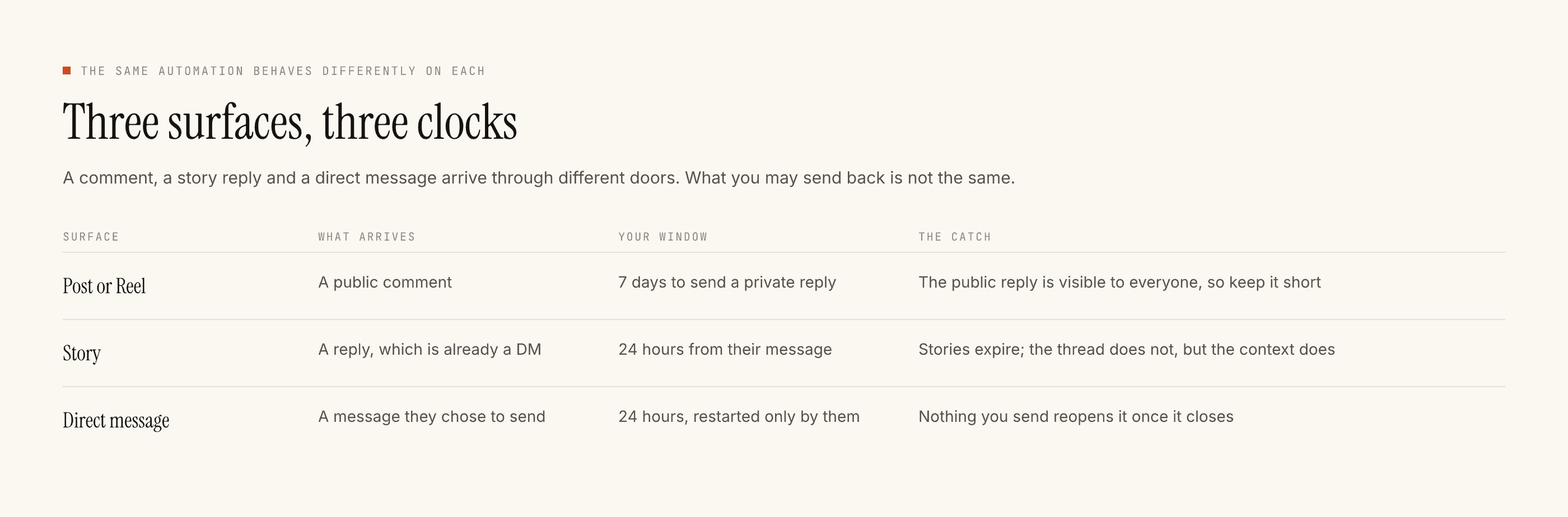
Everything above runs the same official Meta API. None of them can DM a stranger, none can broadcast to your followers, all of them reply to a comment for 7 days and to a DM for 24 hours. A feature grid showing one of them beating that is showing you a mistake. What differs is the builder, the reporting, and what the tool refuses to send.
A free tier is an evaluation budget. It is not a smaller version of the product you will end up on, and judging tools by whose free number is biggest is how people pick wrong. The question is whether the thing behaves acceptably on your audience, which takes very few sends and a lot of reading.
Which is why the rest of this is sorted by the job rather than by the vendor. Find the sentence below that sounds like your week.
"Someone was ready to buy and I saw the comment two days later"
The job is catching intent while it is still warm. Somebody commented price under a Reel at 11pm and by the time you scrolled past it they had bought elsewhere.
Solved, this looks like: a keyword under a specific post, a short public acknowledgement, and the real answer arriving as a DM within seconds.
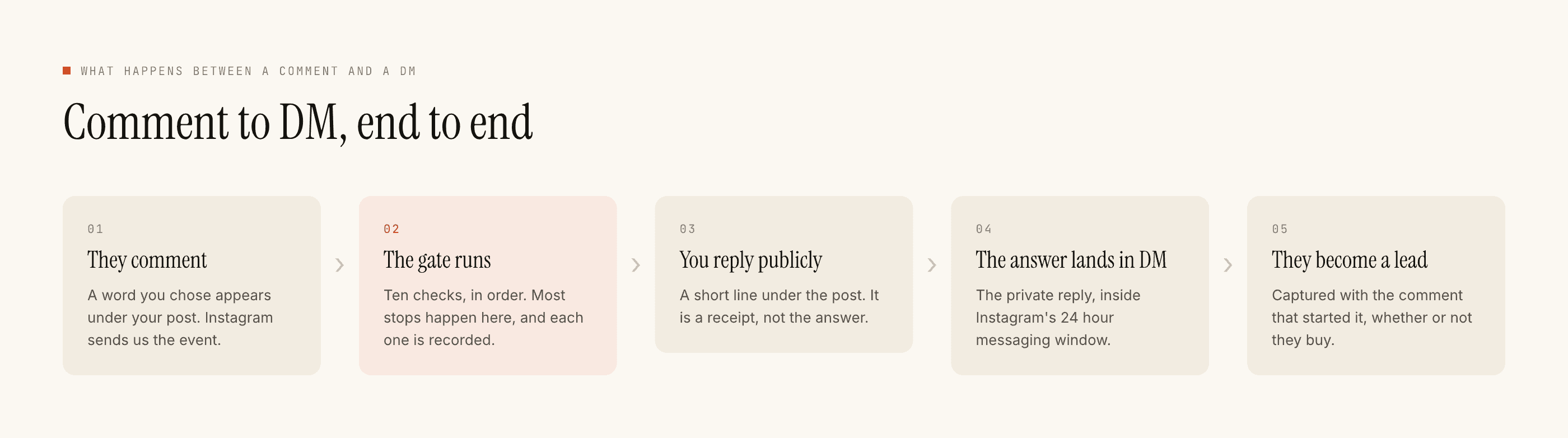
Verify: that keyword matching ignores case and punctuation, that negative keywords exist so not interested never gets a pitch, and that the comment clock is honoured — seven days, after which nothing fires no matter what any dashboard says.
Will not fix: a caption that promises something the DM does not deliver. That produces reports, not sales.
"I answer the same four questions every night"
The job is repetition, not intelligence. You are not looking for an AI. You are looking for a way to stop typing the same paragraph.
Solved, this looks like: four templates you wrote yourself, each on its own keyword, running at any volume.
Verify: whether templated sends cost anything. This is the single largest difference in running cost across the category and it is rarely on the comparison table. A tool that charges for sending answers you already wrote is charging you for typing.
Will not fix: the fifth question. Which is the next job.
"People ask things my templates do not cover"
The job is the tail. Every account has one and it is where the interesting customers live.
Solved, this looks like: a generated reply that reads like you wrote it and is tied to something you actually supplied — your notes, your previous answers, the automation's own fields.
Verify: what happens when the answer is not in the source. The correct behaviour is a refusal — the template goes instead, or it waits for a human. A tool that fills the gap with a plausible number in your exact voice has created a promise your customer will hold you to. Grounding and refusal is the mechanism worth understanding here.
Will not fix: facts you never wrote down anywhere.
"I have no idea who asked what"
The job is memory. The conversations happened, they went well, and three weeks later there is no record of anything.
Solved, this looks like: everyone who triggered an automation captured with what they said and when, and an export that works.
Verify: that capture is not a paid feature. The people are yours either way, and a tool holding your own contact history hostage is a tool you cannot leave.
"Two of us reply and it is chaos"
The job is handoff. Your teammate answers a DM, the automation answers it again, and the customer now has two different versions of your delivery time.
Solved, this looks like: automation standing down on a thread the instant a human replies by hand, without anyone pausing anything.
Verify: this one directly. Reply mid-thread by hand and watch. It is the test most tools fail and it takes ninety seconds.
"I need to know it is not doing something embarrassing"
Nobody shops for this and everybody needs it by month two. The job is evidence.
Solved, this looks like: a log of what was sent, and more importantly a log of what was not sent and why. A reply that did not go out should be a row you can read, not a mystery you reconstruct.
Verify: ask a vendor to show you the screen where refusals are recorded. If there is not one, the tool cannot tell you why a bad reply went out either.
Will not fix: a bad decision you made in the builder. It will, however, show you that you made it.
Every tool in this category can send a message. The gap between them is whether they can decide not to, and whether they will tell you afterwards.
"I want more followers, fast"
There is a category that sells this, it works by signing into your account, and it is the one that gets accounts restricted. It is not a tooling job and no compliant product can do it, because messaging people who never contacted you is not a permission that exists. What actually triggers a restriction covers the mechanics if you want them.
Buy for the job you have this month
The failure pattern in this category is buying for the org chart you will have next year. Feature lists are written to sell that future, and channels you have not switched on still appear on the invoice.
Where we sit: jobs one, two, three, four and six, on Instagram only, through the official Graph API. Templates free and unlimited, a credit only when the model writes something new, free tier a hundred credits with no card, packs from ₹499. Job five we do through takeover rather than a full shared inbox, and job seven we will never do at all.
If several of these sentences are yours at once, that is a legitimate reason to buy a wider platform, and we would rather you did that than force five jobs through a tool built for three.
Questions people ask
What is the best Instagram automation tool in 2026?
There is no single answer, because the tools meter different things. ManyChat charges per active contact, Chatfuel per unit of AI processing, LinkDM and ReplyRush and CreatorFlow and InstantDM per message sent, and we charge only when a model writes something new. Work out which unit your inbox grows and the shortlist picks itself.
Which Instagram automation tool has the biggest free plan?
On raw sends, ReplyRush at roughly 1,500 DMs a month as advertised, then LinkDM at about 1,000. ManyChat’s free tier is now 25 active contacts, which is a demo rather than a plan. Chatfuel’s free Light tier has unlimited contacts but a fair-use limit on AI processing, and pauses the bot when it runs out.
Are any of these tools risky for my account?
Not the ones named here — they all connect through Meta’s official permission screen and never see your Instagram password. The risk in this category comes from tools that sign in as you through a password, a browser extension or a borrowed session, which is a different product entirely and the thing that actually gets accounts restricted.
Can any of them send a DM to someone who has not messaged me?
No. Not one, at any price. The official API allows a reply to a comment for 7 days and a reply inside a DM thread for 24 hours from the contact’s last message. There is no cold outreach and no broadcast to followers, whatever the marketing suggests.
Do I need a Facebook Page to use these?
A professional Instagram account is required by all of them. Whether a linked Facebook Page is required depends on which login flow the tool uses — it is Meta’s requirement rather than the vendor’s, and worth confirming during signup rather than after.
Should I pick the cheapest one?
Pick on the meter, not the sticker. The cheapest headline price on a unit your account grows fast is the most expensive plan you can buy, and the reverse is also true. Read fifty of your own DMs, count the distinct questions, and let that number decide.